Posted in nature

Bees in Autumn

The Autumn equinox finally arrived last Wednesday. It was lovely to notice bees still flying around when the sun shone. While these insects are synonymous with spring and summer, some are still active in September.
Common carder bees (Bombus pascuorum) were the most noticeable last week but I also saw a new Buff-tailed (Bombus terrestris) bumblebee queen visiting some Hylotelephium as well.

Common carder bee
Buff-tailed bumblebee queen

I also observed a couple of active bee nests in some lawns too. It was difficult to identify the specific species although given the time of year and colouration they were possibly Common furrow-bees (Lasioglossum calceatum) also called Slender mining bees. These bees are active from Spring until mid Autumn and nest in short grass. 

Posted in nature

A Long Wait

A Tree bumblebee (Bombus hypnorum) resting on a Lime tree (Tilia) leaf.

Often one of the earliest bumblebees to emerge, I thought I wouldn’t notice any Tree bumblebees this year. Colonies of this bee are mostly active from March to July so by now my chances had reduced.

The first record of these bees in this country was in Wiltshire, in 2001. Now they are seen in Scotland (by 2013) and Northern Ireland (in 2017) having become one of the most common eight in the UK (see PDF from the BBCT below); especially making use of bird boxes for their nests.

Early in the year, they forage for nectar and pollen at plants such as Winter heathers (Erica carnea), Pussy willow (Salix caprea), Apple (Malus), Cotoneaster, Ceanothus and Chives. While later on, in early summer, they will favour the flowers of Lime trees, Fuchsias Raspberries and Blackberries

Posted in Allotment, nature

Blossom Watching

Warm sunny weather has finally replaced the wet conditions we seemed to be stuck in all May.

As I write this, meteorological summer has begun so the change in weather is rather fitting.

It has been fascinating to follow the seasons so far this year; paying particular attention to the timing of tree blossom arrival. After the Blackthorn (Prunus spinosa), the ornamental Cherries (Prunus) took over alongside the Crab apples (Malus). Then for the last few weeks Rowan (Sorbus), Horse chestnuts (Aesculus hippocastanum) and Hawthorn (Crataegus) have been blooming and continue to do so.

More wild flowers are joining in the visual performance as Red clover (Trifolium pratense) and Common vetch (Vicia sativa) started putting on a show too.

Even on the allotment, the Lacy Phacelia (Phacelia tanacetifolia) has begun to bloom alongside the vibrant Geums, which is a great combination.

The bees have been enjoying their nectar and pollen, along with a Hairy shield bug (Dolycoris baccarum) who came to visit on them Saturday (see photo below).

We do have blackthorn hedges nearby so I guess it had been overwintering on those.

I’ve noticed that the Chive flowers are particularly loved by worker Red tailed bumblebees (Bombus lapidarius); this isn’t too much of a surprise as I know they have short tongues, plus once they have found a good food source they will repeatedly visit the same plant.

Seven-spot ladybirds (Coccinella septempunctata) numbers are increasing on allotment too. Plus one Female Wolf spider (Pardosa amentata) carrying a blue egg sac was spotted.

It is always a joy to share my plot with beneficial insects, as I don’t use insecticides.

It was nice to have a long weekend, it gave me a chance to walk through the local woodland park which I hadn’t done for a few weeks. Lots of butterflies were flitting about, including one Speckled wood butterfly (Pararge aegeria).

Posted in nature

Delayed April Showers in May

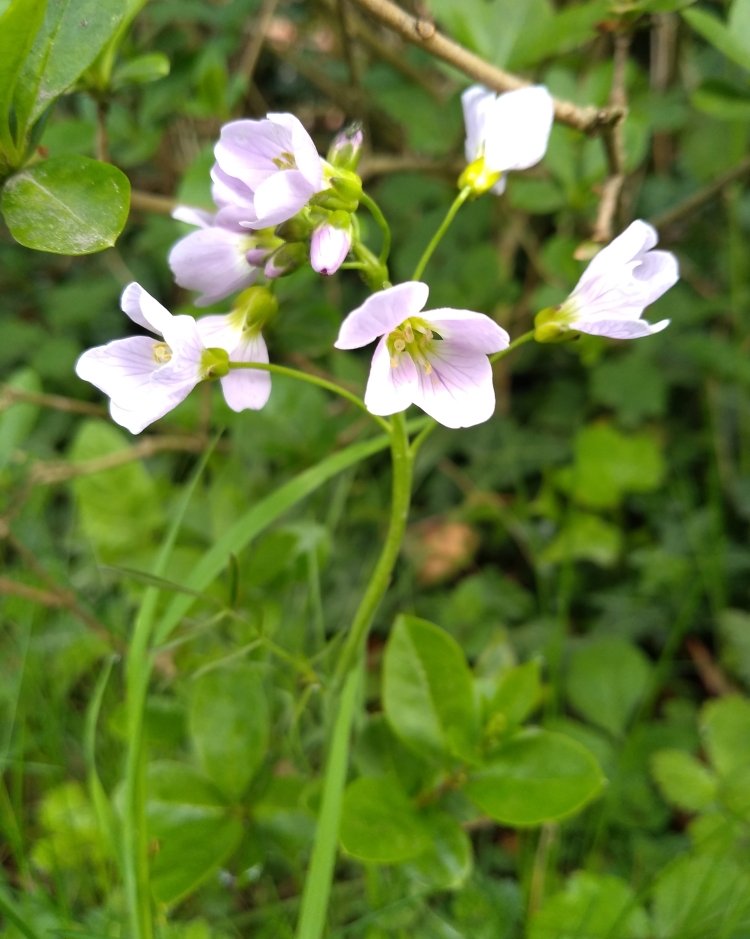
Rain showers continued to fall, reviving the ground at last. Between the downpours I noticed Cuckooflowers (Cardamine pratensis) begin to bloom last week.

So named because it flowers from late April, around the time male Cuckoos (Cuculus canorus) are heard in the UK once the birds return from Africa; signs that spring is well underway.

The last time I heard Cuckoos was in Shropshire many years ago. At the time, I only heard the males call of “cuck-oo’ in the distance. I have never witnessed the females call which can be heard here (Garden birds). I have never seen these birds either; perhaps one day, although their conservation status in the UK remains red (reasons for this is explained by the BTO website).

I love witnessing wildflowers being pollinated; yet more proof that patches of wildflowers are essential for pollinators. Last Sundays walk resulted in such a sighting. As I walked past an area where White dead-nettles (Lamium album) were blooming I became aware of a gentle buzz. A solitary Common Carder Bee (Bombus pascuorum) was visiting the patch of flowers.

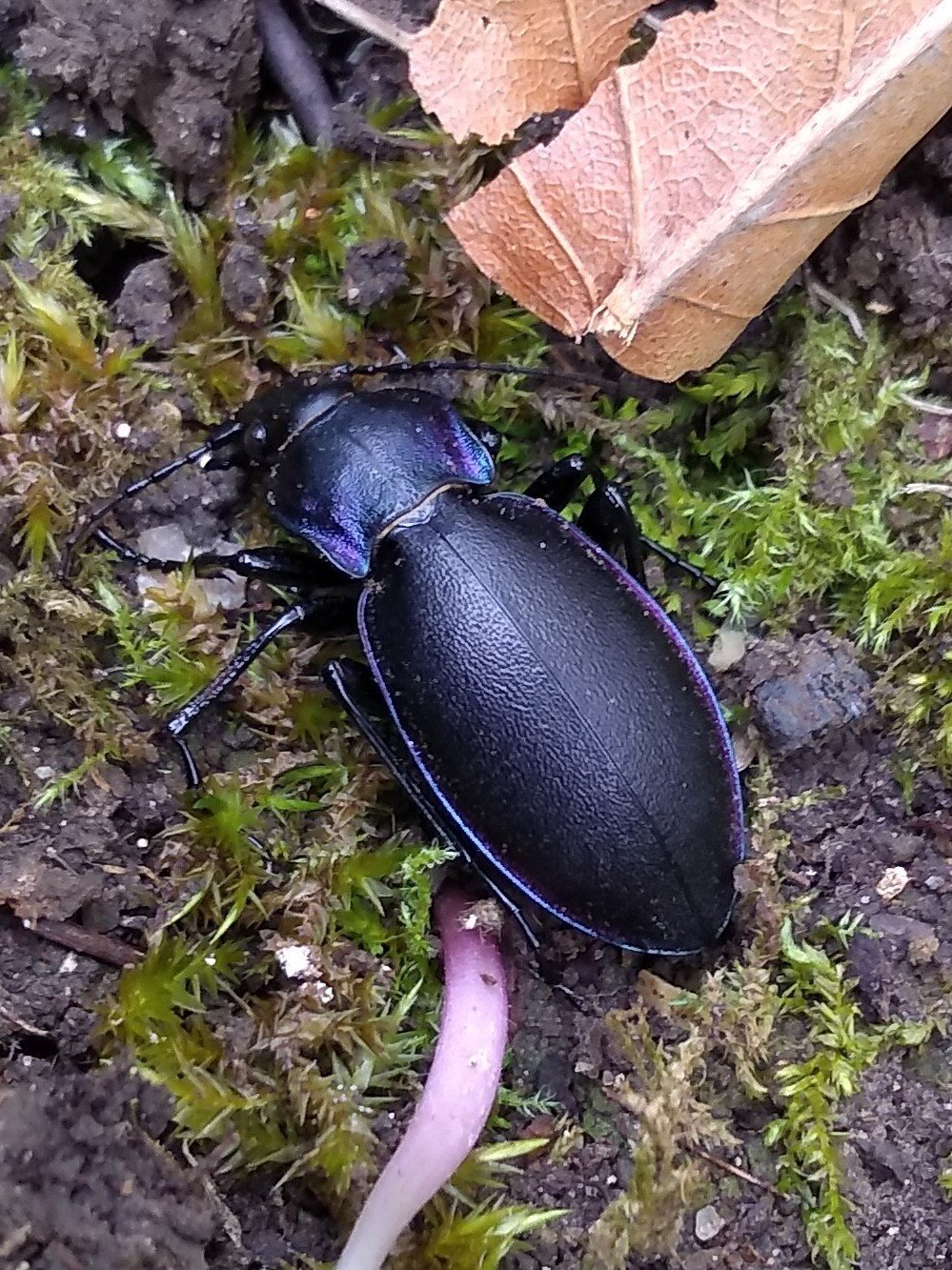
An insect that I became aware of later in the week was a Violet ground beetle. I have never seen one of these beetles before; it was so mesmerising as it glistened in the daylight.

It could have been one of two species of Violet ground beetle, either Carabus violaceus or Carabus problematicus, as they are difficult to tell apart (it’s all down to the amount of dimples and ridges apparently). As both can be found in gardens, if I had to make an educated guess, I would say it was a Carabus violaceus ground beetle (the more common of the two, especially in gardens). The Carabus violaceus can also inhabit farmland and meadows where as Carabus problematicus is predominantly found in woods and heathland.

Active at night, it doesn’t fly but will rely on running fast to capture pray and find shelter if disturbed. During the day, it predominantly hides under logs or stones; however I noticed this one when I moved a clump of soil. I was very conscious of taking its photo as quickly as possible before I covered it up once again. This adult beetle, along with their larvae, feeds on other insects alongside slugs, snail and worms.

Posted in Allotment, nature

Magic on the Winter Solstice

As a gardener and wildlife lover following the seasons is important to me. I celebrate seasonal festivals throughout the year to acknowledge the importance of nature in my life.

During the winter solstice I take time out to observe the sunrise, reflect on the past twelve months as well as think about the year to come. I also go for a walk to collect greenery for my home and give presents to the local wildlife. This year I planted some Heather and Mahonia for any winter foraging bumblebees and made fat balls for my bird feeder.

I am glad that even in tier 4 I can still go for walks amongst nature and visit my allotment for exercise; for me these are essential for healthy body and mind.

Last week I checked on plant growth on my plot. I currently have seedlings and cuttings safe in a small greenhouse; all remain healthy and continue to grow. I also noticed buds on my fruit trees along with borage still growing in the beds.

On monday I also witnessed a Kestrel (Falco tinnunculus) hover above a road (More information on Kestrels can be found at the RSPB). I don’t get to see these amazingly beautiful birds often enough. It was a magical sight on the longest day of the year which began with me watching the sunrise at Stonehenge (online) while at home and listening to bird song; plenty of positivity on a gloomy day.

Posted in nature

A Rare Visit

Last Sunday five Greenfinch (Chloris chloris) came to visit the Rowan tree outside my flat. Seeing these lovely finches is a rare occurrence for me, I tend to hear their wheezy call rather than see them; although even this isn’t often. The Greenfinch call can be heard on the RSPB website.

Along with Chaffinch (Fringilla coelebs) the greatest decline in bird numbers over the years has been in Greenfinches; due to the parasite Trichomonas gallinae. This parasite was first recorded in the UK in 2005 and believed to be transmitted via bird saliva around food and water sources especially in gardens. Greenfinch are social birds that often rely on garden feeding stations and bird baths. It is incredibly important to keep on top of good hygiene around these areas, if you feed birds, in order to prevent the spread of this parasite. Clean bird feeders, tables and bird baths thoroughly each week and fill little and often is the best strategy to combat it’s spread. For further information see the BBC news report on the Trichomonas gallinae parasite.

On a more positive note from last week, it was lovely to hear the occasional gentle buzzing of a Buff-tailed bumblebee (Bombus terrestris) around Mahonia japonicas which are currently blooming; it is such a relaxing sound.

Unfortunately the bee was camera shy.

This plant is great for bumblebees and will flower well into spring. If like me, you prefer not to have spiky plants in your garden then there is a Mahonia for you. Mahonia eurybracteata subsp. ganpinensis ‘Soft Caress’ (see the RHS website) is smaller than Mahonia japonica and as the name suggests can be handled without risk of skin being punctured. Along with Heathers (see my post from 18th November this year What Present Would you Buy for Bees?) this plant is on my list of must buys.

Posted in nature

🎵”It’s a Beautiful Da(hlia)…” 🎶

Actually there were lots of beautiful Dahlias at the Autumn festival I went to last Saturday. In fact even the weather was beautiful during the afternoon.

The Dahlia originates from Mexico (where its the national flower) and Central America. A perennial that grows from tubers, it is part of the Asteraceae family which also includes Daisies, Zinnias, Sunflowers and Chrysanthemums.

Because they’re not hardy and prefer light, free draining Soil, Dahlias are often lifted and stored somewhere dry over winter in the UK.

However, in southern counties, where gardens contain favourable conditions (with no heavy, soggy soils in colder climates) I have known people keep them in the ground. Sure enough the following year they reappear without fail. The lack of harsh winters in recent years no doubt enabling their survival.

Apparently Dahlia tubers can be eaten in the same way as Sweet potatoes (originally they were grown as a food source by the Aztecs). They can also flavour drinks when roasted. See Alys Fowler’s piece for the Guardian newspaper)

Over the past few years the popularity of Dahlias has increased; I must confess I am one if their fans.

I love the flowers vibrant colours but prefer the plants with single flowers, which are great for pollinators too (although I have caught sleepy bees having a nap amongst petals of other Dahlias as well; see below).

Unnamed variety from my Allotment with a Buff-tailed bumblebee snuggly sleeping inside a petal.
Formby Art: Bee seen relaxing on this Dahlia at the festival.

Some of my favourites on display last Saturday were:

Honka: Apparently popular with butterflies.
Pooh
Blueberry Hill
Carstone Firebox
Preston Park

I was also impressed by the wonderful bug hotel within the Celebration garden at the garden centre.

Posted in nature

Sparkling Fireworks on a Damp and Windy Saturday

The autumnal weather remains mostly damp with brief glimpses of sunshine. Even Saturday was wet and blustery, so it was lovely to see fireworks from the comfort of my sofa. Although I worry about fireworks disturbing wildlife and pets, it is lovely to have light festivals to brighten the spirits once the clocks go back. At this time of year I try to find enjoyment in small things each day to counteract the gloom; the beauty of autumn helps this. My main obsession at the moment continues to be fungi. They are as difficult to identify as moths which adds to the fascination. As with the previous two weeks, I have discovered more fungi as I work.

*Once again, please do not use this post as a guide to edible mushrooms. I have managed to identify some but have placed question marks next to those I am unsure of.*

Last weeks finds were;

– The deceiver (Laccaria laccata)?

– Fried chicken mushrooms (Lyophyllum decastes)

– Suede bolete (Xerocomus subtomentosus)

– Common rustgill (Xerocomus subtomentosus)?

– Porcelain fungus (Oudemansiella mucida)

– Wood blewit (Lepista nuda)

– Shaggy scalycap (Pholiota squarrosa)

– Tawney funnel cup (Lepista flaccida)?

Fungi haven’t been the only things I noticed last week. On Monday I saw two Long-tailed tits (Aegithalos caudatus) in my neighbouring Rowan (Sorbus) tree. These social birds were eating insects and spiders alongside the regular Blue tit (Cyanistes caeruleus) and Coal tit (Periparus ater) visitors.

I was surprised to see a Tree bumblebee (Bombus hypnorum) last week. It was resting in the sunshine on Tuesday morning.

I usually see them between March and July so I relied on the Norfolk Wildlife Trust website to explain this sighting. New queens can be seen feeding through to October before hibernating until February; therefore it was a female bee I saw.

Another insect I saw last week was a Feathered thorn (Colotois pennaria) moth.

Due to the presence of the feathered antenna I was able to identify it as male. The caterpillars of this moth feed on various deciduous trees and shrubs with the moths appearing between September and November.

Posted in nature

🌞Sunny weather brings many sightings

Birdsong filled the air throughout the day. The calls I could identify were of Robins, Blackbirds and a Long-tailed tit. I also heard a Great Spotted Woodpecker (Dendrocopus major) drumming against a tree and a couple of Tawny owl (Strix aluco) calls in the morning. Once the sun broke through the cloud lots of insects started flying around too.

In the morning I noticed another Harlequin ladybird, this one was sheltering on a Cornus sanguinea ‘Midwinter Fire’. Unlike Seven spot ladybirds I only find Harlequins one at a time.

During the afternoon a female Red-tailed Bumblebee was enjoying the flowers blooming on a Berberis darwinii shrub. Pollen sacks can be seen as well as her proboscis as she collects pollen and nectar.

Lastly, I saw a Small White butterfly warming up on some ivy.

Posted in nature

Successful photo shoot

I have finally managed to take photos today. The sun eventually shone during late afternoon and the wildlife responded.

While weeding I noticed a Common Carder Bee (Bombus pascuorum) busily flying around, visiting the Pulmonaria (Common Lungwort) flowers that were blooming.

This plant is loved by early spring foraging bees and therefore a great plant to have in the garden.

The Common Carder bee is one of the 7 most common species of Bumblebee in the UK and one of the first bees to see emerge in Spring.

I also saw my first Coccinella septempunctata (seven-spot ladybird) of the year, sitting on a geranium leaf.

In the morning I had also noticed a group of Adalia bipunctata) 2 spot ladybirds huddled together on a Stinking Hellebore (Helleborus foetidus) plant.