Posted in nature

Increased Sunshine to Lift the Spirits.

With an increase in sunnier moments last week the more life is seemed to come out to enjoy the sun’s rays. Amidst these strange times I am especially glad I can enjoy nature therapy. In particular seeing Bumblebees flying around makes me smile. Along with several Buff-tailed Bumblebees (Bombus terrestris), I also saw a Hairy-footed flower bee (Anthophora plumipes) last Wednesday.

A Hairy-footed flower bee visiting Lungwort (Pulmonaria officinalis).
A Buff-tailed Bumblebee (Bombus terrestris) pollinating Winter heath (Erica Carnea).

In fact Wednesday was a very productive day for sightings. I saw my first lacewing (Neuroptera) of the season, which was hitching a ride in the van. I also saw a couple of 7-spot ladybirds (Coccinella septempunctata) amongst some Heuchera

Last week was great for counting frogs (Rana temporaria) too. On Wednesday there were seven attempting to remain shaded by a pile of scaffolding boards in a garden attached to a new build development. Consequently the frogs were moved to a quieter area so that access could be gained to the garden. Even on Thursday, as I worked next to a pond, I observed tadpoles emerge; It was fascinating to see the process unfold. I couldn’t count the total number of tadpoles but the pond was full of them as well as frogspawn; as it had been the previous year. Plus I even found a frog on the allotment.

As well as amphibians and insect sightings, further flowers blooming were,
Glory of the snow (Chionodoxa luciliae)

Anemone apennina and

Two-leaf squill, also called Alpine squill (Scilla bifolia)

Posted in Allotment, nature

‘March’ing into Spring

As with the first of March, this week ended with sunshine; although there have been moments of heavy rain as well. Meteorological Spring has begun and things are certainly waking up in the gardens. My Scilla have started to bloom and the Anemone blanda are looking magestic too.

Scilla
Anemone blanda

Wild flowers are starting to grow now as well; particularly Hairy bittercress (Cardamine hirsuta) and Common chickweed (Stellaria media).

When the sun was out, I noticed bees foraging. I have seen an Early bumblebee (Bombus pratorum) and a few Buff-tailed bumblebees (Bombus terrestris) visiting flowers. Early bumblebees are one of the smallest in the uk and emerge from hibernation in March, before many other species are seen.

A Bombus terrestris visiting a
Spring crocus (Crocus vernus)

I managed to spend Saturday at the allotment. It’s only the second week on a new plot. After an initial viewing the previous Saturday, my partner and I spent five productive hours this weekend; pruning the apple tree, removing grass from the weedsheet covered beds and sorting the compost bins. No Robins (Erithacus rubecula) visited as earth was disturbed but we did have some friendly Jackdaws (Corvus monedula).

Our allotment helpers

I also treated myself, and pollinators, to a Fuji cherry (Prunus incisa) ‘Kojo-no-mai’. It is the only thing flowering on the allotment at the moment (until we start growing cut flowers, fruit, herbs and vegetables) so it looked wonderful blooming in the sun.

Posted in nature

I Spy… Something Beginning With B

The mild temperature continued last week. When the sun came out on Wednesday and Friday mornings it almost felt like spring. Bees foraged on both days. Wednesday was the busiest as a [1] Buff-tailed Bumblebee (Bombus terrestris) and about five [2] Honeybees (Apis mellifera) were visiting a Winter honeysuckle (Lonicera fragrantissima).

[1]

[2]

While on Friday another Buff-tailed Bumblebee was collecting nectar from a Mahonia. I found the perfume from these shrubs hard to ignore so I am not surprised that the bees were intoxicated by them too. However I have never seen Honey bees active in January before.

Other things I noticed last week, usually associated with Spring, were lawns full of daisies (Bellis perennis) along with a Great tit (Parus major) loudly singing it’s repetitive two syllable song ‘tea-cher, tea-cher’.

[3]

Should I be concerned that I am noticing lots of spring activity in January? It is lovely to be reminded that Spring isn’t far away but hopefully it won’t be a continuing annual trend.

Posted in nature

Crisp Autumn Mornings

The clear cold nights and frosty mornings have arrived. I don’t mind crisp starts to the day because eventually the sunshine appears.

As more trees become leafless I find other means of identifying them. I learnt two new trees last week; the first was a Strawberry tree (Arbutus unedo) and the second was an American sweetgum (Liquidambar styraciflua). In both instances the first things I noticed on each was their fruit.
The unripe fruit of the Strawberry tree can be seen below alongside the delicate flowers. The common name, Strawberry tree, comes from the ripe red fruit which look similar to strawberries. The fruit of this evergreen tree will be eaten by birds. It seemed strange to see the fruit, from the pollination of last year’s flowers, appearing at the same time as this years flowers.

The American sweetgum tree also gives interest to gardens at this time of year. The leaves turn a rich mixture of yellow through to orange and red and even purple in autumn.

The spiky looking fruit dangle from the branches at the same time as the leaves turn and fall.

I have started noticing more Robins (Erithacus rubecula) hanging around lately; always eager to gobble up insects and worms that I unwittingly uncover as I work.

Moments after taking this photo another Robin swooped down and a fight over winter territory began.

It is fascinating to observe Robins, who can be relatively social towards humans, eagerly defend their patch of garden against other Robins. It is quite a contrast to the other bird which became more noticeable last week; Ring-necked parakeets (Psittacula krameri) flock together. I saw groups of this social parrot flying overhead throughout the week. They have been breeding in the area for a long time and I often see them but not usually every day.

I still notice the occasional bee and on Wednesday I saw a Buff-tailed (Bombus terrestris) bumblebee (the buff coloured tail enabled me to Identify it as a queen). I observed her walking amongst leaf litter. She could have been a new queen, going into hibernation before starting a nest next spring, or an old queen who will soon die.

More fungi are appearing as autumn continues to take hold.

*Once again, please do not use this post as a guide to edible mushrooms. I have managed to identify some but have placed question marks next to those I am unsure of.*

Those I saw last week are;

-The Bitter oyster (Panellus stipticus) fungus

-Collared earthstar (Geastrum triplex) fungus.

-Grey Spotted Amanita
(Amanita excelsa var. spissa)?

-The prince (Agaricus augustus)?

This is the largest fungus I have seen this autumn; the diameter was almost as long as my size 5 boot. It also had a slightly sweet aroma.

Posted in nature

Quieter Days Ahead

We finally have some rain today, the start of some wetter weather this week. It looks very autumnal and very different from the weather of late. Although last week was still sunny and dry the amount of butterflies have reduced. However I do still see some Small white butterflies (Pieris rapae) flitting about. Wednesday was the best day for seeing these butterflies along with bees.

In a few gardens many late flowering plants are blooming nicely; this is especially important for pollinators that are still around in Autumn. Extending the season at the beginning of the year is just as helpful too. Early flowering bulbs, shrubs, wildflowers (including dandelions) Hellebores and Pulmonaria are great for the bees that forage in early spring. The first bees of spring are various solitary bees and the queens of some bumblebees (see Wildlife Trusts).

On Wednesday I saw;

– a Buff-tailed bumblebee (Nimbus terrestris) and Tree bumblebee (Bombus hypnorum) on Helianthus ‘Lemon queen’ flowers,

Buff-tailed bumblebee

Tree bumblebee

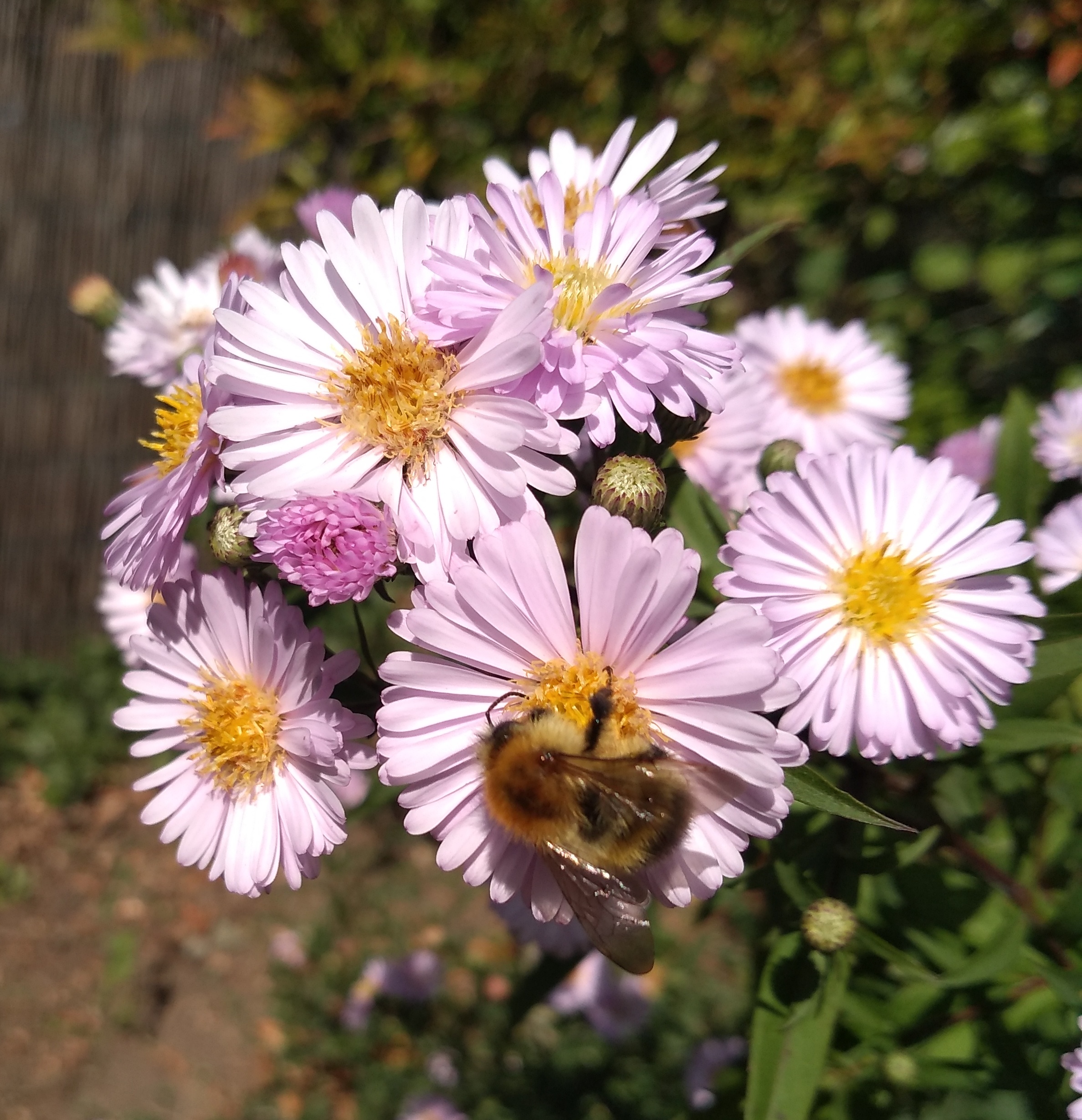
-Common carder bees (Bombus pascuorum) visiting Aster, Verbena bonariensis and Rudbeckia,

Aster

Verbena bonariensis

Rudbeckia

– and a Small white butterfly on Aster flowers.

On Friday I noticed more Common carder bees as they visited a hardy Fushia. This was the first time I noticed bees visit a Fushia so it was lovely to see it happen. These bees have long tongues and because they are small can collect nectar easily from Fushia flowers. However the two bumblebees I saw this week are larger and have short tongues which explains why I saw them visiting the Helianthus. Interestingly though Buff-tailed bumblebees are able to ‘rob’ nectar from bell shaped flowers by cutting a hole in the side of the flower to access the nectar. White-tailed bumblebees (Bombus lucorum) can also undertake nectar robbing. Even so single flowers, together with a variety of flower shapes are important for bees and other pollinators. Plus night scented flowers are beneficial for moths.

Another sighting from Wednesday was watching a Red Kite (Milvus milvus) soaring in circles above where I worked. I love hearing Red kites repeatedly call as they fly; it is a beautiful sound.

As well as insects and birds, occasionally I get to see wild mammals as I work too. There was an instance of this last Monday. I noticed a Fox (Vulpes vulpes) exiting a hedge and run into the neighbouring garden while I ate my lunch.

Posted in nature

A Magical Week

I have begun to notice a chill in the mornings as the nights grow colder. I love the promise of Autumn. It doesn’t quite feel autumnal yet (especially as the weather has warmed up again this weekend) but some changes are occurring. Conkers and beech masts have started dropping and fungi are appearing in some lawns. A couple of times I have come across fairy rings; in both instances the Marasmius oreades fungi was the cause (sadly no magical elvish, fairy or pixie dancing).

The week continued with more observations of Painted lady (Vanessa cardui) butterflies. On Monday there were two visiting a Buddleja bush along with a Small tortoiseshell (Aglais urticae) and a Large white (Pieris brassicae).
Then on Friday, in different gardens, more were flitting about. On one occasion, during the morning, I saw a Painted lady on a Ceratostigma willmottianum.

In the second half of the week I noticed more butterflies including a Green-veined white (Pieris napi) on Verbena bonariensis

and a Small tortoiseshell visiting an Erysimum ‘Bowles’s Mauve’.

Throughout last week I saw lots of pollinators busily collecting nectar and pollen.
On Monday I noticed lots of small flies and Buff-tailed bumblebees (Bombus terrestris) pollinating Marigold (Tagetes) flowers. Perhaps they are enticed by their overwhelming aroma which even I found hard to ignore.

Then on Wednesday there was a Common carder (Bombus pascuorum) bee flying between Nandina domesticas and several Agapanthus africanus.

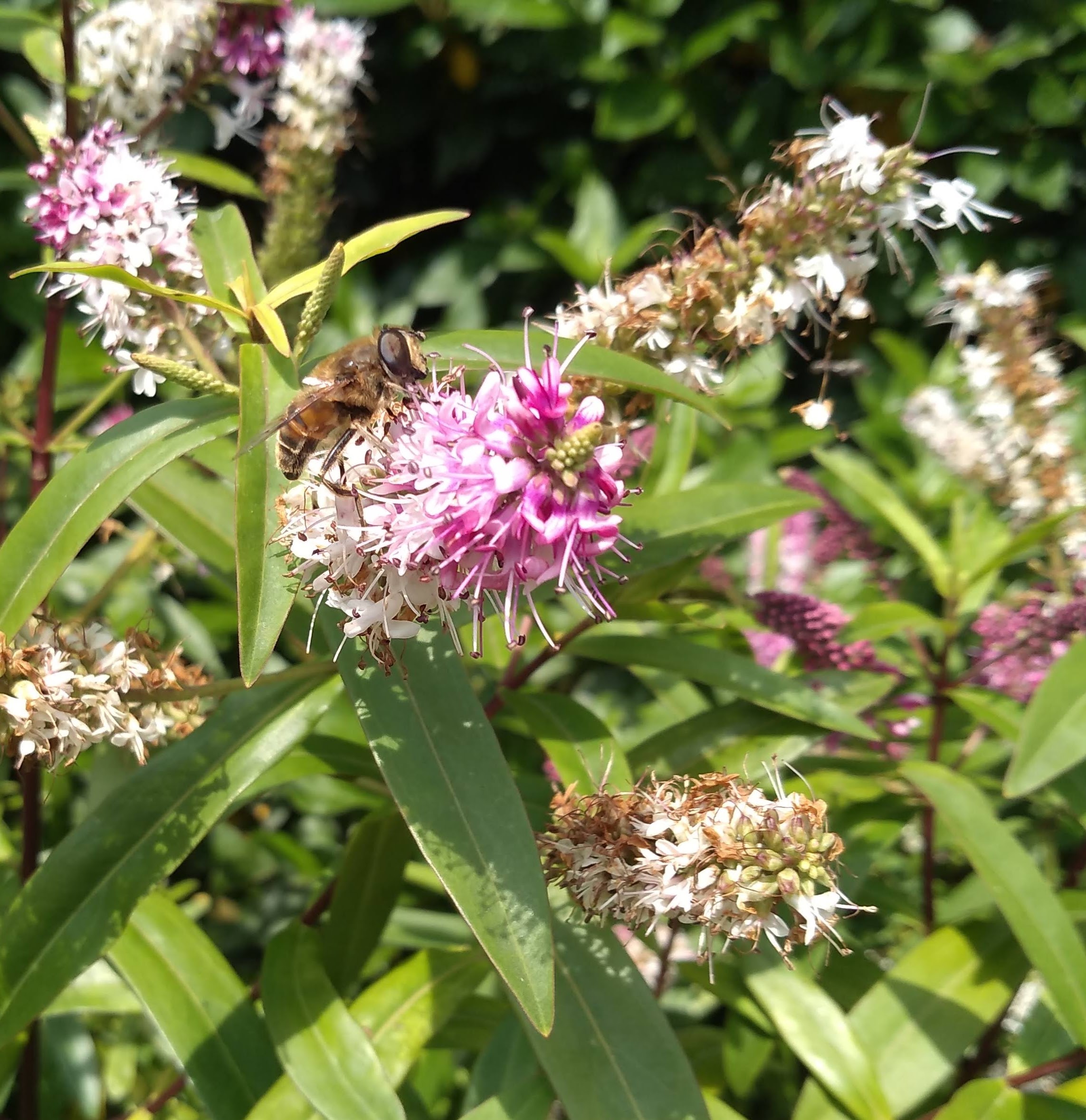
On Friday while working near some Hebe ‘Great Orme’ there were lots of honey bees (Apis mellifera) as well as a Hornet mimic hoverfly (Volucella zonaria).

Another interesting thing I noticed last week was a Red campion (Silene dioica) plant growing on an old moss covered log.

With no soil surrounding its roots clearly it was receiving sufficient moisture and nutrients from this unusual source. It has been flowering healthily all summer but I hadn’t realised it had been relying on the log for its growth until then. I found this plants ability for survival amazing and will closely watch its development.

Lastly I have been aware of how wonderful hardy Fuchsias (Fuchsia magellanica) are currently looking. Although I don’t see pollinators visiting the flowers, there have been a couple of times, in the past, when I have seen Elephant Hawk-moth (Deilephila elpenor) caterpillars feeding on Fushia plants. (See Elephant Hawk-moth).

These caterpillars also eat Himalayan balsam (Impatiens glandulifera) and Willowherbs including Enchanter’s nightshade (Circaea lutetiana) and Rosebay willowherb (Epilobium angustifolium). This beautiful pink and olive green moth flies at night and therefore feeds on Honeysuckle (Lonicera).

Across the way from this hardy Fushia there was a Honeysuckle growing along the wall so it would have been a fantastic place for these moths to inhabit. Unfortunately I didn’t come across any Elephant Hawk-moths this year but hopefully I will in years to come (and I am sure it will feel magical).

Posted in nature

The Very Hungry Caterpillar

The weather at the beginning of last week started nicely. Early on a sunny Monday morning I spotted seven Large white (Pieris brassicae) butterfly caterpillars on a Nasturtium (Tropaeolum) plant.
Used as a companion plant near brassicas this plant has been sacrificed to prevent the butterfly eggs being laid on the cabbages.

Unknown to me at the time, I also photographed some caterpillar faeces as well as an undeveloped egg on the leaf. I don’t remember the loved childhood picture book, The Very Hungry Caterpillar mention poo (although I’m sure children would have loved that addition to the story).

As with elsewhere in the country, the weather continued to be unsettled throughout the week. Tuesday was mostly overcast but the bees were still out foraging. As the lavender (Lavandula) was over lots of Honeybees (Apis mellifera) started visiting the Echinops bannaticus.

Later the same day I managed to see another Male Gatekeeper (Pyronia tithonus) butterfly too, this time visiting a Geranium.

Plus on Thursday I noticed a Holly blue (Celastrina argiolus) butterfly on some Verbena bonariensis. I haven’t seen Holly blue butterflies since spring, so that was nice.

Unfortunately on Wednesday I managed to disturb a Silver Y (Autographa gamma) moth.

Although this isn’t a great photo, it is clear enough to be able to identify the moth. I managed to identify it because of the shape and light colouring along with the unbroken y shaped silver marking on each forewing. This moth is a migrant, visiting from the continent. It can be seen here with the wings vibrating to warm up it’s flight muscles before flying off.

The week ended with a visit to the Royal Botanical Gardens, Kew on Saturday. There were some insects braving the stronger winds and the afternoon rain.

Amongst the Wildflower meadow surrounding The Hive experience the flowers still blooming were; Red Campion (Silene dioica), Red clover (Trifolium pratense), Ragwort (Senecio jacobaea), Yellow toadflax (Linaria vulgaris), Creeping buttercup (Ranunculus repens), Yarrow (Achillea millefolium), Flatweed (Hypochaeris radicata) and Wild marjoram (Origanum vulgare).

Yarrow and Yellow toadflax along the path.

A Volucella inanis Hoverfly visiting the Wild marjoram.

In the Agius Evolution Garden there were lots of bees visiting the Salvias as well as a Buff-tailed bumblebee (Bombus terrestris) on a hollyhock (Alcea)

and a Honey bee (Apis mellifera) visiting a Wallflower (Erysimum).