Posted in nature

Springing Forward

Spring is in full swing now. The Spring equinox has passed, clocks have been changed to welcome in British summer time, april showers often appear (and disappear just as quickly) and the Bluebell (Hyacinthoides non-scripta) season has begun. It has been a while since my last post and a lot has happened since then.
Back in early march, I noticed lots of frogspawn appear, they have since developed into tadpoles and some now resemble small versions of the adults. Male Smooth newts (also called Common newts- Lissotriton vulgaris) were undertaking courtship displays, swishing their tails to waft pheromones towards the females. The video below shows this courtship display; I managed to capture it back on the 7th of march.


Newt eggs are laid individually wrapped in the foliage of aquatic plants and therefore not as obvious as frogspawn. I haven’t noticed any Efts (young newts) yet though but hopefully I will soon.

Hawthorn (Crataegus) blossom has replaced those of Blackthorn (Prunus spinosa) now. Plus alongside the flowering Bluebells, many more spring flowers are currently blooming including, Cuckoo flower (Cardamine pratensis), Lesser stitchwort (Stellaria graminea) and Cow parsley (Anthriscus sylvestris).

Butterflies are more noticeable these days. Recently I have seen Holly blue (Celastrina argiolus), Speckled wood (Pararge aegeria) and Small tortoiseshell (Aglais urticae) butterflies, as well as plenty more Brimstone (Gonepteryx rhamni).

More bee species have emerged over the past month; even the Leafcutter (Megachilidae) bees from the bee hotel on the allotment. Together with Red tailed bumblebees (Bombus lapidarius), Buff tailed bumblebees (Bombus terrestris), a Common carder bumblebee (Bombus pascuorum), and an Ashy mining bee (Andrena cineraria) I also noticed a Tawny Mining Bee (Andrena fulva)- The latter (shown below) was seen carefully exiting a hole on the side of the Wrekin.

I visited the Wrekin in Shropshire last weekend. A woodland surrounds the base of the hill which is quite a contrast from the more open areas at the top. Here Wood sorrel (Oxalis acetosella), an ancient forest indicator, could be seen blooming alongside ferns and moss. It was lovely to see patches of bluebells while listening to water trickling down the hillside (from the previous nights downpour).

Wood sorrel


At the summit of the igneous bedrock, Common heather (Calluna vulgaris) and Bilberry (Vaccinium myrtillus) are seen growing. Both plants grow on nutrient poor acidic soil. The Bilberries (also called Whinberry or Wimberry in Shropshire) were flowering but the edible fruit will be ripe in the summer.

Bilberry shrubs in flower.


It was also wonderful to see a couple of Buzzards (Buteo buteo) soaring and hovering around, ignoring us humans that had completed the ascent.

Lastly, since the Spring equinox, I have been watching the Peregrine falcons (Falco peregrinus) at St Albans cathedral on the live webcam here. Once again the pair have three eggs, the same as last year. Currently we are all waiting to see if they all successfully hatch and fledge. It is far more entertaining than any tv drama.

Posted in nature

False Autumn

It might be the start of meteorological autumn but it’s still too early for leaves to start falling from trees; yet over the past few weeks this has been occurring. Referred to as false autumn, this leaf (and acorn) drop is occurring as a result of the extreme temperatures and drought we’ve experienced this year. It is a sign of stress as trees attempt to conserve water and energy. Current lower morning temperatures have also lead to an autumnal feeling. Thankfully we are now experiencing rainfall so perhaps this will prevent trees from showing further signs of stress even though it doesn’t stop us being in drought. Hopefully autumnal colour won’t be affected too much and we will still witness the spectacular seasonal colours this year.

A couple of weeks ago my partner and I went for a walk to spot Saturn ascending in the sky at dusk; we visited the local woodland park. At nine o’clock, on one of the hottest days of the year, the temperature was quite pleasant. As we walked through the woodland to an open area, where we could view the planet, we got to experience bats flying close by (the following videos is of some footage I managed to obtain).

Without a Bat detector, I have no way of correctly identifying the species out of the 18 that roost in the UK. According to the information I found on the Hertfordshire and Middlesex Bat Group website, the ones we most likely encountered in the area are either the Common Pipistrelle (Pipistrellus pipistrellus) or Soprano Pipistrelle (Pipistrellus pygmaeus). Regardless of the species, just experiencing the creatures flying nearby to capture insects was amazing. I haven’t witnessed bats in fight since I was a child.

It’s still possible to see some butterflies and bees at this time of year so late year flowering plants are essential.

A Common carder bee visiting a group of Aster flowers.

White tailed bumblebees (Bombus lucorum), Buff tailed bumblebees (Bombus terrestris), Red tailed bumblebees (Bombus lapidarius), Common carder bees (Bombus pascuorum) and even some Honey bees (Apis mellifera) still forage in September. The Butterfly Conservation charity produced a photo (see below) of common butterflies and moths to see at this time of year.

During the previous week I was still noticing several Hummingbird hawk moths (Macroglossum stellatarum) too. These moths have been quite prevalent this year.

On one occasion I managed to get a video of a Hummingbird hawk moth visiting a Buddleia.
Posted in nature

Worm Moon Shining

The full moon in March, is commonly named the Worm moon in the UK as it coincides with the appearance of worm casts. Worm casts begin to appear as the soil warms up enabling worm activity on the top layers of soil. They are often the bain of those who love prestine lawns but easily dealt with by raking, to break them up before mowing (thus preventing small bare soil patches that encourages wild flower and moss growth). However, apart from this slight inconvenience for some, obviously worms are hugely beneficial creatures in nature. They help create a healthy soil ecosystem, aid the decomposition of organic matter, improve soil structure and increase available nutrients for plants.

In the UK there are 27 species of earthworm, which can be categorised into three types, Anecic, Endogeic and Epigeic. The latter are surface dwellers which breakdown vegetation lying on the ground. These small, usually red worms (or stripey in the case of Tiger worms- Eisenia fetida) are often seen in composts. The other two types of worm burrow. The most commonly seen in gardens are the Anecic worms (which pull leaves down into the soil). These large reddish brown worms are responsible for worm casts in lawns and burrow vertically while the paler coloured Endogeic worms burrow horizontally and live further down in the soil.  More information on earthworms can be discovered here on the Earthworm Society website.

Another notable date that occurred last week on the astronomical calender (in the northern hemisphere) was the Spring equinox. The moment in March when day and night length are equal and officially the first day of spring.  (Meteorologically this already occurred on the first of the month). Whichever date you prefer to observe as it’s start, Spring has definitely arrived here in the UK.

Nature seemed to celebrate the arrival of Spring with several days of unseasonably warm weather, together with the appearance of more butterflies, with Peacocks (Aglais io), Commas (Polygonia c-album) and yet more Brimstones (Gonepteryx rhamni) fluttering about, together with lots more bumblebees. So far I have seen lots of Buff-tailed bumblebee (Bombus terrestris) and a few Red-tailed bumblebees (Bombus lapidarius). Even Seven-spot ladybirds (Coccinella septempunctata) came out of hiding last week.

More trees are blossomimg too. Magnolias, Camellias, Forsythia, Gorse (Ulex) and Willows (Salix) are flowering now, joining the Blackthorn (Prunus spinosa). Plus yellow and green carpets of Lesser Celendine (Ficaria verna) have been popping up everywhere.

Posted in Allotment, nature

Blossom Watching

Warm sunny weather has finally replaced the wet conditions we seemed to be stuck in all May.

As I write this, meteorological summer has begun so the change in weather is rather fitting.

It has been fascinating to follow the seasons so far this year; paying particular attention to the timing of tree blossom arrival. After the Blackthorn (Prunus spinosa), the ornamental Cherries (Prunus) took over alongside the Crab apples (Malus). Then for the last few weeks Rowan (Sorbus), Horse chestnuts (Aesculus hippocastanum) and Hawthorn (Crataegus) have been blooming and continue to do so.

More wild flowers are joining in the visual performance as Red clover (Trifolium pratense) and Common vetch (Vicia sativa) started putting on a show too.

Even on the allotment, the Lacy Phacelia (Phacelia tanacetifolia) has begun to bloom alongside the vibrant Geums, which is a great combination.

The bees have been enjoying their nectar and pollen, along with a Hairy shield bug (Dolycoris baccarum) who came to visit on them Saturday (see photo below).

We do have blackthorn hedges nearby so I guess it had been overwintering on those.

I’ve noticed that the Chive flowers are particularly loved by worker Red tailed bumblebees (Bombus lapidarius); this isn’t too much of a surprise as I know they have short tongues, plus once they have found a good food source they will repeatedly visit the same plant.

Seven-spot ladybirds (Coccinella septempunctata) numbers are increasing on allotment too. Plus one Female Wolf spider (Pardosa amentata) carrying a blue egg sac was spotted.

It is always a joy to share my plot with beneficial insects, as I don’t use insecticides.

It was nice to have a long weekend, it gave me a chance to walk through the local woodland park which I hadn’t done for a few weeks. Lots of butterflies were flitting about, including one Speckled wood butterfly (Pararge aegeria).

Posted in nature

A Splash of Purple

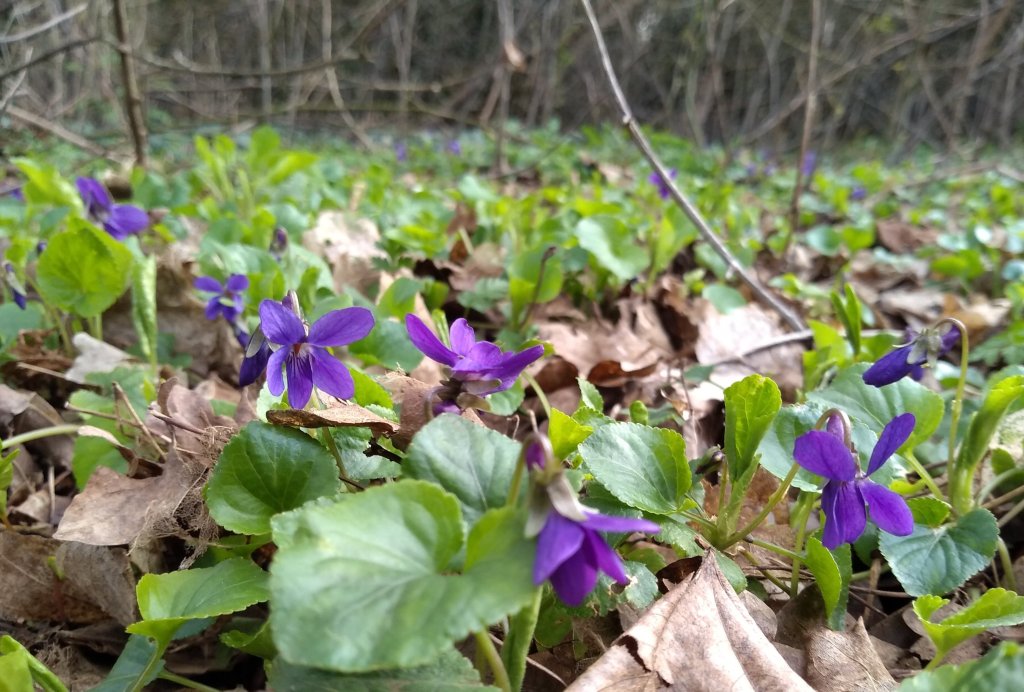
The Common Dog Violet (Viola riviniana) has begun to bloom, both in the wild (in woodlands, heaths and amongst hedgerows)
as well as gardens.

This splash of purple usually arrives in April and lasts until June. If you are lucky, you may notice certain Fritillary butterflies feed from and lay their eggs on this plant (a spectacle I’ve yet to witness).

Willows were blooming last week too. There is one mature Goat Willow (Salix caprea) that I see regularly as I work. Another common name for the Salix caprea is Pussy willow, due to the male catkins resemblance to cats paws before they bloom.

Only males catkins turn yellow once they open.

Willow trees are dioecious; therefore females catkins, grow on separate trees to the male ones. Unlike the male catkins shown above, female ones are green and longer in length. Catkins appear on the trees before the leaves do.

So many catkins were open that the tree seemed alive with the sound of bees.
I love the reddish tinge in the bark.

I am not sure how old this specific tree is but the species can live for about 300 years and grow up to 10 meters tall. The specimen in the garden I work at has definitely reached it full height.

The Kilmarnock willow (Salix caprea ‘Kilmarnock’) is a much smaller version of the Goat willow tree (grafted onto a dwarfing rootstock). I often see this tree in gardens and they were blooming last week too.

Unlike its larger counterpart, the Kilmarnock willow is a great addition to the average sized garden as it too is loved by bees.

The pollen covered Buff-tailed bumblebee pictured here clearly enjoyed visiting the male catkins on this Kilmarnock willow.

Goat willow trees are usually found in woodland, hedgerows and scrub, especially near waterways such as lakes, streams and canals.

Willows are a fantastic source of pollen and nectar for bees and other pollinators. They’re also a good food source for Sallow kitten (Furcula furcula), Sallow clearwing (Synanthedon flaviventris), Dusky clearwing (Paranthrene tabaniformis) and Lunar hornet clearwing (Sesia bembeciformis) moth caterpillars too. Even birds forage for insects amongst their branches.

As the wood burns well it is used to make charcoal. Plus it’s also used for wattle in timber frame houses.

My favourite fact is that the words witch, wicked and Wiccan are derived from Willow.

Traditionally, it was used to help treat toothache by chewing the bark and used to relieve diarrhoea, arthritis, sore throats, stop bleeding and clean wounds. In fact Aspirin, derived from salicin, was sourced from Willows.

The bacteria Brenneria salicis can cause Watermark disease in Willows which causes dieback and eventual death to the trees if left untreated.

If you are looking to add a small tree to your garden, the Kilmarnock willow is definitely worth looking into; unless you have a large garden then choose a mature male Goat willow instead (the bees will thank you for it).

Posted in nature

Common Insects but an Uncommon Viewing Experience

It was great to still witness pollinators flying around last week. Even though, due to the colder weather numbers have greatly reduced, some insects are still foraging. I noticed the odd hardy Buff-tailed bumblebee (Bombus terrestris) as well as a few Honey bees (Apis mellifera) visiting autumn flowering perennials and shrubs. Currently the most wonderful spectacle is Common Ivy (Hedera helix) in full bloom. Loved by pollinators including butterflies, bees and hoverflies, ivy is a useful plant to have in flower at this time of year. It supports up to fifty species altogether, such as providing food for Holly blue Butterflies (Celastrina argiolus), along with the Small dusty wave (Idaea seriata), Angle shades (Phlogophora meticulosa)
and Swallow-tailed (Ourapteryx sambucaria) moths. Mature Ivy plants flower in September and October on clustered umbels. Eventually, pollinated flowers develop into fruit that provides food for Thrushes (Turdidae), Blackbirds (Turdus merula), Blackcaps (Sylvia atricapilla) and Wood pigeons (Columba palumbus). Ivy also provides shelter for hibernating insects over winter.

However the most prevalent insects I witnessed covering the ivy flowers last week were the Common wasp (Vespula vulgaris). They weren’t nesting amongst it but feeding on the abundant nectar. My confidence in their complete focus on the ivy flowers, and not being bothered by my presence, enabled me to unusually observe them up close. Each time I came across ivy covered with wasps, I would take a few moments to watch and listen. Unlike bees, their buzzing was very faint; you had to listen carefully to hear it. I had never been close enough to appreciate the wonderful pattern on their abdomen before or watch their activity as they hurriedly switched from one flower to another.

I would have been observing male and worker wasps obtain nectar from the ivy (which also visit other umbellifier flowers). Queens are active in spring, collecting nectar from Cotoneaster and other spring flowering shrubs.

These much hated creatures are useful pollinators (as the photo below proves) when not pestering us as we eat outdoors. We can’t really blame them trying to access an easy source of food or protecting nests when we stumble upon them.

Wasps also help keep insect numbers down which once captured, are chewed up and fed to the larvae.

Although I haven’t seen any yet, I am ever hopeful that I will see Ivy bees (Colletes hederae) as I look at ivy. Recorded for the first time in southern Britain as far back as 2001, these solitary bees feed on ivy nectar and are therefore only seen when ivy flowers. Since they were first noted in Britain the species has been spreading northwards, nesting in sandy soil. For further information see (Wildlife Trust).

More fungi started to appear last week too; I saw
– Common bonnets (Mycena galericulata)

– Shaggy ink caps (Xylaria hypoxylon) and

– Candlesnuff (also referred to as candlestick or stag’s horn) fungus (Xylaria hypoxylon).

You have to look closely to identify this minute fungi, found on decaying wood, it has a blackened base.

Lastly I was utterly surprised to witness a Fox (Vulpes vulpes) run across my allotment as I worked early on Saturday afternoon. It looked healthy so presumably had been disturbed with all the activity from allotmenteers tidying their plots.

Posted in nature

Garden Treasures

It feels like spiderweb season, the time when they become more prevalent, has arrived. I often get a face full of web when I accidentally walk into hidden ones as I work.

The spider’s web I come across most often is created by the European garden spider (Araneus diadematus). Also called the Diadem spider, Garden cross spider or Crowned orb weaver, due to the pattern on their abdomen and large circular webs they weave.

Males are 9mm in length, smaller than females (which grow to 15mm). Colouration can vary from light to dark brown and even burnt orange.

They are often found in gardens but also inhabit woodlands and meadows. The large orb webs (up to 40cms diameter) become more noticeable at this time of year in strong sunlight, due to the position of the sun, especially when glistening with dew in the mornings.

Those spiders which have survived summer will be mature adults now and start mating when autumn arrives. Males pluck the threads of the female’s web before he approaches, so he isn’t mistaken for food. However this tactic isn’t 100% successful as they can still become prey, even after mating. In late autumn a pregnant female will lay her eggs and spend every second protecting them until she eventually dies. Any adult spider still alive by November will succumb to cold weather.

The young spiderlings will survive winter inside a protective egg sac made of silk, to hatch in May the following year. Repeating the process of feeding on insects caught in webs (after being given a paralysing bite and wrapped in silk for later). They may not be the nation’s favourite garden helpers but they reduce pests and therefore should be treasured just like Ladybirds.

I also learnt a new plant last week. Standing out like a jewel amongst the other perennials was the beautiful Bog sage (Salvia uliginosa).

A Buff-tailed bumblebee (Bombus terrestris) visiting some Bog sage.

As it’s common name suggests this plant grows in damp areas. The one I saw was planted in a herbaceous border that used to be a pond which never completely dries out.

Originally from South American waterways (between Brazil to Argentina) this tall hardy perennial also requires a sunny position to survive. The beautiful blue flowers, loved by bees, bloom between August and October so this plant is a wonderful addition to gardens for extending the pollinating season.

Posted in nature

🎵”It’s a Beautiful Da(hlia)…” 🎶

Actually there were lots of beautiful Dahlias at the Autumn festival I went to last Saturday. In fact even the weather was beautiful during the afternoon.

The Dahlia originates from Mexico (where its the national flower) and Central America. A perennial that grows from tubers, it is part of the Asteraceae family which also includes Daisies, Zinnias, Sunflowers and Chrysanthemums.

Because they’re not hardy and prefer light, free draining Soil, Dahlias are often lifted and stored somewhere dry over winter in the UK.

However, in southern counties, where gardens contain favourable conditions (with no heavy, soggy soils in colder climates) I have known people keep them in the ground. Sure enough the following year they reappear without fail. The lack of harsh winters in recent years no doubt enabling their survival.

Apparently Dahlia tubers can be eaten in the same way as Sweet potatoes (originally they were grown as a food source by the Aztecs). They can also flavour drinks when roasted. See Alys Fowler’s piece for the Guardian newspaper)

Over the past few years the popularity of Dahlias has increased; I must confess I am one if their fans.

I love the flowers vibrant colours but prefer the plants with single flowers, which are great for pollinators too (although I have caught sleepy bees having a nap amongst petals of other Dahlias as well; see below).

Unnamed variety from my Allotment with a Buff-tailed bumblebee snuggly sleeping inside a petal.
Formby Art: Bee seen relaxing on this Dahlia at the festival.

Some of my favourites on display last Saturday were:

Honka: Apparently popular with butterflies.
Pooh
Blueberry Hill
Carstone Firebox
Preston Park

I was also impressed by the wonderful bug hotel within the Celebration garden at the garden centre.

Posted in nature

New House Build. 🐝

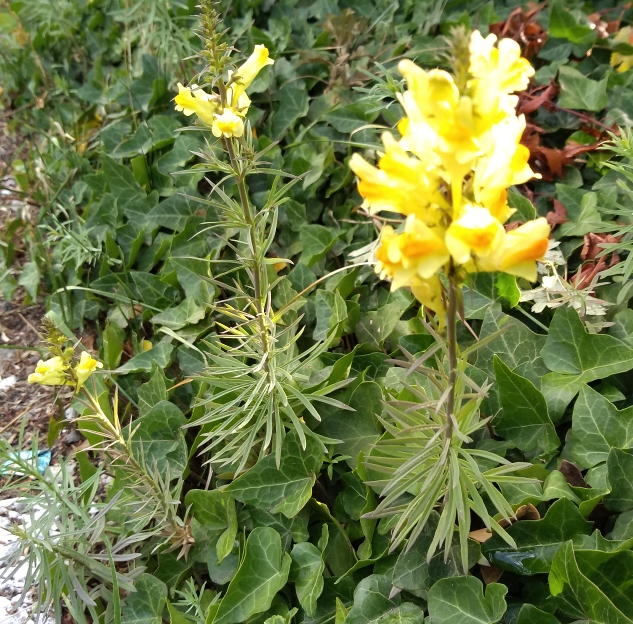
Some fields along my journey to and from work contain a lovely combination of pink Rosebay Willowherb (Chamaenerion angustifolium), purple Buddleia and white Wild carrot (Daucus carota) flowers. Not only do they compliment one another visually but they are all loved by pollinators too. Yellow toadflax (Linaria vulgaris) has started to bloom along the roadside as well.

One special moment occurred on the Monday. As I worked within a border I noticed a Buff-tailed bumblebee (Bombus terrestris) queen flying around a patch of grass. Eventually she began to settle and after a few more large sweeping flights began making a nest in the lawn.

It didn’t take her long to dig into the soil beneath the grass.

She will remain under ground until spring when she will start her own colony.

It was also great to finally get some photos of insects that have have alluded my photographic capture so far this year.

– The first is the Red admiral (Vanessa atalanta),

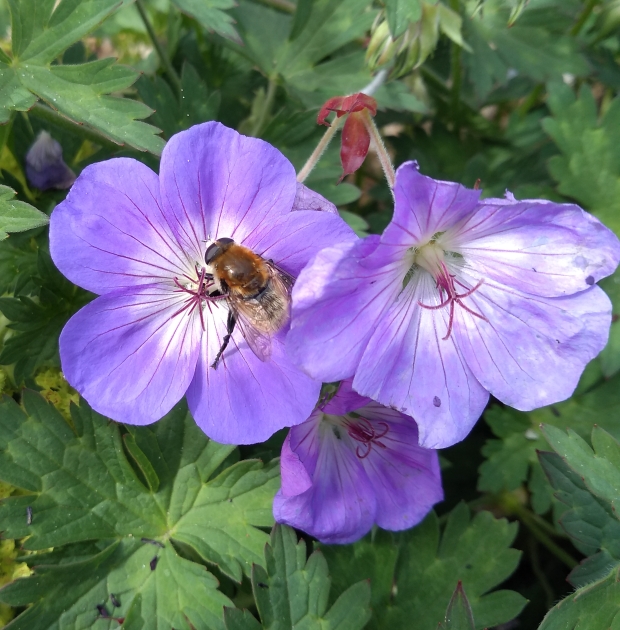
– Some Hoverflies, including a Hornet mimic (Volucella zonaria) hoverfly,

Hornet mimic Hoverfly pollinating Wisteria flowers that were still blooming.
Hoverfly pollinating Geranium flowers.

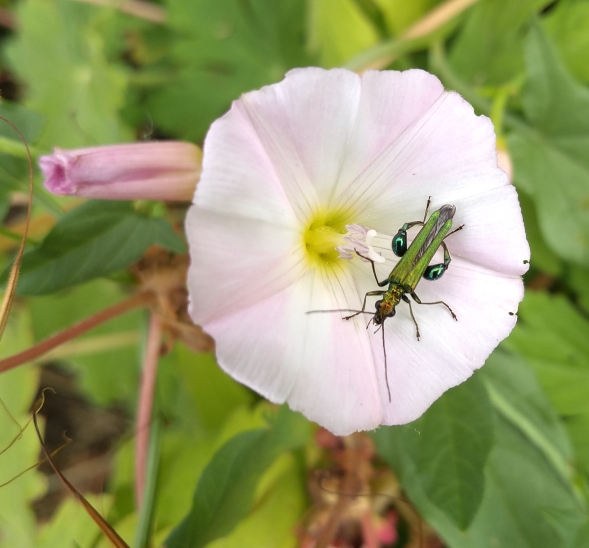
– as well as a Male False oil beetle (Oedemera nobilis), to compliment the female one seen on a walk earlier in the year.

A False oil beetle pollinating a Field bindweed (Convolvulus arvensis) flower.

The males are easily identified due to their large metallic thighs, explaining the reason behind the other common name for this insect the Swollen-thighed beetle.

Posted in nature

Even Nature Turned Blue for the NHS.

While flowers dominated my thoughts last week, there were moments when I enjoyed observing bees and butterflies too. I saw my first male Orange-tip butterfly (Anthocharis cardamines) and female Red-tailed bumblebee (Bombus lapidarius) of the season; both visiting Dandelions (Taraxacum officinale). Other butterflies I noticed were more Speckled woods (Pararge aegeria) and Peacocks (Aglais io). All were too busy making the most of the sun to remain still long enough for me to photograph them.

After threatening to rain last Sunday, with distant thunder in the afternoon and evening, wet weather eventually arrived the following weekend. On Friday it rained late in the day through to Saturday afternoon. The ground loved that sustained soaking and together with all the sunshine we’ve had recently the grass is beginning to flourish. Thankfully lots of wild flowers bloom despite the lack of water, including;

– Ivy-leaved toadflax which is also called Kenilworth ivy (Cymbalaria muralis),

– Lords and ladies, otherwise known as Cuckoo-pint (Arum maculatum),

– Ribwort plantain (Plantago lanceolata),

The seedheads are great for feeding birds in winter.

– Dog’s mercury (Mercurialis perennis),

The tiny flowers are easy to miss amongst the leaves.

– Ox-eye daisy (Leucanthemum vulgare) and

– Cuckoo flower (Cardamine pratensis).

The name for this comes from the belief that this plant blooms at the same time the first Cuckoo arrives in the UK.

The main spring spectacle of the English countryside however are English Bluebell (Hyacinthoides non-scripta) woods in full bloom. Photos of these have filled social media over the past week. I am lucky enough to live near to several woods where English bluebells flower, however due to the lockdown this year I have to make do with spotting the ones amongst the headgerow, on my way to the allotment. Thankfully even small scale sightings of these flowers makes my heart soar. Swathes of these beauties are an indicator of ancient woodland (they are slow growers with seeds taking five years to become bulbs, which then flower). 

English bluebells continue to be under threat from the Spanish bluebell (Hyacinthoides hispanica) escaping from gardens, brought to these shores by the Victorians, which readily hybridise with English ones to produce the Hybrid bluebell (Hyacinthoides x massartiana). However, this isn’t the only threat to our native Bluebell. Habitat destruction is another reason for their decline. Simply walking on them can prevent them from flourishing for years afterwards as photosynthesis is prevented and the plant is weakened. They are a protected species under the ‘Wildlife and Countryside Act (1981)’. This means that people can be prosecuted for removing the plants and bulbs from their habitat and/ or selling them. 

It is possible to tell the English and Spanish Bluebells apart.
English Bluebells are a deep violet shade of blue with creamy-white pollen. The leaves are narrow (1-1.5mm wide) as are the flowers. The tips of each petal (six in total) curl up and inwards. The scented flowers grow on one side of the stem causing it to arch over to the one side (referred to as inflorescence).

Spanish bluebell flowers are pale blue (but can be pink or white), have a wider open bell shape with flared petal tips and bloom all around the stem, which therefore remains upright. The leaves are also wider (by 3cms) than its English counterpart and the flowers have no scent. 

Unsurprisingly the hybrids possess characteristics of both parents, however their appearance tends to be more like the English Bluebell meaning distinguishing the two can sometimes be difficult. 

Last week I saw both English and Spanish Bluebells on my daily exercise.

English Bluebells are great for long-tongued bumblebees. However previously I have seen evidence of short-tongued bumblebees visiting Bluebells. Unable to reach the nectar in the traditional method, I noticed a hole in the base of the flower where a bee had obtained the nectar without pollinating it. This is referred to as ‘nectar robbing’.
Spanish bluebells found in a garden.

Bluebells are interwoven into our culture. In the past the sap was used to glue feathers to arrows and in book binding. Plus the Elizabethans used the bulbs to starch collar and sleeve ruffs.

In folklore they are associated with fairies while in the language of flowers (popular in the Victorian era) they represent humility, constancy, gratitude and everlasting love. What better flower to have bloom during this difficult time when we are showing our appreciation for the NHS and other frontline workers. It seems even nature has turned blue in solidarity.