The first of August is the start of the harvest and autumn is beginning to set in slowly now; a time I enjoy.
The weather has recently changed in the south, we have had rain over the past few weeks, meaning the parched lawns are beginning to green up once again and require cutting. I have never known a year where we haven’t cut the majority of lawns for such an extended period over the summer; usually it isn’t until the end of July into August when this occurs.
The wetter conditions are making it difficult to pick a time to undertake the Big Butterfly Count this year, although I am still seeing various butterflies and day flying moths around at the moment; Including the Jersey tiger moth (Euplagia quadripunctaria).
This beautiful medium sized moth (between 5.2 to 6.5 cm in length) is often seen in the south with the range growing upwards towards London and now Hertfordshire; found in Gardens, hedgerows and coastal areas. The caterpillars can be found between September through to the following May, surviving winter as larvae. The adults often visit Buddleia while the food source for caterpillars are Common Nettle (Urtica dioica), White Dead-nettle (Lamium album), Borage (Borago officinalis), plantains (Plantago Spp.), Ground-ivy (Glechoma hederacea) and Bramble (Rubus fruiticosus) amongst other herbaceous plants.
I have also seen a small copper (Lycaena phlaeas) butterfly recently.
This small (3.2- 3.5 cm) orange coloured butterfly can be found on waste ground as well as heath, moor, grass and woodland environments where the soil is chalky and the ground poor in nutrients. The caterpillars eat Sorrels and Broad-leaved Dock (Rumex obtusifolius).
This has been a wonderful year for ladybirds due to the very hot weather at the beginning of spring causing a huge increase in aphids. Out of the 46 different types in the UK, I mostly see Six-spot and Harlequin ladybirds. A couple of weeks ago I noticed another as it flew into the van; the 14 Spot ladybird (Propylea quattuordecimpunctata).
Much smaller than the six-spotted ladybird, this yellow and black beetle can be seen throughout the UK from May to September.
I finally saw a flower crab spider (Misumena vatia) while pruning a shrub too. As seen in the photo below, they are often white but the females of the species can change their colour to a yellow tint in order to blend into its surroundings better.
Usually noticed between May and August they are commonly seen in southern England. The different sexes differ in size, the males are half the size of the females which are between 9 to 11mm in length. These spiders will wait and ambush prey rather than spin webs and can eat various insects including moths and bees,
Now September has arrived, there is definitely an Autumnal feeling in the air. Similar to March, this month often has a transitional effect on me; especially once the Autumn equinox arrives on the 22nd. The nights are noticeably getting colder and drawing in. Over the past few weeks, some mornings have been misty and there has been a mixture of weather throughout the weeks; humid and stormy one moment and colder and sunny another. Spiders and their webs have become more visible, helped in part by morning dew, plus leaves are beginning to turn on some trees while autumn Cyclamen and crocuses (Colchicum autumnale) are starting to flower. I love September after the intense heat of August I long for a bit of relief.
On the allotment, autumn raspberries (Rubus idaeus) and apples are ready to pick along with pears, damsons (Prunus domestica subsp insititia),
Damsons ready to pick.
elderberries (Sambucus) and blackberries (Rubus). Conkers are falling now too, although the walnut and hazelnut harvests have passed.
Sweet chestnuts are almost ready to fall.
On the last bank holiday of the year (almost a month ago), I visited Minster-on-sea with my partner and his parents. It was an ideal day for walking along the beach searching for treasure, perhaps fossils, sharks teeth, sea glass, pieces of broken pottery and the occasional sea lego. Washed up along the beach were lots of Slipper limpets (Crepidula fornicata).
These limpets arrived on these shores from America via ships in the 1800s and thrived in the UK; especially southern England and Wales, where they have become a pest to muscle and oyster beds (competing for food and space). They are edible themselves.
It is usual to see individual empty shells, in fact they are found in huge numbers on beaches in the Solent. The common name of this sea snail refers to the appearance of an individual shell when it is viewed upside down; similarly the latin means small boot. When alive, these gastropod molluscs are rarely found alone (as shown in the photo above). Up to 12 Slipper limpets can be stacked together with the female, the largest and oldest, at the bottom; all the others are male or, in the case of the second from bottom, in the process of transforming into a female. When the one at the bottom dies and falls off, the next one up then becomes female. Further information on these fascinating creatures can be found in an article written by Nick Baker here.
The Slipper limpet isn’t the only snail that I noticed recently. I often get to see land snails but I noticed this beautiful orange coloured Brown lipped snail (Cepaea nemoralis) hanging around after a rainy morning. Snail shells can be very beautiful and I am intrigued by their structure.
Whatever your view on snails it’s hard to look at their shells without admiring the beauty.
I have become more aware of insects lately, mostly when cutting back perennials at work. Although I try to be careful as much as possible, occasionally I disturb a few. I always make a point of replacing or moving them to a safe place. Mostly it is ladybirds but I have also noticed a few other species, such as Common earwigs (Forficula auricularia) and the Rusty tussock (Orgyia antiqua) and Knot grass (Acronicta rumicis) moth caterpillars
Common earwigs feed on organic matter and like to hide away in dark areas of the garden (not in human ears).
Earwigs are useful garden recyclers.
Once eggs are laid, the females diligently clean them and constantly guards the nest only stopping when the young can fend for themselves. While the adults can nip humans and predators, it is only as a warning.
Caterpillars of the medium sized Rusty tussock moth can be seen between May and September.
The males and females of this moth, also called the Vapourer, look different from on another. The males are orangey-brown while the female has a more grey colouration and also lacks any significant wings; therefore it is only the males of this species that are active (mostly flying during the day). The young feed on broadleaf trees and shrubs in gardens and parks, as well as along hedgerows, heaths, moorland and woodland. The adult female and male moths can be seen here .
Knot grass caterpillars (see photo above) can often be found in late summer (and even as late as October in Southern Britain; although these are usually a second generation). Pupa of this moth survive the winter in leaf litter. The grey coloured adults (with a wingspan of 3-3.5 cms) can be seen from May through to September. The caterpillars can be observed on herbaceous or woody plants such as knotgrass (Polygonum aviculare), bramble (Rubus), hawthorn (Crataegus), common sorrel (Rumex acetosa), heather (Calluna), plantains (Plantago), docks (Rumex) and purple loosestrife (Lythrum salicaria). It makes sense therefore that this one was found nibbling on a raspberry leaf on the allotment. The numbers of this moth are declining and while they are still commonly found in gardens, heathland and grassland, it is thought that the species is becoming vulnerable. I was happy to share my raspberry plant with this caterpillar; raspberries are my favourite fruit but it certainly wouldn’t do any major damage. A photo of the moth can be seen on the UK Moths website.
Sadly the results of the Butterfly count for this year came out last week. They confirmed people’s suspicion that it hasn’t been good for butterflies and moths (as well as bees). Many butterfly and moth numbers continue to fall, and significantly so from previous years results, due to a variety of factors including the cold wet weather we’ve experienced this year. Further information can be found on the butterfly conservation website here.
Thankfully last Friday, I witnessed a wonderful sight during a warm sunny afternoon. A huge area of ivy in full bloom was covered in so many bees that it stopped me in my tracks. I stood nearby and listened to the wonderful buzzing sound, it was so relaxing. There were so many Ivy bees (Colletes hederae) alongside buff tailed bumblebees (Bombus terrestris) and honey bees (Apis mellifera) visiting the ivy flowers. It was the first time I was able to definitely identify ivy bees which was amazing (see below).
First recorded in the UK in 2001, Ivy bees are becoming more common. They look very similar to honey bees but can be distinguished by the stripes on their abdomens; the bright yellow stripes are distinctly separate from the black ones than they are with honey bees. Unlike honey bees these are solitary, however there can be lots of nests close to one another and these bees will forage together when opportunity allows. As their name suggests, they feed predominantly on the nectar of ivy flowers and therefore their appearance coincides with this plant flowering (between September and November). I have been searching for a definite sighting of these bees for years and finally I have been rewarded for my patience.
I’ve found more galls, over the last few weeks, this time on the ground surrounding a few Pedunculate Oaks (Quercus robur).
These galls remind me a little of the Facehugger in the Alien film franchise.
They are produced by these trees as a result of the Knopper gall wasp (Andricus quercuscalicis) laying young in the acorns. As with the Oak apple gall wasps (Biorhiza pallida) mentioned in a previous post ‘Relaxing Evening Birdsong’ , they are not detrimental to these majestic trees and don’t appear on many of the fallen acorns. Interestingly each generation of the wasp will change between sexual and asexual each alternate year.
I also saw my first Goldcrest (Regulus regulus) in a cypress tree near the beginning of the month. Although I could see the silhouette of this tiny bird moving around the top of the tree. I was only able to identify it using the Chirp-o-matic app on my phone, due to its loud singing. The Goldcrests song can be heard on the Woodland trust website here , where you can also see a photo of this diminutive bird. I wish I could have viewed it at closer range, then I would have been able to see the wonderful plumage on the crown (yellow for females and orange for males). The Goldcrest is the smallest bird in Britain, even smaller than the Wren (Troglodytes troglodytes). Hold a 20 pence piece in your hand, and you will have an idea of the birds weight (just 5 grams). They inhabit mixed woodland and conifers along with parks and gardens. The numbers of our resident birds increase with the migration of others from Scandinavian countries during the winter. They feed on insects and other invertebrates. It is always lovely when I am still able to witness new things in nature like this. It gives me a buzz, allowing me to learn through research.
After a slow start, due to the weather, things are growing nicely on the organic, no dig, wildlife friendly allotment.
The view of the allotment from the Buddleia shrub.The view of the allotment from the apple tree.
While most of the soft fruit season has come to an end (apart from the autumn raspberries), the plums and apples continue to develop and are something to look forward to later in the season.
Thankfully the rhubarb has recovered a bit after a disappointing harvest. Rhubarb doesn’t like growing in waterlogged soil and although we have sandy free draining soil, I think it ended up being too wet over the winter. The rhubarb was on the plot when we took it over four years ago and had grown very large. Every five years Rhubarb can be divided when the growth has become weaker or leaves are overcrowded so I will do this around November and hopefully this will invigorate its growth next year.
The slightly depleted Rhubarb patch.
The vegetables remain on a three yearly rotation to maintain soil health and keep viruses at bay. Main crop potatoes, kale (Cottagers and Cavolo Nero), beetroot, radishes and courgettes are doing well as usual. This years addition are carrots. I always like to try something different each year and It’s been a while since I tried growing these; so far they are surviving. They are in a raised bed and were sown later and sparsely to help avoid detection by carrot fly (Psila rosae). They are also in a mixed raised bed which also helps.
Along with covering vulnerable plants and growing sacrificial plants such as nasturtium (Tropaeolum majus) and marigolds (Tagetes), I intersperse herbs and other flowers in between the vegetables to help prevent too much loss from pests. I usually find beneficial insects soon appear when needed; there are lots of ladybirds on the plot at the moment. I also find the best way to deal with slugs and snails is to collect them and place them elsewhere; plus any plants with soft young growth are protected by copper tape on old pots and thorny material. I do allow some slugs to remain on the allotment however. The Leopard slug (Limax maximus) is one beneficial slug to have in a garden as they don’t eat living plant matter. They are great for the compost and also eat the eggs of other slugs.
Thorny material protecting new growth from slug and snail damage. Also a plastic bottle (with the bottom cut off) to allow water to be directed to the roots.Copper tape around an old pot (with the bottom cut off) used as a guard around the base of an annual while it establishes itself.
We have a lot of wildlife visiting the allotment. There is often evidence of a fox (Vulpes vulpes) visitor (which we have seen on other plots). Plus we often see grasshoppers and Common blue Damselflies (Enallagma cyathigerum) and frogs (at the moment we regularly notice one adult and one youngster hopping around). Last saturday, the sun was out and there was an abundance of bees on the Catmint (Nepeta), Red clover (Trifolium pratense), Lavender and Buddleia.
The wild area on the plot contains a bug hotel and is located near to a neighbouring pond. This is where the red clover grows.
This year, I decided to undertake the Big Butterfly Count at the allotment. The butterflies seen were;
2 Small skippers (Thymelicus sylvestris), 1 Comma (Polygonia c-album), 2 Gatekeepers (Pyronia tithonus), 1 Peacock (Aglais io) and 2 Large whites (Pieris brassicae)
Given the abundance of Cabbage whites (Pieris brassicae) nearby I have made sure my kale is covered up.
The perennial kale mixed in with the cut flower patch.
I find it reassuring to have seen so many butterflies and bees at the weekend, especially as overall there seems to be a reduction in numbers this year; partly due to the frequency of wet days.
I have noticed lots of moths this year too. Perhaps the most exotic looking one I have seen so far is the Scarlet tiger moth (Callimorpha dominula).
The creamy coloured spots on the top of the forewings can sometimes have a more vivid yellow tint.The red underwings can be seen here. I also managed to capture some of the shimmering blues and greens of the forewings when the sun shone on the moth.
This moth is medium sized, at 23- 27mm (across the wings). It flies during the day and night through May and June; often noticed while resting on plants. The caterpillars of this moth feed on Comfrey (Symphytum), Hemp Agrimony (Eupatoriumcannabinum), Common Nettle (Urtica dioica), Bramble (Rubus fruticosus), Honeysuckle (Lonicera), Meadowsweet (Filipendula ulmaria) and Green alkanet (Pentaglottis sempervirens); they can be seen from August until May, overwintering into the following year. The habitats where the Scarlet tiger moth will be found are in areas of wetland, riverbanks, woodlands, gardens as well as coastal areas.
One sound and aerial display of summer which I enjoy is the return of Swifts (Apus apus). I have even been lucky enough to see them catching insects as they swoop over a pond (sometimes just skimming the water) along with another flock soaring high up the sky. I always treasure seeing these amazing birds as they are on the red list for Birds of Conservation Concern 5: (2021). A few things we can do to help them is to put up appropriate nest boxes, as well as adding swift bricks to new builds, giving them somewhere to raise their young. The RSPB also have a citizen science project where you can record their presence. Further information on how you can take part, can be found here. Having arrived in Britain in April and May, it won’t be long before they return to Africa as they only remain here until August. Most of their time is spent on the wing, only stopping to nest in roofs especially of old buildings such as churches. If this isn’t incredible enough when feeding the young they regurgitate a bolus, (a pellet formed in the back of the birds throat) containing between three hundred to one thousand insects mixed with saliva. More information on swifts, including how to identify them can be found on the RSPB website, where you can also hear a recording of their distinctive call.
Swifts are not the only thing I have noticed around ponds lately. I recently learnt about another pond invertebrate, the Common backswimmer (Notonecta glauca). So called because they swim on their back just beneath the surface of the water. Not only do they feed on insects, but also tadpoles and small fish. They suck out the contents of their prey’s body after injecting it with toxic saliva. Found all year round they moult a few times before reaching their final length of one and half centimetres. It was quite fascinating to observe them swimming around.
The last few weeks have been opposites in terms of the weather. A wet previous week turned into the hottest of the year so far (with no relief overnight). Although too hot for my comfort, it was perfect weather for butterflies, and a great start for the Big Butterfly Count. Finally I was beginning to witness an increase in the amount of butterflies. I was getting worried this years reduction in butterfly sightings (due to the cold spring and wet summer experienced in 2021 up to this point) would continue. However by the end of the first week, I saw a Speckled wood (Pararge aegeria) and a Brimstone (Gonepteryx rhamni). Then, while on a walk around my local woodland park (early on the following, sunny and very warm, Sunday morning) I witnessed lots of butterflies making the most of the sunshine.
In one open area of the park, the grass had been allowed to grow, with many species of wildflower blooming amongst it. One of the plants I saw was Common centuary (Centaurium erythraea) which blooms between May and October. Overshadowed by the other wildflowers and grasses, initially this shorter plant was difficult to spot; in fact had it not been next to a mown walkway, I may not have seen it. Thankfully it’s pink and yellow colouration stood out enough, from the more muted colours surrounding it, as I wondered past trying to identify butterflies.
Common centuary represents delicacy and felicity in the Victorian Language of Flowers.
This plant is found in a many places, from heathlands and woodlands to cliff tops and quarries. A natural meteorologist, the flower closes when the weather is dull and damp to reopen once the weather brightens up. While I’m not sure this is a practical weather indicator to use (when a simple observation of the sky, in that moment, will give you the information you require) it’s a pretty cool reaction to weather conditions.
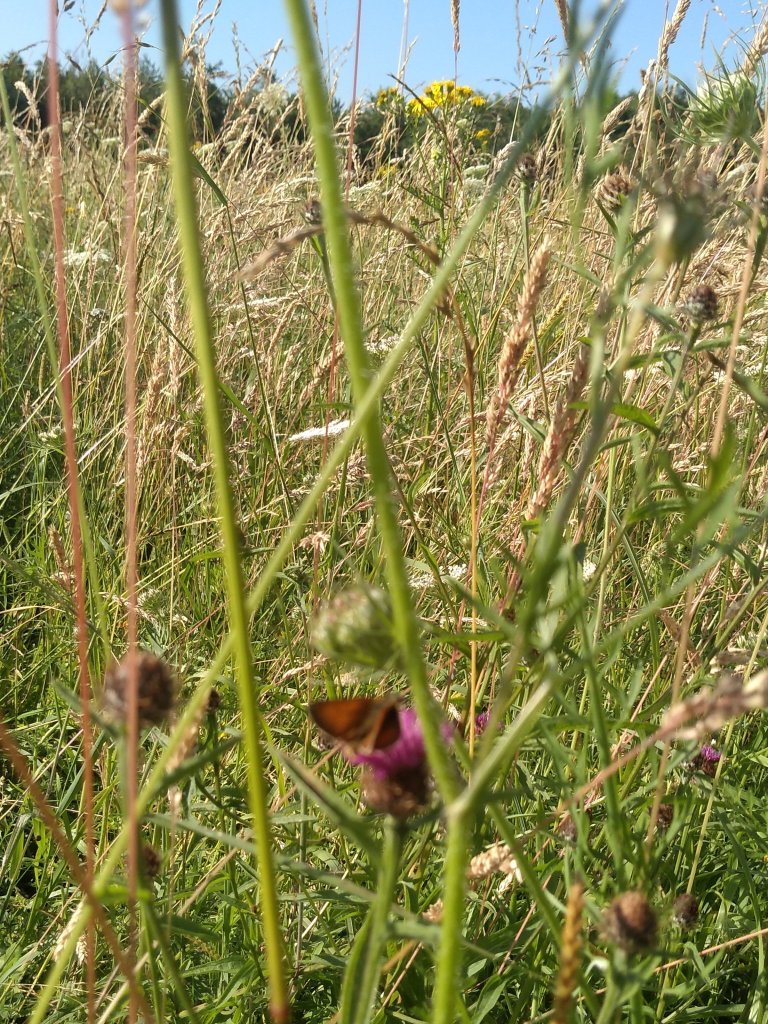
There were many butterflies flitting about on that Sunday morning. Most prominent were Gatekeepers (Pyronia tithonus), Small skippers (Thymelicus sylvestris)
A small skipper visiting some Knapweed (Centaurea).
and Small heath (Coenonympha pamphilus) butterflies; probably due to the grass being allowed to grow fully. All these species of butterfly are associated with grassland and their caterpillars feed on grasses. Marbled white (Melanargia galathea) caterpillars also feed on grasses while the adults feed on many purple coloured flowers, including knapweeds; so it was lovely to see one of these butterflies flying around the meadow too.
Another plant that was growing amongst the long grass was Ragwort (Jacobaea vulgaris). This is a favourite nectar source of the Gatekeeper butterfly, along with other plants including Bramble (Rubus fruticosus), Wild marjoram (Origanum vulgare) and Wood sage (Teucrium scorodonia).
Ragwort is great for many pollinators, including these Small heath butterflies.
I also got to see another insect with a strong connection to Ragwort, a caterpillar of the day flying moth, the Cinnabar (Tyria jacobaeae).
This wasn’t the only caterpillar I noticed. Earlier in the week, I saw a caterpillar of the Knot grass moth (Acronicta rumicis), seen below on a bramble leaf.
This caterpillar will be part of this years second brood, the adults of which appear in August and September. The Caterpillars have a varied diet, eating a wide range of herbaceous plants; this one clearly eating out (and pooping on) bramble. The photo of the adult moth can be seen at Uk Moths.
For a few weeks, I have been wondering if I would notice any Holly blue (Celastrinaargiolus) butterflies this year. However, the week beginning 17th May I was finally rewarded with the sighting of a male (deduced from a lack of dark edges on the wings) making the most of a brief spell of dry sunny weather. As so often with butterflies, it didn’t remain still long enough for me to photograph it.
From one year to the next, Holly blue numbers can vary significantly. This rise and fall in numbers is mostly due to the parasitic Ichneumon wasp, which feeds solely on the larvae of this butterfly. When this wasp has a successful year then Holly blue numbers fall. Consequently the reverse is also true because without adequate Holly blue larvae numbers of the wasp decrease, thus enabling Holly blue butterfly numbers to increase once again. Perhaps this explains why I haven’t seen many Holly blue Butterflies as usual this year; however other factors could be the weather (so far this May has been colder and damper than usual), or maybe I simply haven’t noticed them flying around.
This male butterfly will have been part of the Spring generation (adults which fly from March to May); however there is also a summer generation that I may have more opportunity to witness, later in the year.
As a caterpillar, the spring generation will have been feeding upon Holly (Ilexaquifolium); preferably the buds, berries and terminal leaves of female plants.
The caterpillars of the second generation of butterflies seen flying around between July and September mostly feed in Ivy (Hedera helix); although they will also feed on other plants such as bramble (Rubusfruticosus) Gorse (Ulex spp.), Dogwoods (Cornus spp.) and also Snowberries (Symphoricarpos spp).
Things are moving along at pace at the allotment as well. There are lots of seedlings on the go, fruit is developing and the potatoes are showing growth. The Rhubarb has been harvested for a while now too.
New tenants have taken over plots at the bottom and to the left of our plot. Our new neighbours having made such a headway already means that we no longer have long grass on these two sides. While it is lovely to see the plots being productive at long last, it is a little sad to think we won’t hear grasshoppers during the summer like we did last year.
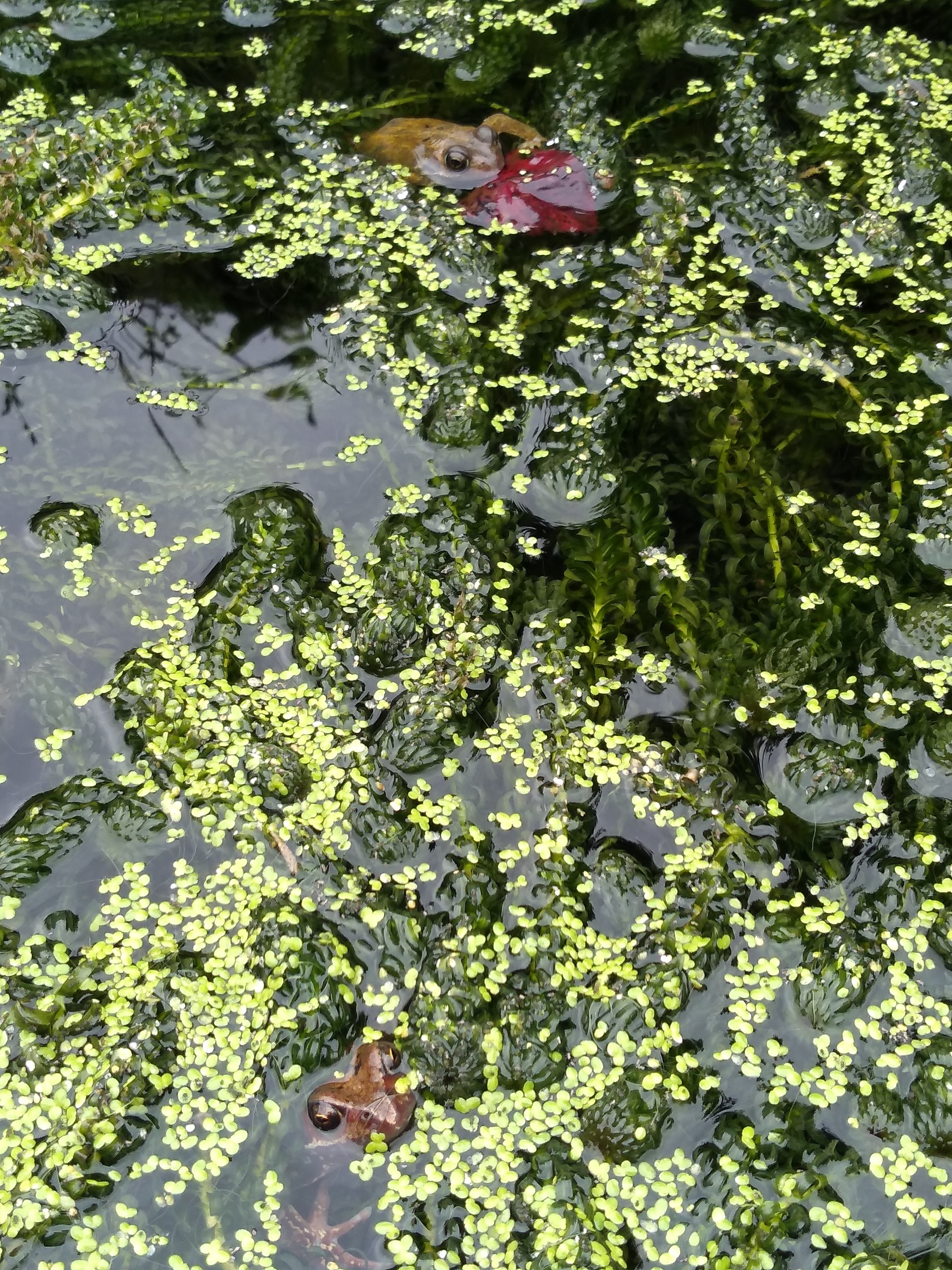
The removal of the lush grass may explain why we found two frogs (Rana temporaria) on our plot last weekend. They seemed to be seeking refuge on the tiny patch of grass I purposely left for wildflowers. Thankfully for them the predominant thing growing there is still grass highlighted with a few dandelions. As I want to reduce the slug and snail population on our plot, I am happy to encourage these frogs by giving them a home amongst the long grass. Instead, I may move the wild flower area nearer to the shed.
While I mostly witness nature in amphibian, insect or plant form, just occasionally I get to see mammals too.
Last week I briefly observed two adult Hares (Lepus europaeus) as I traveled from a job; a garden at a house surrounded by farmland.
They were out in an open field some distance away from the driveway, yet close enough to be able to appreciate their size as well as distinguish the black tips on their long ears along with their distinctive hind legs.
As Hares are usually seen alone, I’m guessing these two were a pair. Perhaps aware of the movement of the electric vehicle, one suddenly crouched down as the other sat bolt upright alongside it. It was lovely to witness these two together in this way. Previously, I’ve only ever seen one Hare far in the distance running across an open field, presumably after being disturbed.
Hares are the UK’s fastest mammal, when disturbed they have a top speed of 45 mph and move in a zig zag formation.
While mostly solitary, these mammals occasionally live apart from one another in loosely connected groups. This explains why, in early spring, when two Hares are seen ‘boxing’ they’re not two males fighting for dominance but actually a female fighting off a male.
Their preferred habitat is a combination of farmland or undisturbed grassland surrounded by woods; enabling easy access to grass and crops for food while giving some protection.
Rather than burrows, Hares live in a form (an exposed depression on the ground). They remain close to their form during the daytime, becoming more active and feeding at night. The two I saw must have been in their form. I wonder if they had a litter? Hares can have three to four litters within a year (between March and July) giving birth to two- four leverets each time. Hares can live for up to four years.
There was one other prominent sighting from last week, that of a Angle shades Moth (Phlogophora meticulosa). I noticed it on Thursday, resting on the milk bottle carrier as I collected my milk delivery.
This is the moths I see more than any other, perhaps because I am surrounded by the perfect habitat for them; a mixture of gardens, parks, woodland and hedgerows containing an abundant food source for their caterpillars. Angle shades caterpillars will feed upon Common Nettle (Urtica dioica), Red Valerian (Centranthus ruber), Broad-leaved Dock (Rumex obtusifolius), Bramble (Rubus fruiticosus) and Hazel (Corylus avellana). As this is a night flying moth, I carefully transferred it to the nearby wall where it could gain shelter from the daylight.
Last week began with Spring bank holiday monday. I went for a socially distant walk around the village with my partner. Thankfully he was very patient as I constantly stopped to take photos with my phone.
There were lots of sights and sounds to observe and it really felt like a summers day (which aren’t far off). Some I have noticed for a while like Orange-tip Butterflies (Anthochariscardamines), Red-tailed bumblebees (Bombuslapidarius), Skylarks (Alaudaarvensis), Red kites (Milvusmilvus) and House sparrows (Passerdomesticus).
Yet amongst the Elderflowers (Sambucus nigra) and Brambles (Rubus fruticosus), which are blooming at this time of year,
These flowers are great for making Elderflower cordial.Looks like there will be lots of Blackberries this year.
were many more plants flowering too. The explosion of colour within our countryside is fantastic for pollinators. One insect I saw on Mondays walk, in a field busily pollinating Buttercups (Ranunculus), was the False oil beetle (Oedemeranobilis). This very small beetle is a vibrant metallic green colour. When it’s wings glistened in the sun, they changed from mid to light green.
Unfortunately this is the best photo I managed to get of this tiny beetle.
Upon my return to work, I noticed other insects flying about. Several small tortoiseshell Butterflies (Aglaisurticae) were too quick for me to photograph, however I did capture Common carder bees (Bombuspascuorum) on Common comfrey (Symphytumofficinale) and
a Cream Spot Ladybird (Calviaquattuordecimguttata)
Once again, another ladybird determined to get my attention by falling on my sunglasses while I wore them.
The Cream Spot ladybird has fourteen spots and survives winter in tree bark and Beech masts. Although it is usually found amongst hedgerows rather than gardens.
Wildflowers that were in full bloom last week were;
-Purple toadflax (Linariapurpurea),
-Field scabious (Knautiaarvensis),
– Common stork’s-bill (Erodiumcicutarium),
This plant is a good food source for Brown argus Butterfly (Aricia agestis) caterpillars, along with Meadow and Dove’s-foot Crane’s-bills (mentioned below). This butterfly is often found in southern chalk and limestone grassland but it can also inhabit places with disturbed soil like verges and coastal areas. In fact this plant was found on disturbed soil edging a field.
-Meadow crane’s-bill (Geraniumpratense),
-Creeping cinquefoil (Potentillareptans),
-Common poppy (Papaverrhoeas),
-Dove’s-foot Crane’s-bill (Geraniummolle),
-Field bindweed (Convolvulusarvensis),
-Common mallow (Malvasylvestris),
-Creeping woodsorrel (Oxaliscorniculata),
-Birds-foot trefoil (Lotuscorniculatus) and
-White clover (Trifoliumrepens).
Found amongst lawns, this is a wonderful food source for the Common blue butterfly (Polyommatusicarus) and some bumblebees
Recent weather conditions have caused dryness within nature that normally exists during summertime. Water is already required and talk of conserving water has already begun to help prevent restrictions later in the year. I shall be interested to see how nature deals with this early warm dry weather, especially with less human disturbance due to lockdown. Will it be another great year for butterflies? I look forward to discovering more as we spring into summer.
On Saturday night I woke up to a beautiful duet. A pair of Tawny owls (Strix aluco) were calling to one another, reinforcing their territory. The male call sounds like ‘hooo, hu, huhuhuhooo’ while the female gives a ‘keewik’ sound (see BTO).
Tawny owls pair for life and remain in their territory (initially established in winter) throughout the year. Deciduous broadleaf woodland is their traditional habitat but sometimes they live in large gardens and parkland. They nest within tree cavities or nest boxes. Occasionally eggs are laid in February but more often between March and April. While the female is slightly larger than the male, these owls are the same size as a wood pigeon. They feed on small mammals, birds, rodents, fish, frogs, insects and worms. Their UK Conservation Status is Amber as their numbers are declining.
Another bird which caught my eye last week was a male House sparrow (PasserDomesticus). I was leaving the allotment when I observed him collecting nest material before flying off. As with the Tawny owl, House sparrows pair for life and their numbers have also been declining for a while; House sparrows are Red in the UK Conservation Status list. I grew up seeing lots of them but since moving down south, I haven’t seen one for years so this was a wonderful sight. I love these little birds, especially hearing their chattering and chirping in their colonies. Hopefully I will see him and more Sparrows soon.
As the week went on I noticed more flowers blooming in the hedgerows. Wild strawberry, also called Alpine strawberry (Fragariavesca), was the first one I saw.
The fruit of this strawberry can be eaten.
Others I saw were; Bugle (Ajuga reptans),
These flowers are visited by White-tailed bumblebees (Bombus lucorum), Common carder bees (Bombuspascuorum), Silver Y moths (Autographa gamma) alongwith Green-veined white butterflies (Pieris napi).
– Herb bennet/Wood avens (Geum urbanum) and
Grizzled skipper butterfly (Pyrgusmalvae) caterpillars feed on this plant.
– Bush vetch (Vicia sepium).
Bees and other pollinators enjoy these flowers.
I got to see a female Orange- tip (Anthocharis cardamines) butterfly, having seen a male one the other week. Males have the orange tips while the tips on the female’s forewings are black (both have the black spots). The female can be identified apart from other white butterflies by the mottled green and white underwings (also exhibited by the males). Caterpillars of this butterfly feed on Garlic mustard (Alliaria petiolata) and Cuckoo flower (Cardamine pratensis).
It was a slow start to last week, not brightening up until later on.
Yet as I waited for the bus to work on Monday I saw some Common yarrow (Achilleamillefolium).
It would have been flowering since June but the council have allowed the verges to grow long enough for it to fully bloom around the bus stop. Once in folklore it was believed to bring good luck and wellbeing if you carried it with you.
Tuesday was a washout so it was nice when I started to see bees and butterflies flying around from Wednesday onwards.
I noticed a different butterfly to those I usually identify.
There were two Gatekeepers (Pyronia tithonus) also called Hedge brown butterflies basking on some Bergamot (Monarda).
Bergamot is also called Bee balm because it is loved by bees.
The Gatekeeper in the previous photo is a male due to the pattern on the upper wings. Wing patterns vary within the genders, dependent on high temperature conditions while the butterfly is in the chrysalis stage of development.
The caterpillars feed on long grasses such as Couch-grass (Elymusrepens) or fescues (Festuca) while the adults like the nectar of Wild marjoram (Origanumvulgare), Common ragwort (Jacobaeavulgaris) or Bramble (Rubusfruticosus).
The name Gatekeeper made me remember Sigourney Weaver’s character Dana (who is possessed by Zuul the gatekeeper for Gozer) in Ghostbusters; therefore I have had the theme tune in my head ever since. Thankfully I like this earworm as it reminds me of an enjoyable childhood film. 🎶
In the same border I also noticed Buff-tailed bumblebees (Bombus terrestris) and Garden bumblebees (Bombus hortorum) on a Catmint (Nepeta × faassenii) plant.
On Thursday I was working near a pond and came across a dragonfly which I have been unable to completely identify.
The leg stripes rule it out as a Ruddy darter (Sympetrumsanguineum); however given the position I took the photo from, I can not see the frons (area on the face above the mouth parts) well enough to be certain if it is a female Vagrant (Sympetrumvulgatum) or a female or immature male Common darter (Sympetrumstriolatum).
Friday was the opposite of Tuesday, both for the weather and successfull nature observing. In fact during the afternoon in the space of twenty minutes I saw a Large white (Pierisbrassicae), Small tortoiseshell (Aglais urticae), Red admiral (Vanessaatalanta), Comma (Polygoniac-album), Meadow brown (Maniola jurtina)
along with three Peacock (Aglais io) butterflies.
I managed to obtain a photo of the Comma on a purple Buddleia as well as (finally) manage to capture the elusive Peacock on a white Buddleia.
I had to photograph something else from that garden too. A Chinese trumpet vine (Campsisgrandiflora) plant was arching over the wall from the neighbours.
The gorgeous colour of the flowers took my breath away, especially set against the white house and sunny blue sky. I couldn’t resist sharing its beauty.
Lastly I have ended a tiring week relaxing at a cafe drinking a mocha. Once again my spirits were lifted as I watched a Wagtail (Motacillaalba) hoping to benefit from dropped crumbs; it was a lovely thing to see.
My week started and ended working next to ponds. The first was a small natural pond with a couple of frogs (Rana temporaria) sitting in it.
The other was a large disused outdoor swimming pool. In its neglected state rainwater collects within the concrete walls and nature is taking over. Given the murkiness of the water I was unable to obtain decent photos of my findings; however I saw another frog, (surrounded by lots and lots of tadpoles) along with a dragonfly nymph and a newt. It should be interesting to discover how many tadpoles survive to adulthood.
For the rest of the week insects were centre stage, especially on Wednesday when flying ants took to the sky. Flying ant season really tests my resolve to work through my dislike of ants (which originated in childhood). Thankfully I now find them more fascinating than loathsome, mostly.
The other insects I saw that day were;
– A (Chrysotoxum cautum) hoverfly on some Pyracantha.
– Honey bees (Apis mellifera) and a Red-tailed bumblebee (Bombus lapidarius) visiting a Geranium ‘Rozanne’ plant.
– Lavender (Lavandula) full of bees and butterflies, including more Honey bees as well as Buff-tailed bumblebees (Bombus terrestris), Meadow browns (Maniola jurtina) and a Ringlet (Aphantopus hyperantus) butterfly.
The Meadow brown butterflies also enjoyed visiting the Echinops bannaticus flowers too.
Even as I returned home I noticed a Willow Beauty (Peribatodes rhomboidaria) moth on the hall window.
The adults feed on Creeping thistle (Cirsium arvense) and Ragwort (Senecio jacobaea) both of these plants are common around this area. The caterpillars feed on various trees, shrubs as well as climbers ranging from Yew (Taxus baccata), Birch (Betula), ivy (Hedera helix), honeysuckle (Lonicera) and the wild Clematis, Traveller’s joy (Clematis vitalba).
The previous day I came across more insects that I was previously unaware of.
The first one was the Common red soldier beetle (Rhagonycha fulva).
It is a beneficial insect as adults eat aphids and are pollinators (feeding on nectar and pollen from open flat flowers such daisies and hogweed) while the larvae feed on slugs and snails along with other ground dwelling invertebrates.
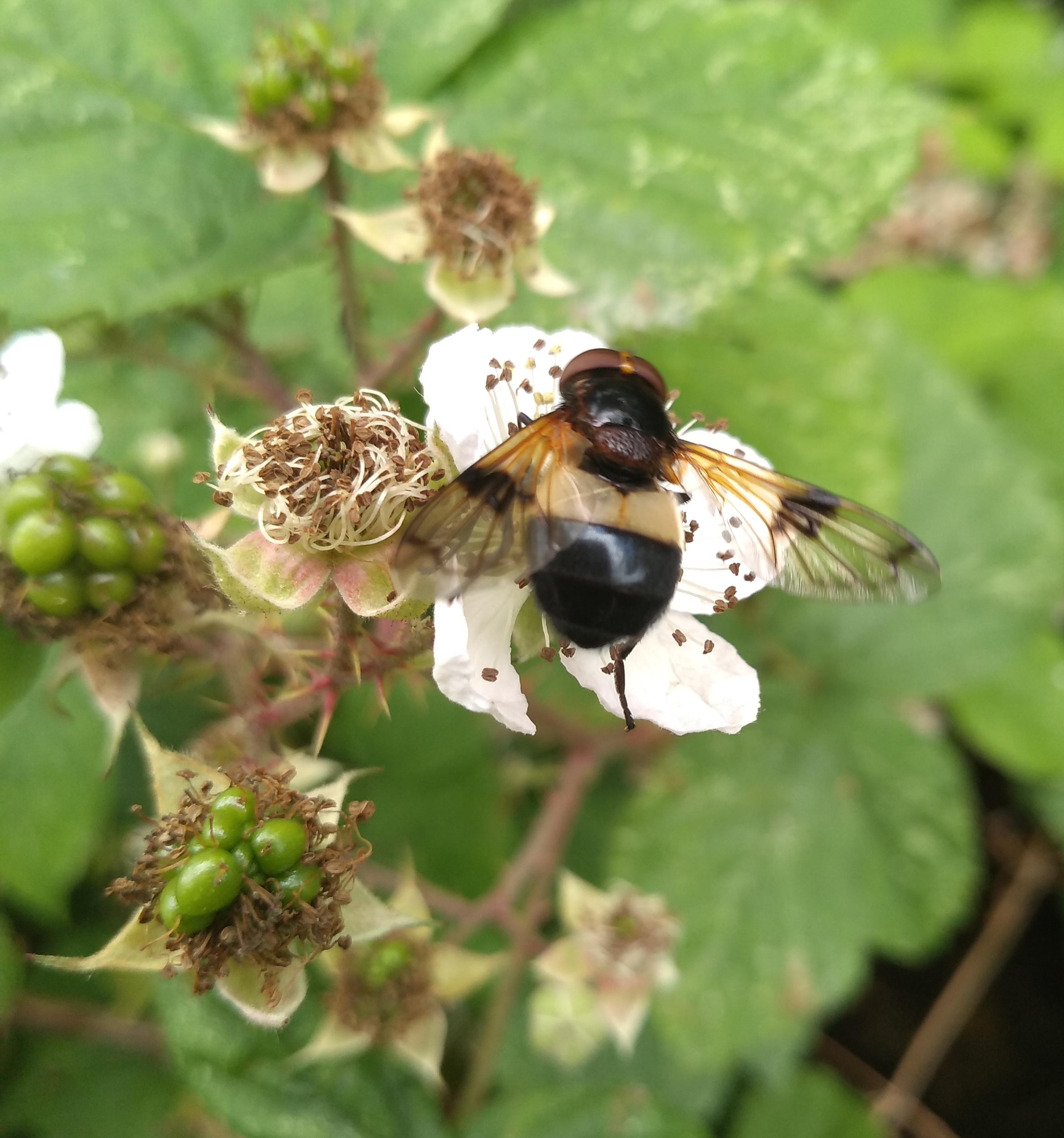
The other insect I saw on Tuesday was a female Volucella pellucens hoverfly feeding on nectar and pollen from Bramble (Rubus fruticosus).
These hoverflies also pollinate umbellifers; However as larvae they inhabit Bumblebee and wasp nests eating any waste produced along with their hosts larvae.






 Bee in the Moment