Posted in nature

Amazing Insects

The first of August is the start of the harvest and autumn is beginning to set in slowly now; a time I enjoy.

The weather has recently changed in the south, we have had rain over the past few weeks, meaning the parched lawns are beginning to green up once again and require cutting. I have never known a year where we haven’t cut the majority of lawns for such an extended period over the summer; usually it isn’t until the end of July into August when this occurs.

The wetter conditions are making it difficult to pick a time to undertake the Big Butterfly Count this year, although I am still seeing various butterflies and day flying moths around at the moment; Including the Jersey tiger moth (Euplagia quadripunctaria).

This beautiful medium sized moth (between 5.2 to 6.5 cm in length) is often seen in the south with the range growing upwards towards London and now Hertfordshire; found in Gardens, hedgerows and coastal areas. The caterpillars can be found between September through to the following May, surviving winter as larvae. The adults often visit Buddleia while the food source for caterpillars are Common Nettle (Urtica dioica), White Dead-nettle (Lamium album), Borage (Borago officinalis), plantains (Plantago Spp.), Ground-ivy (Glechoma hederacea) and Bramble (Rubus fruiticosus) amongst other herbaceous plants.

I have also seen a small copper (Lycaena phlaeas) butterfly recently.

This small (3.2- 3.5 cm) orange coloured butterfly can be found on waste ground as well as heath, moor, grass and woodland environments where the soil is chalky and the ground poor in nutrients. The caterpillars eat Sorrels and Broad-leaved Dock (Rumex obtusifolius).

This has been a wonderful year for ladybirds due to the very hot weather at the beginning of spring causing a huge increase in aphids. Out of the 46 different types in the UK, I mostly see Six-spot and Harlequin ladybirds.  A couple of weeks ago I noticed another as it flew into the van; the 14 Spot ladybird (Propylea quattuordecimpunctata).

Much smaller than the six-spotted ladybird, this yellow and black beetle can be seen throughout the UK from May to September.

I finally saw a flower crab spider (Misumena vatia) while pruning a shrub too. As seen in the photo below, they are often white but the females of the species can change their colour to a yellow tint in order to blend into its surroundings better.

Usually noticed between May and August they are commonly seen in southern England. The different sexes differ in size, the males are half the size of the females which are between 9 to 11mm in length. These spiders will wait and ambush prey rather than spin webs and can eat various insects including moths and bees,

Posted in nature

Song Finally Identified.

For several weeks I have heard lots of male Grasshoppers in the long grass next to my allotment plot. I have been hoping to see one so I can identify them. Finally last Saturday the opportunity arrived. Sitting on some carpet used as a weed suppressor, a Field Grasshopper (Chorthippus brunneus) was seen basking in the sun.

A Common Field Grasshopper (unsuccessfully) attempting to hide behind a stone.

At last I knew which grasshoppers were repeating that soft short chirruping ‘song’. The sound made as the hind legs are rubbed against their wings attracts females. With successful mating approximately 15 eggs are laid and remain in the soil until next year. The nymphs hatch from March onwards and after shedding their skins three or four times become adults in the subsequent summer. This common UK grasshopper feeds on grasses so they won’t go hungry living amongst the overgrown plot.

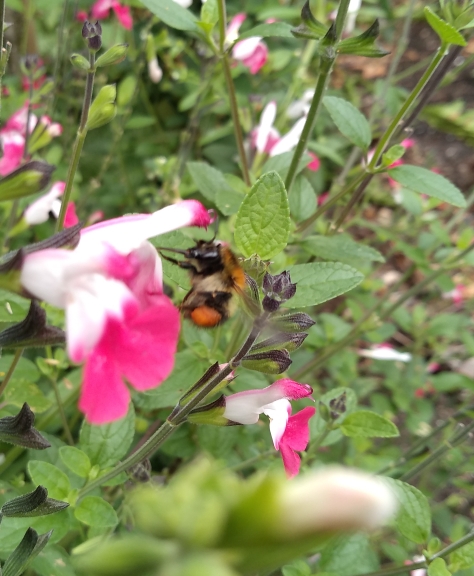
The other amazing thing I saw last week was another bee with spectacular coloured pollen baskets. A Common carder bee (Bombus pascuorum) with orange pollen baskets was visiting a Salvia flower.

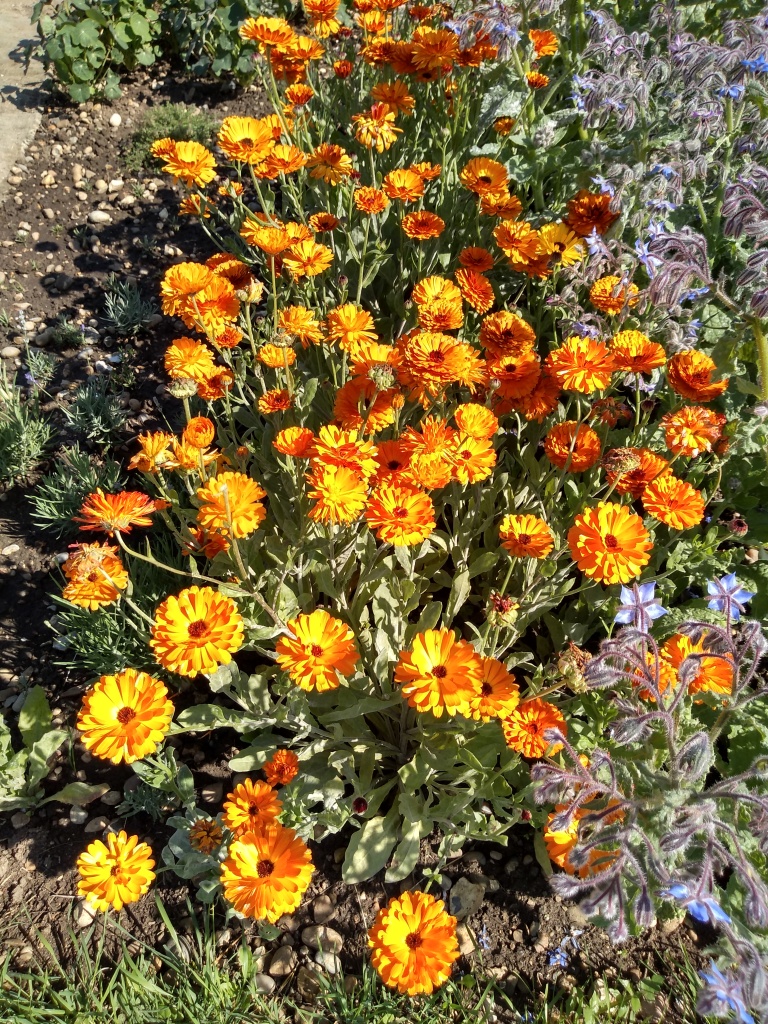
After checking a pollen colour chart, the source of the pollen it had collected was most likely from Calendula officinalis which are in full bloom at the moment (especially on my allotment).

Given the vibrant petals of Calendula I am not surprised that it’s pollen is deep orange. My Calendula is growing next to Borage which has been blooming for a while too. Loved by bees, Borage nectaries refresh every few minutes and the pollen is greyish blue in colour. I look forward to seeing bees with their pollen baskets full of Borage pollen.
Posted in nature

Allotment of Dreams

If I create a wildlife friendly allotment nature will come. My allotment is really filling up and blooming now even though I’ve only had it since February. Most of the plants are from seed, cuttings or rescued from other gardens. For the first year I plan to let the plants develop before harvesting properly.

We’ve had so much rain in recent days that I didn’t need to visit the allotment to water during the week. So last Saturday was the first time in seven days that I visited my plot to undertake major garden tasks. It was the summer solstice and the weather was glorious.

As I walked around to check how things were, I noticed a large number of wildlife; nature had come.

The first things I saw were two Small tortoiseshell Butterflies (Aglais urticae) pollinating the Thyme ‘Lemon curd’ (Thymus ‘Lemon curd’)

whilst Oedemera beetles were taking advantage of the Dandelions (Taraxacum officinale) left on the grassy walkways.

Several Buff-tailed bumblebees (Bombus terrestris) busily flew between the flowers on a neighbouring allotment’s Hebe and flowers on my patch, including the Lacy Phacelia (Phacelia tanacetifolia)

as well as the Borage (Borago officinalis).

A Honey bee (Apis mellifera) also visited the Borage.

There was even a solitary bee buzzing about; an Ashy mining bee (Andrena cineraria) pollinating the Hebe.

Most likely this is the bee that was accidentally unearthed the previous weekend while getting rid of bindweed from around the potatoes (see photo below).

I had contacted the Bumblebee Conservation Trust to see if they could identify this silvery bee, if indeed it was a bee. Stephanie Miles answered my query explaining; ‘This is indeed a bee! It’s a male solitary bee of the genus Andrena. When these bees first hatch from the pupa they’re completely silver-haired, like this – over a day or so they dry out, lay down pigmentation, and the normal colour appears. Once the normal colour appears they can be identified to species level. You disturbed this one before it was quite ready to be seen in public!’ Therefore the Ashy mining bee seen on the Hebe seems a likely candidate.

Seven-spot ladybirds (Coccinella septempunctata) in different stages of development were resting on potato, Calendula (Calendula officinalis) and Borage foliage. There were newly formed adults along with the larvae.

A young Seven-spot ladybird before the recognisable red and black beetle develops fully.

Outside of my allotment wildflowers that are beginning to bloom included;

– Ladies bedstraw (Galium verum),

– Rosebay Willowherb (Chamaenerion angustifolium),

– Spear-leaved Willowherb (Epilobium lanceolatum),

– Creeping thistle (Cirsium arvense),

– Spear thistle (Cirsium vulgare),


– Hedge bindweed (Calystegia sepium)

– and Self-heal (Prunella vulgaris).