Posted in Allotment, nature

March Arrives like a Lion

I’ve slowly started to emerge from hibernation now that Imbolc, the half way point between the Winter solstice and Spring equinox, (meaning ‘In the belly of the mother’- referring to the first stirrings of the years new growth) has passed; mirroring the snowdrops, winter aconites and hazel flowers (the first signs of the transition into the next season).

The scents of Daphne, Mahonia and Sarcococca fill the air alongside the arrival of other spring flowers; daffodils, cyclamen, crocus and hellebores. Willow (Salix) catkins are also opening while Blackthorn (Prunus spinosa) blossoms fill the roadsides with glorious white clouds.

Although it has still been too early for most allotment activities, the rhubarb has been emerging on the plot for the last month. I still haven’t cut back perennials as I want to allow cover for beneficial insects such as sheltering ladybirds (Coccinellidae) until the weather makes their survival easier. Instead February is mainly a month for planning the forthcoming years growing (thinking about chitting potatoes and planning seed sowing). One job I have begun however is the indoor Sweet pea and Chilli seed sowing. This small step gives me hope that I will soon be able to sow other seeds soon.

Although I am beginning to think ahead, I am still fondly holding on to snuggly sofa moments such as reading and partaking in arts and crafts, especially on wet days.

Through the winter I still immersed myself in nature. In January I pruned my apple tree on the allotment, blessing and giving thanks through Wassailing. Although symbolic, it was a nice way to feel deeply connected to the plot. I am grateful to be a guardian over it and receive the abundance of fruit, veg and flowers in return.

I saw quite a few foxes (Vulpes vulpes) over the winter too, including one on the allotment. It was such a beautiful moment to watch it foraging under trees.

Once again, I took part in the RSPB Big Garden Bird Watch in January. The list of birds I saw this time were;
4 Long-tailed tits (Aegithalos caudatus)
5 Starlings (Sturnus vulgaris)
1 Blackbird (Turdus merula)
3 Wood pigeons (Columba palumbus)
5 Sparrows (Passer domesticus)
2 Blue tits (Cyanistes caeruleus)
1 Greenfinch (Chloris chloris)
1 Great tit (Parus major)
6 Magpies (Pica pica)
1 Gull (Larinae) and
1 Red kite (Milvus milvus)

There is a small group of Ring-necked Parakeet (Psittacula krameri) that visit a nearby tree of late but frustratingly they didn’t show up during the observation hour.

During February, bird song continued to fill the skies, growing in frequency and volume. Also occasionally insects have boldly buzzed and fluttered about on the odd sunny days. Butterflies I noticed were a Brimstone (Gonepteryx rhamni) and Peacock (Aglais io); the latter I saved from an abandoned spider web.
I have also seen bees visiting mahonia, crocuses and hellebores, especially queen bumblebees.

Last week, I was excited to find some Jelly ear fungus (Auricularia auricula-judae) for the first time. They were growing on a Buddleia bush. Although this fungus is usually associated with elder (Sambucus) it can also be found on other hard woods like sycamore (Acer pseudoplatanus), ash (Fraxinus) and beech (Fagus) in damp shady conditions. Perhaps the fungus was thriving on the Buddleia, in the garden I visited, because of the recent weather as well as it being planted near a beech hedge.  Interestingly this fungus can continue to grow on dying wood that has been thawed, once frozen; hence it can survive really cold winters. The common name was given to this fungi because of how it looks and also its jelly-like texture.


Worryingly, it has been a very mild winter overall with lots of flooding occurring in Britain; certainly very different from last winter. So far the wet weather is continuing into March; hopefully the month will exit like a lamb and the roaring weather won’t continue too much in spring, as it will have an affect pollinators. We will have to see what the rest of 2024 has in store.

Posted in nature

Reawakening

There have been really cold moments this January, with temperatures barely reaching positive numbers here in the UK and some areas experiencing more snow; however nature has started to emerge once again.

On a walk a few weeks ago, I noticed Blackthorn (Prunus spinosa) buds ready to burst open and the tiny red female Hazel (Corylus avellana) flowers open alongside male catkins.

Blackthorn buds
Hazel flower and catkins

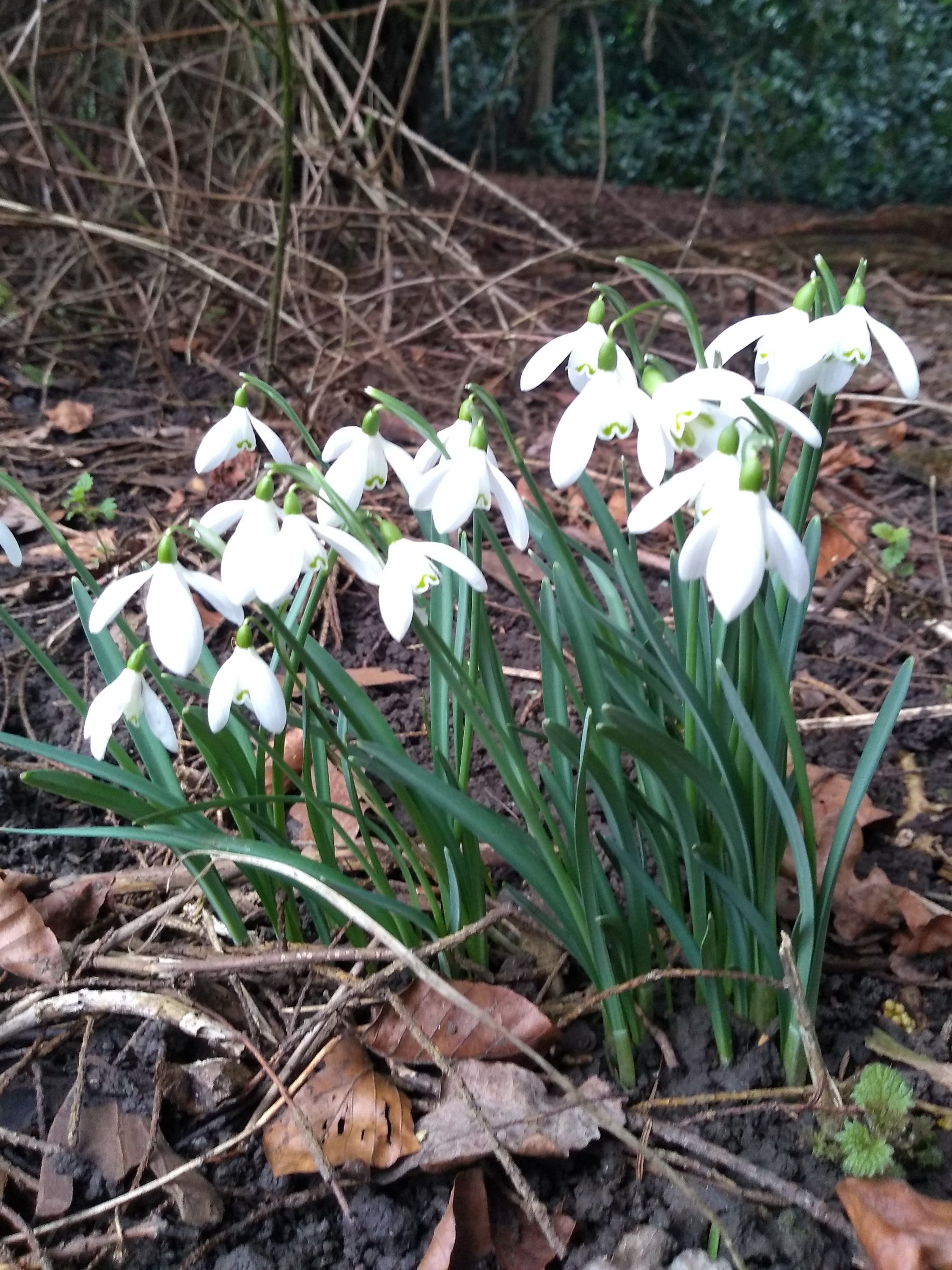
Cyclamen and Snowdrops (Galanthus) are also blooming now and even Daffodils (Narcissus) and Crocus are beginning to push through the now defrosted ground.

Last weekend was the annual RSPB’s Big Garden Birdwatch. My results this year were;
3 Wood pigeon (Columba palumbus)
5 Starlings (Sturnus vulgaris)
2 Blackbirds (Turdus merula)- 1 female and 1 male
2 Great tits (Parus major)
1 Magpie (Pica pica)
1 Robin (Erithacus rubecula)
3 Bluetits (Cyanistes caeruleus)
2 House sparrows (Passer domesticus)- 1 male and 1 female
2 Goldfinch (Carduelis carduelis) along with
2 Carrion crows (Corvus corone)

It’s hard to believe it’s now February. As usual during January I slowed and hunkered down, reflecting nature at this time. Yet the wild flowers are beginning to stir and birds pairing up. It isn’t long before spring arrives and I am already starting to plan what I shall grow on the allotment this year.

Posted in Bookworm review, nature

February Arrives

As another month rolls on, an initial glance may suggest that nothing is changing. Bare trees and quiet gardens with cold weather still nipping at fingertips and noses still persist, while sunny days bring glorious colourful skies.

A stripey sunset.

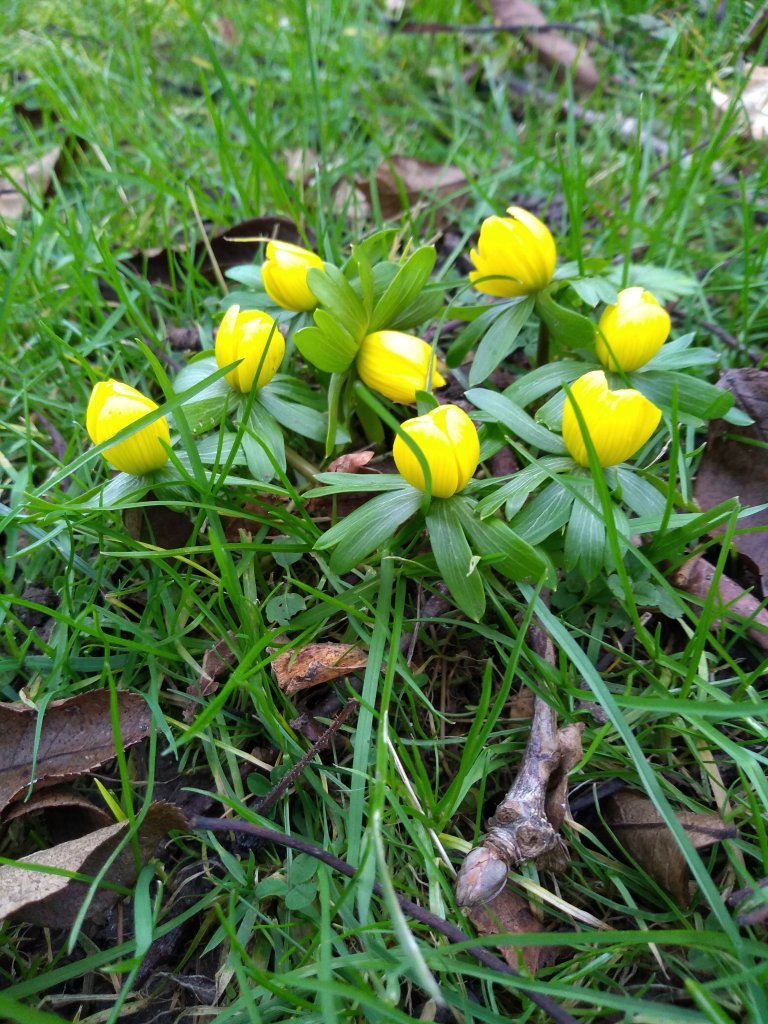
However, upon closer inspection small changes can be seen. The striking yellow of Winter aconites (Eranthis hyemalis) as well as delicate Early crocuses (Crocus tommasinianus) are beginning to bloom alongside the snowdrops (Galanthus).

The tiny red female flowers of Hazels (Corylus) have opened joining the male catkins. Plus, Blackthorn (Prunus spinosa) buds are ready to burst open (in fact on one walk, I saw a single flower already blooming).

I even witnessed a Red admiral (Vanessa atalanta) visit a flowering Mahonia on one sunny day; clearly making use of the milder weather before sheltering once again.

However the main focus of my attention, over the past few weeks, have been birds.

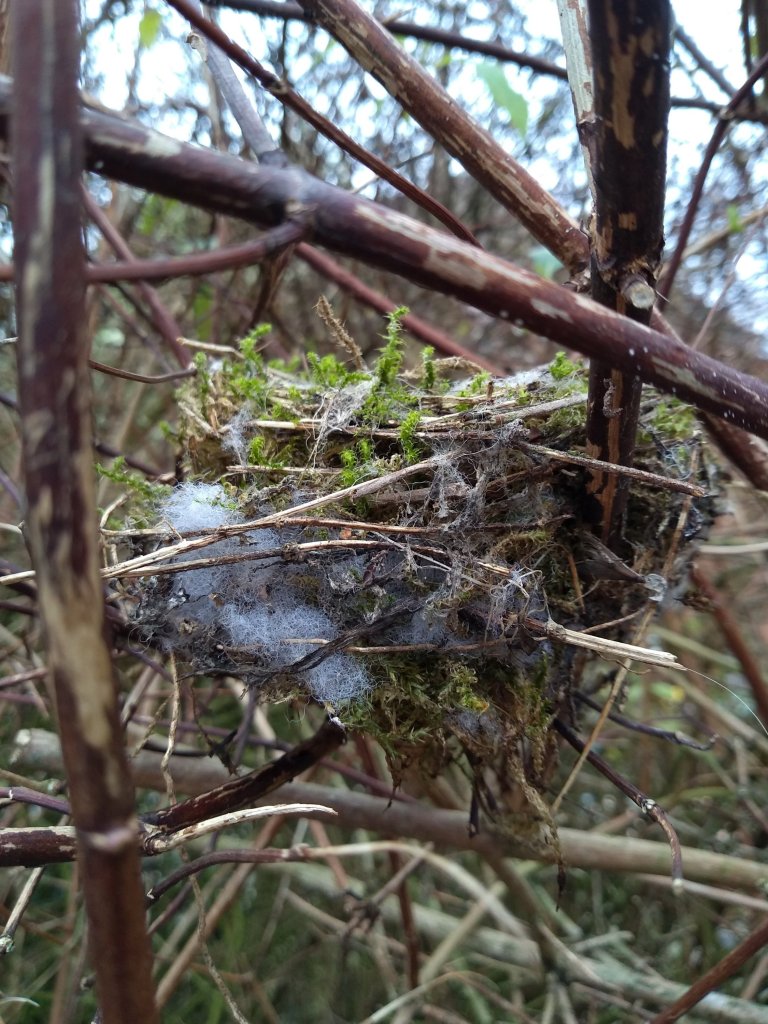
In one garden, I discovered a lovely little nest, from the previous year, in a shrub. Upon investigation I discovered it was either a Goldfinch (Carduelis carduelis) or Greenfinch (Chloris chloris) nest (most likely the former); it can be seen below.

I also saw a Lesser spotted woodpecker (Dendrocopos minor) perched on a tall tree in the distance. I was able to follow the sound of the drumming to watch it move around the trunk before flying off. Given the length of drumming and location of the red on it’s crown I was able to identify it as a male Lesser spotted woodpecker.

Then later in the week, while pruning roses, I watched a Wren (Troglodytes troglodytes) forage around the base of a hedge; I managed to film it briefly before it disappeared fully into the undergrowth.

I am currently reading ‘The Wren: A biography’ by Stephen Moss.

This charity shop find is a fascinating read. Chapters are set out month by month, each concentating on an aspect of a Wrens life. Included alongside facts about the Wren, are their involvement in human history, culture, literature, art and folklore together with beautiful illustrations. The chapter entitled February, for example, focuses on courtship and population. As with other books written by this author, such as ‘The Robin’, this book is definitely worth emmersing yourself in.

Lastly, once again I partook in the Big Garden Birdwatch. My results this year were-
7 Starlings (Sturnus vulgaris),
4 Magpies (Pica pica),
2 Bluetits (Cyanistes caeruleus),
2 Blackbirds (Turdus merula)- a male and female,
2 Wood pigeons (Columba palumbus),
1 Dunnock (Prunella modularis) as well as a Carrion crow (Corvus corone).

Although there weren’t any major surprises in what I saw, it was lovely that the Dunnock made an appearance (usually I only get to hear them). However the Red Kite (Milvus milvus), Ring-necked parakeets (Psittacula krameri), Great tit (Parus major) and Robin (Erithacus rubecula), that I regularly observe, all decided to have a lie in the previous weekend, most only making an appearance once my chosen hour had ended.

Posted in nature

More Wonderful Singing

Last Monday lunchtime I got to hear a wonderful song. A Song thrush (Turdus philomelos) was singing loudly from an Oak (Quercus) tree. It’s repeated phrases made it easy to identify even though I couldn’t locate it visually. Their conservation status in the UK is red (see RSPB) so was nice to hear it. I have also seen one in the past but observations of Song thrushes are rare for me.

I haven’t noticed the young Bluetits (Cyanistes caeruleus) in the Rowan (Sorbus) tree for several days now. However while I ate my breakfast on Wednesday I
briefly saw a young Jay (Garrulus glandarius) instead. It didn’t remain for long, perhaps realising that it hadn’t landed on an Oak tree (a favourite of Jays as they love acorns). It was a great sighting; unfortunately in my sleepy state I wasn’t quick enough to get a photo.

The observations for the rest of the week were of insects. On my way to work I saw a Riband Wave moth (Idaea aversata).

Plants which their caterpillars feed on are Wood Aven (Geum urbanum), Primrose (Primula vulgaris), dandelions (Taraxacum) and dock (Rumex). I also saw another Cinnabar moth (Tyria jacobaeae) on my travels. Common Ragwort (Jacobaea vulgaris) is the main food source for their caterpillars. I often see these wildflowers around this area. I love to learn about plants that are beneficial for wildlife so I can undertake wildlife-friendly weeding. I allow ‘weeds’ to flower, remove seed heads before they set seed and control them via digging to prevent them from taking over a patch. With the exception of a few (which could remain in wild uncultivated areas of a garden) I find wildflowers can complement a border. I read an interesting article about this subject yesterday (see The Guardian).

I recently discovered that the collective noun for a group of Ladybirds is a loveliness. I saw loveliness of Seven spot ladybirds (Coccinella septempunctata) on a geranium on Tuesday afternoon.

They were a bit pale so it is possible they had only recently emerged; their wings not hardened properly or developed from pink to bright red. At one point I counted 10 and eventually noticed a Green shield bug (Palomena prasina) nymph too.

This wasn’t the only encounter with ladybirds last week. On Thursday a Harlequin ladybird (Harmonia axyridis) larvae attached itself to my colleague’s t-shirt.

I have started noticing more moths lately, especially different species. I tried to discover the collective noun for moths. I couldn’t find an official word but one suggestion online was a whisper of moths which I like.

Another moth that I saw was a Large Yellow Underwing (Noctua pronuba).

Unfortunately it had a slightly damaged wing. It must have been disturbed because it isn’t a day flying moth. It soon sought shelter under the Hebe I photographed it resting on.

Posted in nature

Last weeks Highlights

I have been away for a few days, emersed in beautiful countryside. Below are a few special highlights from last week.

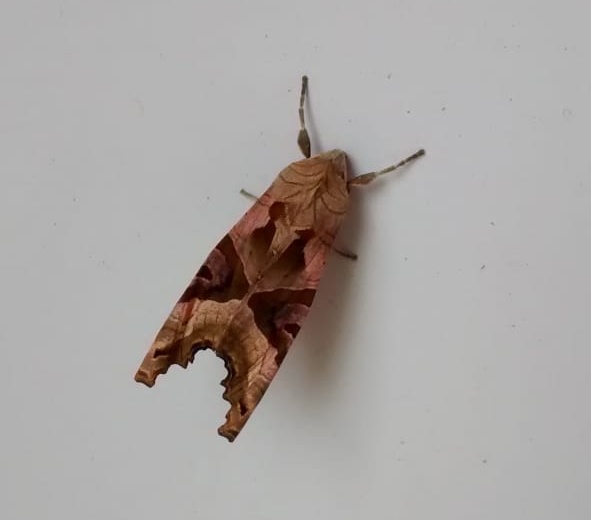
Firstly this Angle Shades Moth (Phlogophora meticulosa) was resting on the door, early Wednesday morning, as I set off on holiday.

Then, on Thursday, I visited Chirk Castle. While looking around the old Laundry building I noticed something swoop from the ceiling and land on a beam.

This juvenile Swallow (Hirundo rustica) wasn’t too far from the nest, which was therefore easy to locate. The hint of a red throat was present but not easy to spot in this photo due to distance and low lighting.

The swallow nest in the rafters.

Lastly I awoke early on Sunday, relaxed with a cup of tea and listened to the dawn chorus. The 5th was International Dawn Chorus Day (celebrated on the first Sunday in May each year). The change of scenery brought with it a change in bird song to listen to. I heard a Collard dove (Steptopelia decaocto), Goldfinch (Carduelis carduelis) and House Sparrows (Passer domesticus) along with the Blackbirds (Turdus merula) and Bluetits (Parus caeruleus) that I usually hear.