
It’s hard to believe that it’s May already, the months are certainly rolling on quickly. I feel like I have only just left winter behind. The weather continues to be mixed with many heavy rain showers combined with thunder passing through. Temperatures have increased though with warmer sunny days reaching 18 degrees celsius, encouraging Tree (Bombus hypnorum) and Buff-tailed bumblebees (Bombus terrestris) to buzz about. I also noticed three Peacock (Aglais io) butterflies dancing around a couple of weeks ago; perhaps two males trying to attract a female? Plus I saw the first Holly blue (Celastrina argiolus) butterfly of the season as well.
Cherry blossom is blooming at the moment and Bluebells (Hyacinthoides non-scripta) are out in force too; it’s the height of their season which is quite a contrast from the beginning of the month when a few were slowly unfurling.
Birds are prominent at the moment as the dawn chorus is reaching its crescendo. Birdsong can be heard clearly throughout the day as I work in gardens. I have seen several House martins (Delichon urbicum) swoop past me. These summer visitors from Africa return to the same nests (made of mud) under ledges such as the eaves of houses or cliffs. I am very privileged to have seen so many lately as they are categorised red under the Birds of Conservation Concern 5: the Red List for Birds (2021) and therefore protected by the Wildlife and Countryside Act 1981. They eat flying insects so living in a rural area no doubt helps. House martins can be distinguished from similar birds using the Wildlife Trusts information here. There is a call to help reverse the decline of House martins; advice on ways to help them can be found on the RSPB website.
Another bird I came across recently which I haven’t observed before is the Rook (Corvus frugilegu). Not as common as some other Corvids their UK conservation status is amber. Similar to Carrion crows (Corvus corone) they are identifiable by their off white beaks. Their diet varies from fruit, nuts and grain to invertebrates and worms. Rooks are sociable birds. Unlike Crows which are seen by themselves or in pairs, Rooks are often seen in groups, just like Jackdaws (Corvus monedula). Infact groups of Rooks and Jackdaws can be seen together; this is how I saw the Rooks, alongside Jackdaws in a busy carpark where humans often dropped scraps of food.
Several Robin (Erithacus rubecula) couples and even one bold male Blackbird (Turdus merula) have come inches away from me to feed and collect food for their young as I work in gardens over the past few weeks. I like to think of their broods back in the nests as I see them fly away with the unearthed bounty towards hedges and trees nearby.
On the 28th March I got to see an amazing spectacle. Two Buzzards (Buteo buteo) were being faught off by a couple of Red kites (Milvus milvus). The thermals aided one Buzzard to appear to briefly hover over some fir trees. I was working in an area with a woodland where Red kites nest. The buzzards (which I often see at the other end of the wood) had ventured over the the Kite territory. Maybe the Red kites were protecting some young or eggs? This I was unable to determin, however the kites were clearly concerned about having the Buzzards near their territory. It was unusual to witness the Red kites attack another bird usually they are the ones being warned away. I frequently see birds attacking kites when they venture too near a nest (even though they don’t predate young but scavange for food). It was lovely to hear the Buzzards calling to one another, an example of which can be heard on the RSPB website along with a picture for identification.
Buzzards are now the most common birds of prey in the UK, and widespread across the land inhabiting woodland, moorland and farmland areas (after a comeback from years of persecution). They are brown in colour and they are 51-57cm in length with a wingspan between 113-128cm. Along with being predators they will also scavenge; their diet consists of birds as well as small mammals and invertebrates. Hardly surprising then that the Red Kites didn’t want them in their territory if they had a brood.
Since then, I have seen other Buzzards in a few areas near roads along with a male Sparrowhawk (Accipiter nisus) by the road side (near to where I had already witnessed a female (see previous post- Daffodils in Snow).
These are not the only large birds that feature prominently in my life at the moment. I have also been keeping an eye on the Peregrine falcon (Falco peregrinus) nest at St Albans abbey. So far Alban and Boudica have three eggs yet to hatch. Incubation usually takes about a month (29-32 days) for each egg, so they are due to hatch beginning of May and fledge by the start of July. This is the pairs second breeding season. Peregrines pair for life and return to the same nest site each year. Alban mostly hunts (birds or rodents) but does incubate the eggs too, enabling boudica to hunt occasionally. The live cam to watch them is here.
Tag: Bluebells
Daffodils in Snow
Daffodils (Narcissus) began to bloom at the beginning of March, in time for St David’s day, together with Hellebores. Since then wildflowers including Red dead nettle (Lamium purpureum), Speedwell (Veronica), Celandine (Ficaria verna), Dandelions (Taraxacum), Primroses, Cowslips (Primula veris), Daisies (Bellis perennis), Dog violets (Viola riviniana) and Winter aconites (Eranthis hyemalis) have joined them. It’s lovely to see all the colour developing, taking over from the Snowdrops (Galanthus nivalis) and early flowering Crocuses that have started to whither. I have even noticed Bluebell (Hyacinthoides non-scripta) leaves showing now too, it wont be long before they flower.
Blackthorn (Prunus spinosa), the first trees of the year to bloom are putting on a show, their blossom resembling white clouds lining the roads. Willow (Salix) aren’t far behind, their buds ready to burst open. Even Magnolias, Camelias and Forsythia (in gardens) are beginning to flower as well. The male catkins on Poplar trees are noticeable now too.

I have also witnessed the first queen Buff-tailed (Bombus terrestris) bumblebees venturing out on the few warmer sunnier days that we have had. Seeking energy sources as the venture out from hibernation. I also noticed a Brimstone (Gonepteryx rhamni) butterfly flutter passed me last week while the previous Friday a Peacock (Aglais io) butterfly flew passed as I worked. It was also lovely to see lots of Smooth newt (Lissotriton vulgaris) in a garden pond last Wednesday. The newts were almost full sized and looked fully developed already.
Although 20th of March was the Spring equinox we experienced a cold northerly blast of weather a few weeks ago. The wintery showers that arrived brought snow. During this transitional time, March weather can be very mixed. Although spring has sprung, winters grasp still holds on; It was strange to see Daffodils poking above snow for a day.
During a few of the snowy days, I witnessed a wonderful sight of a female Sparrowhawk (Accipiter nisus) perched on top of a tree and later in flight as it swooped towards a smaller bird in a more wooded area of town. Presumably the weather had forced it out into the open to search for food. It’s size, together with its dark brown head back, tail and wings together with a pale breast made it clear to identify. Males are a bluey grey colouring with pale breasts and orange highlights. Males are about 25% smaller than the females, the size of a Collared dove (Streptopelia decaocto).
These birds are protected under the Wildlife and Countryside Act 1981 because they are Amber Under the Red List, Birds of Conservation Concern 5: (2021).
Often found in woodlands or open ground nearby, as well as gardens in urban settings, Sparrowhawks are the most commonly seen bird of prey in the UK. They can be seen throughout the year eating smaller birds, rodents and also rabbits when their regular food is scarce. In fact many years ago I witnessed a male Sparrowhawk take down a city pigeon (Columba livia). Although similar in size, and although the feral pigeon was doing its best to escape the Sparrowhawks clutches it didn’t win the fight.
Sparrowhawk breeding will occur between May and the end of July, laying 4-5 eggs.
Although mostly silent, these birds do have a call which can be heard on the RSPB website here.
Flowers Bloom in Spite of the Weather
Much needed rain arrived last Wednesday evening, lasting through the night; followed by another short downpour later in the week. Unfortunately, these weren’t enough to replenish the parched ground which currently resembles crazy paving. It’s hard to believe we experienced a cold damp winter when cracks in the earth are so deep.
Somehow, even with of the lack of rain, wildflowers still bloom regardless. Buttercups (Ranunculus), Cow parsley (Anthriscus sylvestris) and Stitchwort (Stellaria) have joined the early spring bloomers; replacing the faded Lesser Celandine (Ficaria verna). Unlike the pinks of the ornamental Cherry trees (currently blooming), the predominant colours lower to the ground are blue, yellow and white.


Another plant I noticed was Ground ivy (Glechoma hederacea).

Usually found on damp ground, amongst woodlands, hedgerows, wasteland and in lawns, It’s violet flowers appear between March and June. Surprisingly, it was flowering last week, even with the current dry conditions.
The common name, Ground ivy, is rather misleading as it belongs to the same family as dead-nettles (Lamiaceae) and isn’t ivy. This evergreen perennial most likely obtained the name due to its spreading nature, which occurs overground, rooting from stolons. In fact this plant has numerous common names including, Alehoof, Gill-over-the-ground, Creeping Charlie, Run-away Robin and even (during medieval times) Our Lady’s Vine. A more comprehensive list can be viewed on the RHS website, along with how to grow it if you want to introduce it into your garden.
This herb releases a scent when disturbed. As I crushed some leaves, the smell reminded me of a slightly medicinal thyme aroma, actually quite pleasant.
In times past Ground ivy was used to flavour beer, thanks to its bitter taste (before it was replaced with hops) and as a rennet substitute in cheese making.
I am always intreagued at a plants ability to thrive in unusual places or difficult situations; I love spotting plants growing in such circumstances. Last week I was amazed to see a foxglove (Digitalis) growing without soil on an old wall.

Normally I would only see plants such as Buddleja, Ferns or Yellow corydalis (Pseudofumaria lutea) thriving in this way; their shallow root systems able to anchor themselves amongst the bricks.
Last week wasn’t solely dominated by plant observations. After the previous weeks sighting of the Tawny Mining bee (Andrena fulva), see Auburn Beauty Spotted, it was nice to follow up with sightings of some Mining bee nests. Unfortunately I don’t know whether these nests had or were housing Tawny or Ashy Andrena cineraria) mining bees.


The second nest was spotted on Saturday, while going for a lovely walk with friends. On that sunny day we also witnessed three Speckled wood (Pararge aegeria) butterflies flitting about; clearly enjoying the sunshine and great company as much as I was.
Flowers to Lift the Spirit
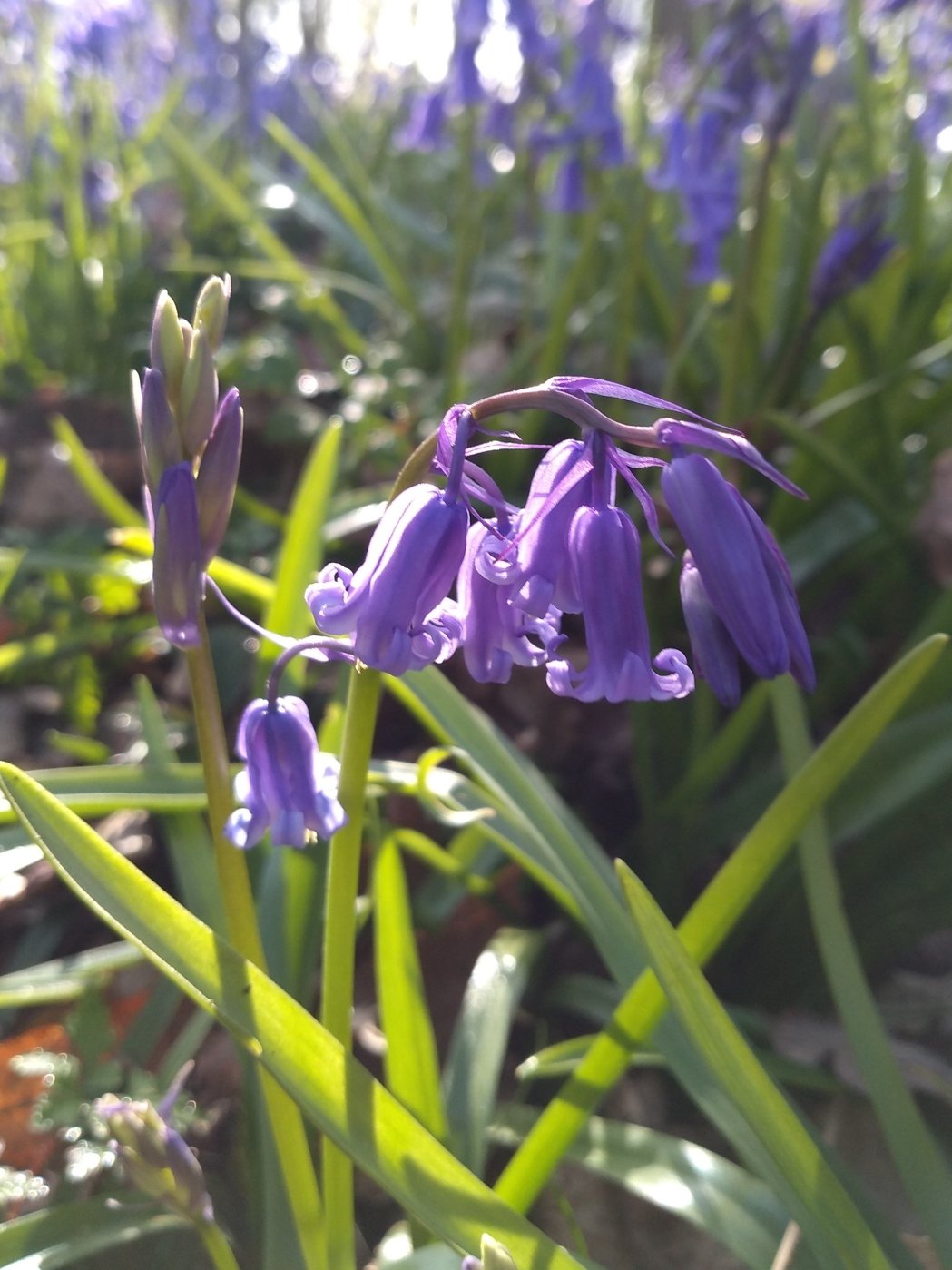
Last week the Bluebells (Hyacinthoides non-scripta) were just beginning to open. I always look forward to seeing these delicate flowers appear; it brings such joy to see their destinctive shade of blue on mass. Although not yet in full bloom, as I knelt down to take photographs I caught their delicate aroma.

Then later the same day, I got my first sighting of a Common carder (Bombus pascuorum) bee of the year, as it took advantage of the apple tree blosom.
I will never tire of hearing birdsong, it’s a wonderful soundtrack to have as I work. Not only is birdsong relaxing to me but it gives me the opportunity to keep learning too. The bird I became most aware of last Tuesday was the Nuthatch (Sitta europaea). Amongst all the birds I could here on that day, this was the clearest (it can be heard here on the RSPB website).
Unfortunately I didn’t get to see it. Having never seen one before I would have loved to see it’s mostly bluish grey and chestnut plumage (with hints white along with a black stripe across the eyes).
Similar in size to a Great tit (Parus major) these birds resemble a small Woodpecker as they climb trees. Nuthatches can be seen clinging to trunks or branches, as they climb up or down headfirst (the only British bird to descend trees in this way). They forage for insects and invertebrates, as well as feast on seeds and nuts (including beechmasts, hazel nuts and acorns) using tree crevices to store food for later. They also bury food and hide it beneath stones.
Nuthatches are found in mixed broadleaf woodlands, parkland or urban gardens which have sufficient tree cover; occasionally eating from bird feeders. They particularly like areas with mature Oak (Quercus) trees. There was an established Oak nearby where I worked, so perhaps that’s where it was singing from.
They remain close to the nesting site where they fledged and are mostly seen in England and Wales; although their range is expanding into Scotland. Nests are holes in trees such as old Woodpecker nests.
Silver Beauties
The Silver birch (Betula pendula) is from the Betulaceae family, just like Hazel (Corylus) and Alder (Alnus), which also have flowers in the form of catkins (see my previous two posts A Snowy Adventure and The Birds and the Trees).
At the moment only the immature male catkins are visible (as they have been since autumn) dangling at the end of tree shoots.

Female Catkins develop after the leaves unfurl in spring. They face upwards, are bright green and smaller than the male ones; flowering between April and May. Unlike the fertilized Alder catkins these do not become woody and remain on the tree for seeds to disperse from there. Instead seed dispersal occurs as the female catkins disintegrate and are carried away by the wind as they fall from the tree.
The paper like white bark of the Birch sheds to uncover newer, cleaner bark underneath; plus dark diamond shaped fissures develop as the tree ages.

Two birch trees are native to the UK, the other is the Downy birch (Betula pubescens). It is possible for these to hybridize with one another however individually they can be differentiated. The Downy birch has hairy, single-toothed leaves and hairy shoots (which is how it gets its name); plus the leaf base is rounder. The leaves of the Silver birch are more angular, double toothed around the edges and hairless (the shoots are also hairless). The Downy birch also prefers damper soil than the Silver birch but both are naturally found in woodlands.
The Silver and Downy Birches have open canopies allowing flowers such as violets (Viola), Primrose (Primula vulgaris), Bluebells (Hyacinthoides non-scripta) and Wood anemone (Anemone nemorosa) to florish beneath them. Several fungi are linked with Birch trees too, such as Fly agaric (Amanita muscaria), Woolly milk cap (Lactarius torminosus), Birch milk cap (Lactarius tabidus), Birch brittlegill (Russula betularum), Birch knight (Tricholoma fulvum) and the Birch polypore (Fomitopsis betulina).
These trees can support over 300 insect species. They are a good food source for the caterpillars of Angle-shades (Phlogophora meticulosa), Buff tip (Phalera bucephala), Pebble hook-tip (Drepana falcataria), and Kentish glory (Endromis versicolora) moths. Several Bird species make use of these trees including woodpeckers (Picidae), which nest in the trunks, along with Siskins (Spinus spinus), Greenfinch (Chloris chloris) and Redpolls (Acanthis) that feed on the seeds.
Uses for Birch trees include the manufacture of furniture, handles and toys as well as the process of tanning leather.
In times gone by it was used to make bobbins, spools and reels for the Lancashire cotton industry as well. To the Celts Birches symbolised purity, renewal and love. Later on brooms were made using birch twigs in order to clean rooms. In Finland they are the national tree.
There are several threats to Birch trees, two fungal pathogens (Marssonina betulae and Anisogramma virgultorum) which can cause Birch dieback and eventual death. Bronze birch borer (Agrilus anxius) can also attack native trees.
More information on both can be found on the Forest research website, see the links Birch dieback and Bronze birch borer.
Even Nature Turned Blue for the NHS.
While flowers dominated my thoughts last week, there were moments when I enjoyed observing bees and butterflies too. I saw my first male Orange-tip butterfly (Anthocharis cardamines) and female Red-tailed bumblebee (Bombus lapidarius) of the season; both visiting Dandelions (Taraxacum officinale). Other butterflies I noticed were more Speckled woods (Pararge aegeria) and Peacocks (Aglais io). All were too busy making the most of the sun to remain still long enough for me to photograph them.
After threatening to rain last Sunday, with distant thunder in the afternoon and evening, wet weather eventually arrived the following weekend. On Friday it rained late in the day through to Saturday afternoon. The ground loved that sustained soaking and together with all the sunshine we’ve had recently the grass is beginning to flourish. Thankfully lots of wild flowers bloom despite the lack of water, including;
– Ivy-leaved toadflax which is also called Kenilworth ivy (Cymbalaria muralis),

– Lords and ladies, otherwise known as Cuckoo-pint (Arum maculatum),

– Ribwort plantain (Plantago lanceolata),

– Dog’s mercury (Mercurialis perennis),

– Ox-eye daisy (Leucanthemum vulgare) and

– Cuckoo flower (Cardamine pratensis).

The main spring spectacle of the English countryside however are English Bluebell (Hyacinthoides non-scripta) woods in full bloom. Photos of these have filled social media over the past week. I am lucky enough to live near to several woods where English bluebells flower, however due to the lockdown this year I have to make do with spotting the ones amongst the headgerow, on my way to the allotment. Thankfully even small scale sightings of these flowers makes my heart soar. Swathes of these beauties are an indicator of ancient woodland (they are slow growers with seeds taking five years to become bulbs, which then flower).
English bluebells continue to be under threat from the Spanish bluebell (Hyacinthoides hispanica) escaping from gardens, brought to these shores by the Victorians, which readily hybridise with English ones to produce the Hybrid bluebell (Hyacinthoides x massartiana). However, this isn’t the only threat to our native Bluebell. Habitat destruction is another reason for their decline. Simply walking on them can prevent them from flourishing for years afterwards as photosynthesis is prevented and the plant is weakened. They are a protected species under the ‘Wildlife and Countryside Act (1981)’. This means that people can be prosecuted for removing the plants and bulbs from their habitat and/ or selling them.
It is possible to tell the English and Spanish Bluebells apart.
English Bluebells are a deep violet shade of blue with creamy-white pollen. The leaves are narrow (1-1.5mm wide) as are the flowers. The tips of each petal (six in total) curl up and inwards. The scented flowers grow on one side of the stem causing it to arch over to the one side (referred to as inflorescence).
Spanish bluebell flowers are pale blue (but can be pink or white), have a wider open bell shape with flared petal tips and bloom all around the stem, which therefore remains upright. The leaves are also wider (by 3cms) than its English counterpart and the flowers have no scent.
Unsurprisingly the hybrids possess characteristics of both parents, however their appearance tends to be more like the English Bluebell meaning distinguishing the two can sometimes be difficult.
Last week I saw both English and Spanish Bluebells on my daily exercise.


Bluebells are interwoven into our culture. In the past the sap was used to glue feathers to arrows and in book binding. Plus the Elizabethans used the bulbs to starch collar and sleeve ruffs.
In folklore they are associated with fairies while in the language of flowers (popular in the Victorian era) they represent humility, constancy, gratitude and everlasting love. What better flower to have bloom during this difficult time when we are showing our appreciation for the NHS and other frontline workers. It seems even nature has turned blue in solidarity.
 Bee in the Moment