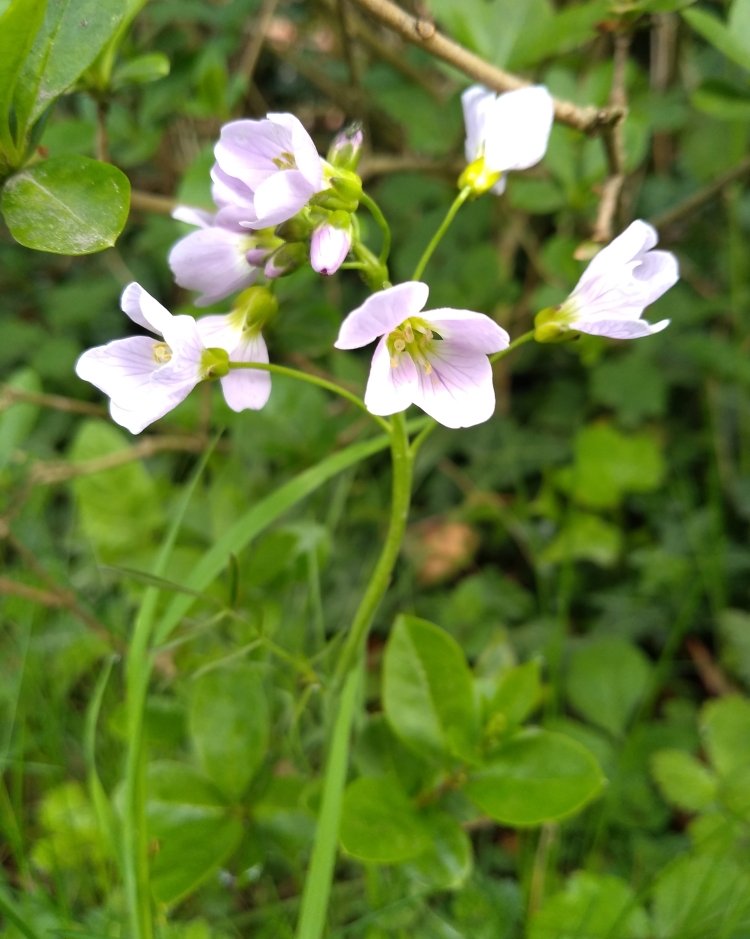
Rain showers continued to fall, reviving the ground at last. Between the downpours I noticed Cuckooflowers (Cardamine pratensis) begin to bloom last week.
So named because it flowers from late April, around the time male Cuckoos (Cuculus canorus) are heard in the UK once the birds return from Africa; signs that spring is well underway.
The last time I heard Cuckoos was in Shropshire many years ago. At the time, I only heard the males call of “cuck-oo’ in the distance. I have never witnessed the females call which can be heard here (Garden birds). I have never seen these birds either; perhaps one day, although their conservation status in the UK remains red (reasons for this is explained by the BTO website).
I love witnessing wildflowers being pollinated; yet more proof that patches of wildflowers are essential for pollinators. Last Sundays walk resulted in such a sighting. As I walked past an area where White dead-nettles (Lamium album) were blooming I became aware of a gentle buzz. A solitary Common Carder Bee (Bombus pascuorum) was visiting the patch of flowers.
These long-tongued bumblebees require deep flowers to collect nectar (a pollen basket can be clearly seen on it’s leg).
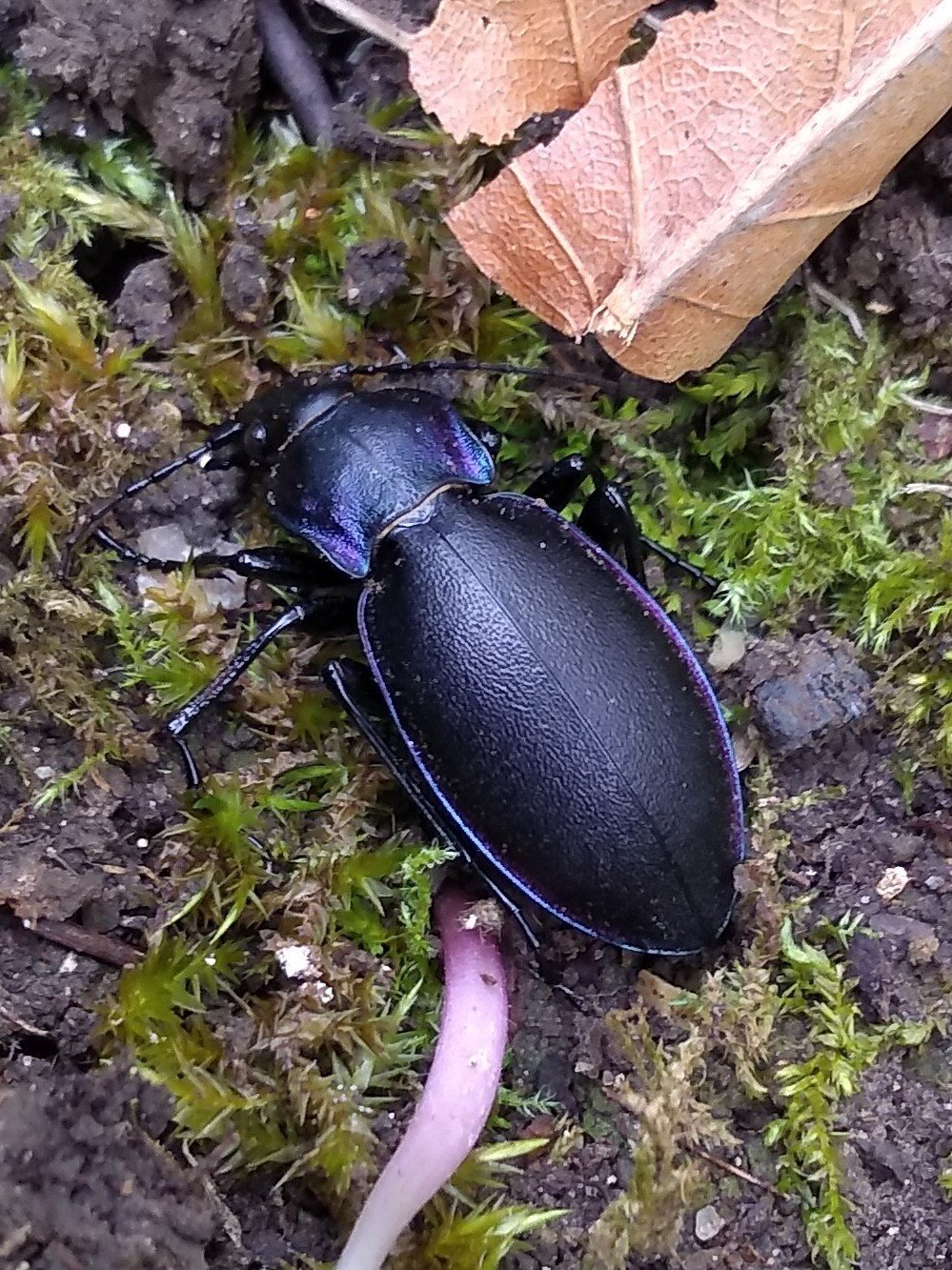
An insect that I became aware of later in the week was a Violet ground beetle. I have never seen one of these beetles before; it was so mesmerising as it glistened in the daylight.
This shiny insect is one of our largest beetles in the UK at 20-30mms. (Photo enlarged to show detail more clearly.)
It could have been one of two species of Violet ground beetle, either Carabus violaceus or Carabus problematicus, as they are difficult to tell apart (it’s all down to the amount of dimples and ridges apparently). As both can be found in gardens, if I had to make an educated guess, I would say it was a Carabus violaceus ground beetle (the more common of the two, especially in gardens). The Carabus violaceus can also inhabit farmland and meadows where as Carabus problematicus is predominantly found in woods and heathland.
Active at night, it doesn’t fly but will rely on running fast to capture pray and find shelter if disturbed. During the day, it predominantly hides under logs or stones; however I noticed this one when I moved a clump of soil. I was very conscious of taking its photo as quickly as possible before I covered it up once again. This adult beetle, along with their larvae, feeds on other insects alongside slugs, snail and worms.
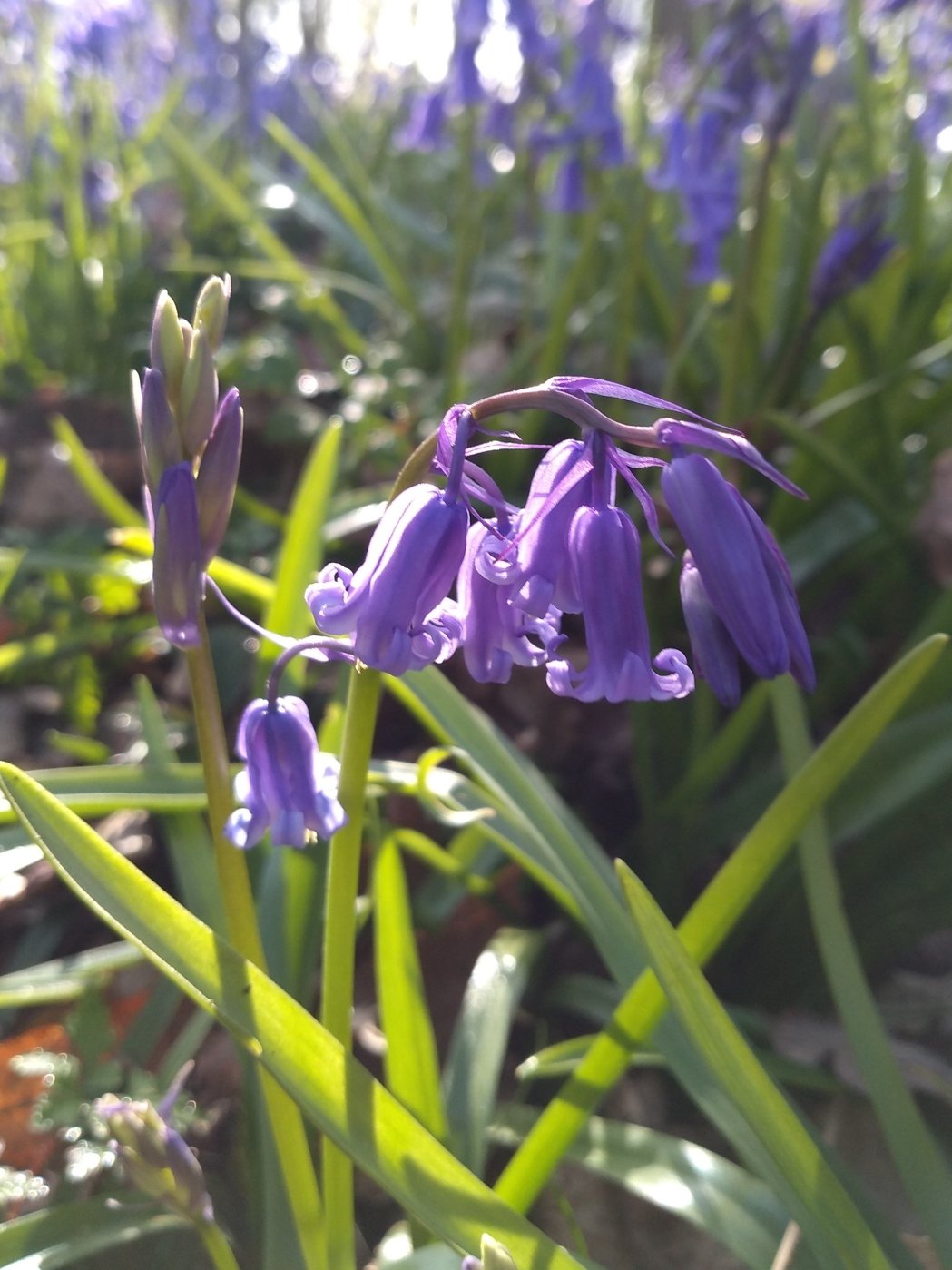
Last week the Bluebells (Hyacinthoides non-scripta) were just beginning to open. I always look forward to seeing these delicate flowers appear; it brings such joy to see their destinctive shade of blue on mass. Although not yet in full bloom, as I knelt down to take photographs I caught their delicate aroma.
Then later the same day, I got my first sighting of a Common carder (Bombus pascuorum) bee of the year, as it took advantage of the apple tree blosom.
I will never tire of hearing birdsong, it’s a wonderful soundtrack to have as I work. Not only is birdsong relaxing to me but it gives me the opportunity to keep learning too. The bird I became most aware of last Tuesday was the Nuthatch (Sitta europaea). Amongst all the birds I could here on that day, this was the clearest (it can be heard here on the RSPB website).
Unfortunately I didn’t get to see it. Having never seen one before I would have loved to see it’s mostly bluish grey and chestnut plumage (with hints white along with a black stripe across the eyes).
Similar in size to a Great tit (Parus major) these birds resemble a small Woodpecker as they climb trees. Nuthatches can be seen clinging to trunks or branches, as they climb up or down headfirst (the only British bird to descend trees in this way). They forage for insects and invertebrates, as well as feast on seeds and nuts (including beechmasts, hazel nuts and acorns) using tree crevices to store food for later. They also bury food and hide it beneath stones.
Nuthatches are found in mixed broadleaf woodlands, parkland or urban gardens which have sufficient tree cover; occasionally eating from bird feeders. They particularly like areas with mature Oak (Quercus) trees. There was an established Oak nearby where I worked, so perhaps that’s where it was singing from.
They remain close to the nesting site where they fledged and are mostly seen in England and Wales; although their range is expanding into Scotland. Nests are holes in trees such as old Woodpecker nests.
Last week had very mixed weather. Easter Sunday was sunny and warm (a hint that summer isn’t far away) replaced by snow showers and frost on Monday and Tuesday; eventually cold days with occasional sunny spells remained.
I took advantage of the glorious weather last Sunday and went for a walk around my local woodland park. More Brimstone (Gonepteryxrhamni) butterflies were flitting about, along with one Comma (Polygonia c-album) and several Peacock (Aglaisio) butterflies too. Blackthorn was still blossoming in earnest, attracting these butterflies as well as bees and hoverflies.
A Peacock butterfly feeding in the sun.
Pollinators weren’t the only wildlife noticeable; lots of Squirrels (Sciurus carolinensis) were running between and up the surrounding trees while birds were singing.
I even noticed a couple of Blackcaps (Sylvi atricapilla). I’m not sure if these birds are resident to the woodland or migrated from Europe or northern Africa. Since the 1960’s records of these Warblers remaining in the UK all year round exhist and since then numbers have increased. Those not living the UK full time visit from April or May and remain until September or October.
It is the first time I have ever seen Blackcaps (presumably a pair given how they were interacting with each other). As they were so high up in the tree, completely unaware I was watching from below, I was unable to actually see their caps (males have black caps while females have a chestnut colouration to the top of their head) however I was able to identify them from their bird song. An example of this can be heard on the RSPB website.
This wasn’t the only amazing experience I had with a bird last week. On the following Tuesday I was privileged to witness a Wren (Troglodytes troglodytes) flying around me as I worked, singing as it did so. At one point it landed on a shrub within a few feet from me; I remained as still as I possibly could, watching this amazing spectacle. Usually remaining near cover Wrens are usually heard but not seen so this was lovely to see; plus I managed to obtain footage.
The first of March, meteorological spring along with St Davids day all took place last Monday. Even the first grass cut of the season took place last week (albeit only a high cut to level off uneven growth).
Blackthorn was fully blossoming and spring flowers still bloomed as the birds, amphibians and insects continued to become more active. There were a few new observations; I noticed a single Two-leaf squill (Scillabifolia) growing in a lawn and, in the same garden, saw a male Ring necked Pheasant (Phasianuscolchicus) strutting his stuff.
Things are moving on at the allotment. Sweetpea and Vegetable seedlings are doing well as are the seeds sown for cut and wild flower areas on the plot. The beds are ready for direct sowing which I hope to undertake within the next few weeks and I wait for Yellow rattle (Rhinanthus minor) and Bird’s-foot trefoil (Lotuscorniculatus) to germinate. I also hope to get the shed painted, install a water conserving system and build a bigger greenhouse sometime in the future.
While I am looking forward to the new growing season to begin in earnest I am also mindful to enjoy this moment; to stop, observe, reflect and plan and allowing nature to dictate the speed when things need to begin.
Aubergine and Chilli seedlingsKale seedlingsTithonia, Scabious and White clover seedlings (Trifolium repens)
The Silver birch (Betula pendula) is from the Betulaceae family, just like Hazel (Corylus) and Alder (Alnus), which also have flowers in the form of catkins (see my previous two posts A Snowy Adventure and The Birds and the Trees).
At the moment only the immature male catkins are visible (as they have been since autumn) dangling at the end of tree shoots.
Silhouette of male catkins on the ends of high branches.
Female Catkins develop after the leaves unfurl in spring. They face upwards, are bright green and smaller than the male ones; flowering between April and May. Unlike the fertilized Alder catkins these do not become woody and remain on the tree for seeds to disperse from there. Instead seed dispersal occurs as the female catkins disintegrate and are carried away by the wind as they fall from the tree.
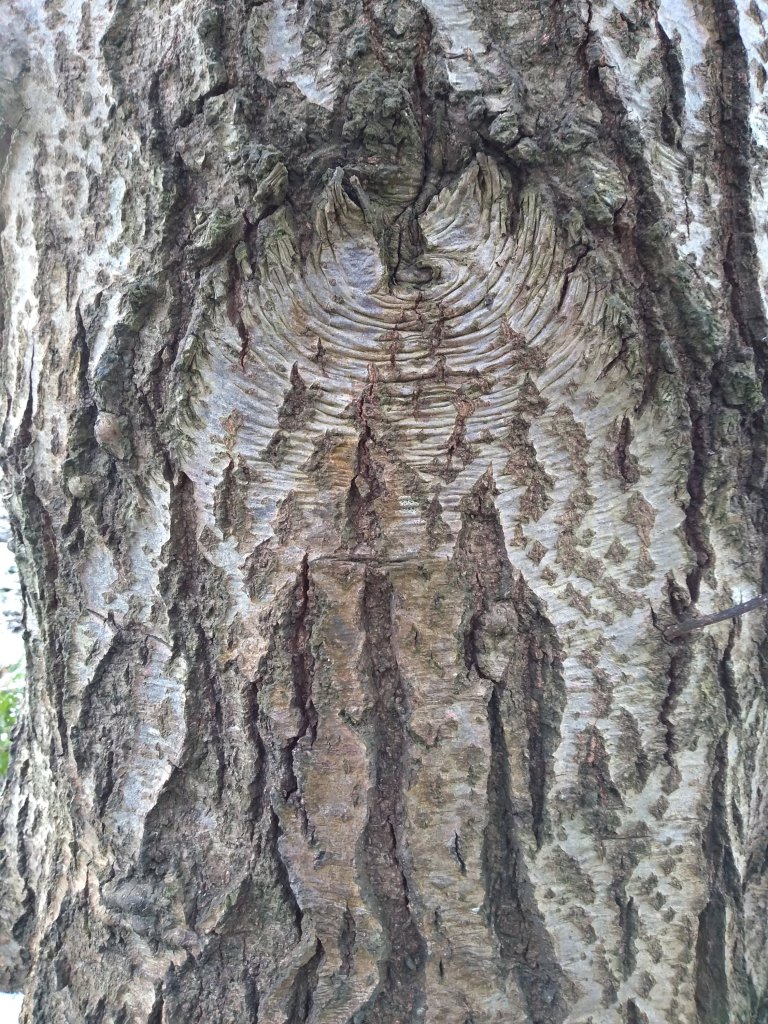
The paper like white bark of the Birch sheds to uncover newer, cleaner bark underneath; plus dark diamond shaped fissures develop as the tree ages.
Fissures developing on the trunk of a Silver birch from my local woodland park.
Two birch trees are native to the UK, the other is the Downy birch (Betula pubescens). It is possible for these to hybridize with one another however individually they can be differentiated. The Downy birch has hairy, single-toothed leaves and hairy shoots (which is how it gets its name); plus the leaf base is rounder. The leaves of the Silver birch are more angular, double toothed around the edges and hairless (the shoots are also hairless). The Downy birch also prefers damper soil than the Silver birch but both are naturally found in woodlands.
The Silver and Downy Birches have open canopies allowing flowers such as violets (Viola), Primrose (Primula vulgaris), Bluebells (Hyacinthoides non-scripta) and Wood anemone (Anemone nemorosa) to florish beneath them. Several fungi are linked with Birch trees too, such as Fly agaric (Amanita muscaria), Woolly milk cap (Lactarius torminosus), Birch milk cap (Lactarius tabidus), Birch brittlegill (Russula betularum), Birch knight (Tricholoma fulvum) and the Birch polypore (Fomitopsis betulina).
These trees can support over 300 insect species. They are a good food source for the caterpillars of Angle-shades (Phlogophora meticulosa), Buff tip (Phalera bucephala), Pebble hook-tip (Drepana falcataria), and Kentish glory (Endromis versicolora) moths. Several Bird species make use of these trees including woodpeckers (Picidae), which nest in the trunks, along with Siskins (Spinus spinus), Greenfinch (Chloris chloris) and Redpolls (Acanthis) that feed on the seeds.
Uses for Birch trees include the manufacture of furniture, handles and toys as well as the process of tanning leather.
In times gone by it was used to make bobbins, spools and reels for the Lancashire cotton industry as well. To the Celts Birches symbolised purity, renewal and love. Later on brooms were made using birch twigs in order to clean rooms. In Finland they are the national tree.
There are several threats to Birch trees, two fungal pathogens (Marssonina betulae and Anisogramma virgultorum) whichcan cause Birch dieback and eventual death. Bronze birch borer (Agrilus anxius) can also attack native trees. More information on both can be found on the Forest research website, see the links Birch dieback and Bronze birch borer.
On the 31st January, I undertook the RSPBs Big Garden bird watch. Most birds, I’d normally see, were clearly hiding but I did notice some within the hour. Those birds I saw were; 1 Carrion crow (Corvuscorone), 2 Robins (Erithacusrubecula), 1 Coal tit (Periparusater), 1 Blackbird (Turdusmerula) and 2 Mistle thrush (Turdus viscivorus). I enjoy taking part in this citizen science project each year; it’s interesting to see how the results differ each time.
Due to the frozen ground last week, I was still able to go for my regular exercise in the local woodland park. Various tree species were waking up from their winter sleep. Beech (Fagus) and Oak (Quercus) had started budding while others were developing catkins.
Last years leaves and new buds on a Beech tree.Old Oak leaves alongside new buds.
As well as the Hazel (Corylus avellana) other trees had catkins hanging from them too. Hazel catkins are the earliest to flower in the year, from January to March (see my previous post A Snowy Adventure).
Then the Alder (Alnus glutinosa) is the next tree to bloom with both male and female catkins. The male catkins are longer than the female ones which flower from February to March. Also hanging from the Alder trees were some small dark brown shapes. These woody cone-like fruit develop from the previous seasons fertilised female catkins; these can remain on the tree (even when the seeds have been shed) well into the following year alongside the newly formed catkins. I also noticed leaf buds growing on the trees last week too. When the buds burst, I shall update the Woodland trust Nature’s calendar with my findings.
Unfortunately I was unable to capture decent photos on location so I collected part of a fallen branch to take home.
One small female catkin above a group of larger male catkins. On the tree (before fertilisation when they develop into the rounder, woody fruit) the female catkins point upwards while the male ones hang down. A magnified view of two unfertilised female catkins.A leaf bud with one of last years fertilised female catkins.A magnified view of the Alder tree seeds that had remained in last seasons female catkin.
I find Alder trees fascinating and the rough, fissured bark beautiful.
Alder are native to Britain and found on wet land, next to water or in marshes and woodlands. They naturally thrive in moist conditions although can also grow in drier areas such as the edges of mixed woodland. Alder wood is durable when wet and actually becomes stronger rather than rot when submerged in water; a characteristic that makes them useful in flood mitigation, boat building, sluice gates, and even the construction of Venice which is mostly built on Alder piles. Alder wood is also used in the creation of charcoal, gunpowder and making clogs.
The pale wood turns a deep orange colour at the point at which it’s cut (while the rest of the wood remains pale); leading to a superstition, in Ireland, that it was bad luck to walk past an Alder tree on your travels. However, traditionally alder branches were also taken into houses to prevent Woodworm. Alder wood is particularly liked by various species of beetle larvae (collectively referred to as Woodworm). It is hoped that the beetles will lay eggs in the Alder rather than the furniture or fixtures; the branches once infested can then be removed.
There is also a traditional use for Alder flowers as a green dye; believed to be used as camouflage by outlaws like Robin hood and fairies.
For fun, I looked up Alder wands used in the Harry potter series. Only one is mentioned, that owned by Quirinus Quirrell. The wands qualities are described on the Wizarding world website.
The roots of Alder are nitrogen fixers. Nitrogen from the air is fixed into the soil, replenishing the levels and aiding soil fertility, through the bacterium Frankia alni.
As well as improving soil, Alder are great for wildlife too. The seeds are eaten by Redpoll (Acanthis flammea), Siskin (Spinus spinus) and Goldfinch (Carduelis carduelis). The leaves are food for the caterpillars of the Alder kitten (Furcula bicuspis), Pebble hook-tip (Drepana falcataria), Autumn green carpet (Chloroclysta miata) and Blue-bordered carpet (Plemyria rubiginata) moths. Bees visit the catkins for an early source of nectar plus Alders provide habitats for the Checkered skipper (Carterocephalus palaemon) butterfly, Small pearl-bordered fritillary (Boloria selene) butterfly, some species of Crane fly, Otters (which create nests amongst the roots) along with mosses, lichens and fungi that like damp conditions.
However, these trees are also threatened through infection by the Phytophthora fungus (together with some other broadleaf tree species). In Alder this disease is referred to as Alder dieback and eventually causes the death of any infected tree. For more information see the Forest research website. There aren’t many Alders in my local woodland park compared to other tree species so it would be sad to see them disappear. Given my newly acquired knowledge I will keep a special lookout for any ill health in these trees; thankfully no infection is being exhibited at the moment.
The previous Sunday brought a little light relief as snow covered most of the UK. My childhood excitement of seeing the snow returned, so the days exercise was a walk through the local woodland park.
As I wondered past trees I began to notice odd glimpses of colour amongst the white and greys. Upon closer inspection I could see catkins already dangling along with female flowers ready to bloom on the Hazel (Corylusavellana) trees.
The male catkins are more showy than the tiny female flowers (which appear at the end of buds and harder to spot). A very enlarged photo showing the red styles of the female flowers.
I also saw female flowers and cones on several Scots pine (Pinus sylvestris).
A closer view of the female flowers at the end of new shoots.
Surprisingly, given it was still snowing at the time, lots of birds were about too. I saw Redwing (Turdus iliacus), Blue tits (Cyanistes caeruleus), a small group of noisy Long tailed tits (Aegithaloscaudatus) as well as a male Chaffinch (Fringilla coelebs) amongst the trees.
Redwings are migratory birds, from Iceland, Scandinavia and even Russia. Named after the red area under the wings, they can be seen in the UK between October and spring.
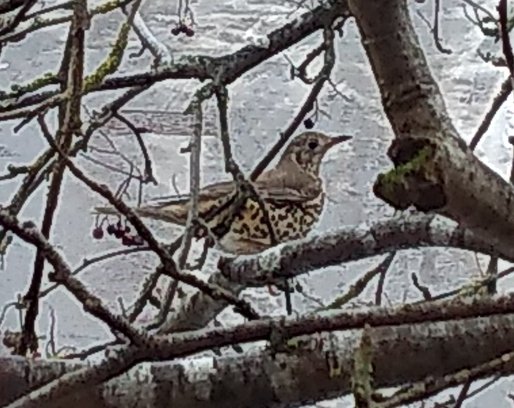
Throughout the week, as the snow slowly disappeared, I saw different birds visiting my Rowan (Sorbus) tree. I had never seen a Mistle thrush (Turdus viscivorus)
or male Chaffinch (Fringilla coelebs) visit the tree before.
Perhaps the reduced availability of food, during the snowy weather, made them search further afield than usual. Thankfully they found the remaining, mostly dried, berries on the Rowan tree outside my window.
Mistle thrush, so named because of their love of eating mistletoe (and guarding trees where it grows) also visit Rowan and Holly (Ilex) trees for their berries as well as eat worms, slugs and insects. They are larger and duller in colour than Song thrush (Turdus philomelos). Their spots are darker and rounder plus they have white tips to their tails. In fact they are larger than Blackbirds (unlike Song thrushes).
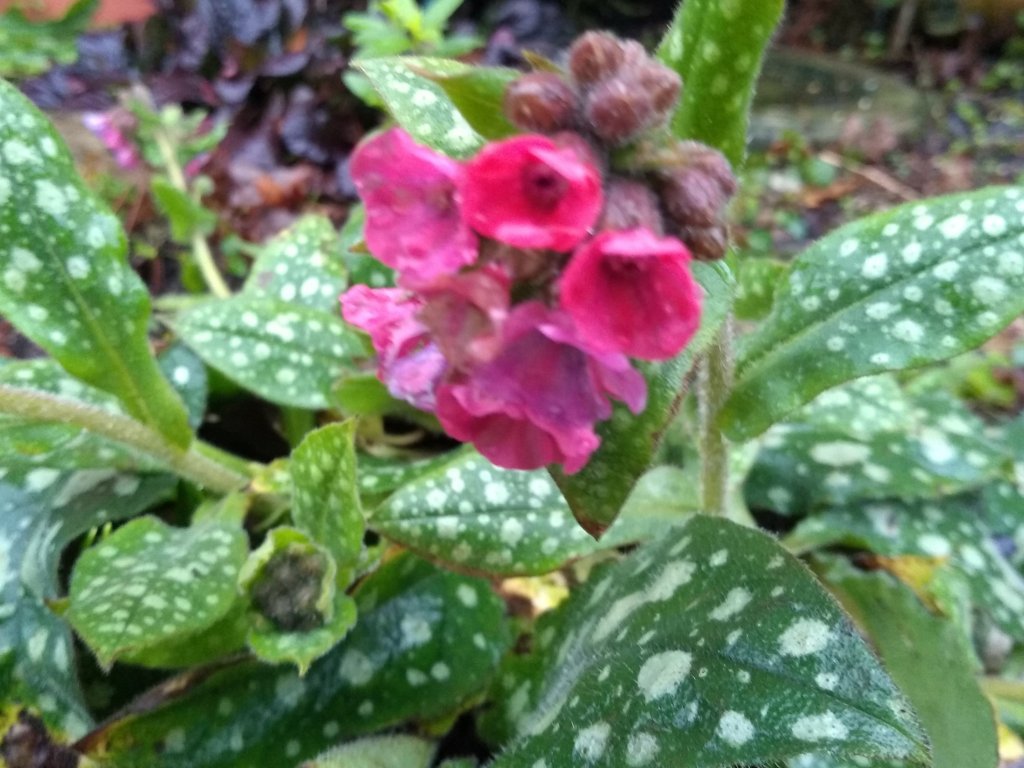
Wonderfully, there were even more flowers blooming in the garden too. I saw
During a particularly difficult week, once again, nature has given me solace. I went on local walks for exercise as well as watch birds from my sofa, while they visited the Rowan tree (Sorbus) next to my flat. Several bird species visited even though it’s mostly stripped of berries now. I noticed bud development on the branches already too.
I have recently spent time catching up on some reading. The first book I read was ‘Witch’s Garden’ by Sandra Lawrence.
This book contains botanical illustrations along with other pictures, including those of specimens from KEW. Folklore as well as natural medicinal properties of fifty well known plants are explored.
One of the plants written about is the Rowan tree. In the past it has been associated with fairies, the Norse God Thor, Goddesses Hebe and Brid as well as St Brigid.
Also known as the Witches tree, traditionally Rowans were believed to offer protection against evil. Other common names for them are Lady of the Mountain, Quicken tree, Wildwood, Whispering tree and probably the most well known Mountain ash. The latter name is due to its ability to thrive in high regions and a similarly in the leaves, however it isn’t actually an Ash (Fraxinus). In fact Rowans are part of the Rosaceae family alongside Apple trees (Malus) Roses (Rosa) and Hawthorn (Crataegus). Just as the haws of the Hawthorn and Rose hips contain vitamin C, Rowan berries are high in this vitamin too. Although all require cooking before they can be eaten they were traditionally used to treat scurvy, sore throats and other ailments, especially during the World War Two.
The second book I read was ‘Back to Nature’ by Chris Packham and Megan McCubbin.
Containing personal stories and factual explanations, this book looks at the importance of nature for humans along with what actions can be undertaken to protect it.
I grew up avidly watching the Really Wild Show and love Springwatch and Autumnwatch. Part of my enjoyment of this book was ‘hearing’ Chris’ voice as I read the parts he’d written. His descriptions contain both urgency and hopefulness. He speaks about various topics from the importance of nature as therapy to wildlife issues that exist at this time.
He also mentions how during lockdown verges sprung into life as wildflowers were allowed to bloom, something that was great for pollinators. Chris talks about the worrying loss by 97% of wildflower meadows since the 1930s, attributing to a decrease in insect numbers. Therefore reversing this by councils allowing verges to grow is great. Yet, having a small wildflower patch in gardens is another achievable action that we can all undertake that will have a big impact on helping wildlife thrive.
Both books are great reads, they are informative and enjoyable; I highly recommend them both.
As a gardener and wildlife lover following the seasons is important to me. I celebrate seasonal festivals throughout the year to acknowledge the importance of nature in my life.
During the winter solstice I take time out to observe the sunrise, reflect on the past twelve months as well as think about the year to come. I also go for a walk to collect greenery for my home and give presents to the local wildlife. This year I planted some Heather and Mahonia for any winter foraging bumblebees and made fat balls for my bird feeder.
I am glad that even in tier 4 I can still go for walks amongst nature and visit my allotment for exercise; for me these are essential for healthy body and mind.
Last week I checked on plant growth on my plot. I currently have seedlings and cuttings safe in a small greenhouse; all remain healthy and continue to grow. I also noticed buds on my fruit trees along with borage still growing in the beds.
On monday I also witnessed a Kestrel (Falco tinnunculus) hover above a road (More information on Kestrels can be found at the RSPB). I don’t get to see these amazingly beautiful birds often enough. It was a magical sight on the longest day of the year which began with me watching the sunrise at Stonehenge (online) while at home and listening to bird song; plenty of positivity on a gloomy day.
Last Sunday five Greenfinch (Chloris chloris) came to visit the Rowan tree outside my flat. Seeing these lovely finches is a rare occurrence for me, I tend to hear their wheezy call rather than see them; although even this isn’t often. The Greenfinch call can be heard on the RSPB website.
Along with Chaffinch (Fringilla coelebs) the greatest decline in bird numbers over the years has been in Greenfinches; due to the parasite Trichomonas gallinae. This parasite was first recorded in the UK in 2005 and believed to be transmitted via bird saliva around food and water sources especially in gardens. Greenfinch are social birds that often rely on garden feeding stations and bird baths. It is incredibly important to keep on top of good hygiene around these areas, if you feed birds, in order to prevent the spread of this parasite. Clean bird feeders, tables and bird baths thoroughly each week and fill little and often is the best strategy to combat it’s spread. For further information see the BBC news report on the Trichomonas gallinae parasite.
On a more positive note from last week, it was lovely to hear the occasional gentle buzzing of a Buff-tailed bumblebee (Bombus terrestris) around Mahonia japonicas which are currently blooming; it is such a relaxing sound.
Unfortunately the bee was camera shy.
This plant is great for bumblebees and will flower well into spring. If like me, you prefer not to have spiky plants in your garden then there is a Mahonia for you. Mahoniaeurybracteata subsp. ganpinensis ‘Soft Caress’ (see the RHS website) is smaller than Mahonia japonica and as the name suggests can be handled without risk of skin being punctured. Along with Heathers (see my post from 18th November this year What Present Would you Buy for Bees?) this plant is on my list of must buys.










 Bee in the Moment