Cold weather from the north arrived over the past few weeks. Initially hard frosts covered the earth along with foggy mornings; then snow arrived overnight on the 11th December. Due to the below average temperatures it lasted for a week but once the warmer southern weather and rain arrived (last Sunday) the snow disappeared as quickly as it arrived; It was beautiful while it lasted.
Also I finally caught Covid (after avoiding it until now). Thankfully, apart from leaving me with a cough I am much better, however for a while my world was reduced to watching birds from my flat. The Rowan (Sorbus aucuparia) outside has been stripped of all berries, no doubt the snow last week was a factor as birds had less places to forage and migratory birds arrived. A group of Redwings (Turdus iliacus) visited the tree along with Starlings (Sturnus vulgaris) and also a Song thrush (Turdus philomelos). Further information on Redwings can be found via the RSPB website.
A Song thrush visiting a snowy Rowan tree while berries still hung from it.
It was also nice to see my resident Blue tits (Cyanistes caeruleus) and a Robin (Erithacus rubecula) appear too.
I can’t believe it’s the Winter Solstice already. I am looking forward to taking a few weeks off; I will take the time to relax, reflect and look to the year ahead.
Within the past month the temperature has reached the highest on record in the UK at 40.2 Celsius. Here in the south, rain still evades us leading to hosepipe bans in some counties. Plus as I write this blog another heatwave begins. While the parched grass will recover once rain eventually falls, and some insects may benefit from these conditions, this drought is not good for nature in general (including humans due to amber and red heat warnings for health issues and fires). We need to use resources more thoughtfully and manage the land better so that nature (to me humans are part of nature not separate from it) isn’t placed under unnecessary pressure due to extreme weather conditions anymore.
Most wildlife isn’t adapted to this current weather and certainly has no chance against wild fires, especially Badgers (Meles meles) and Hedgehogs (Erinaceus europaeus– whose numbers have been in decline for many years for other reasons too). Even birds with second broods will be finding these times difficult; that is why it’s so important to place water sources at both ground level and higher up for birds and Hedgehogs at this time. Plus insects like Butterflies and Bees suffer when flowers start to whither early due to water shortage. Nature can recover from the odd hot dry year but unfortunately this is a trend, year on year, due to climate change so we need to be concerned and act now. Stephen Moss has written a wonderful article regarding this issue recently, it can be read here.
Given the information from the article mentioned above, it will be interesting to see how this prolonged drought will affect the results of the Big Butterfly Count this year (which took place from the 15th July to the 7th August) and consequently next years results too.
I have undertaken a few counts this year. The first time I looked out for Butterflies was on a warm afternoon, in a garden containing a Buddleia along with some Lavender (Lavandula) and Mint (Mentha) that was flowering. During that time, I identified; 5 Red admirals (Vanessa atalanta) 5 Commas (Polygonia c-album) 2 Peacock (Aglais io) 5 Gate keepers (Pyronia tithonus) 1 Meadow brown (Maniola jurtina) 2 Small tortoishell (Aglais urticae) together with 1 Hummingbird Hawkmoth (Macroglossum stellatarum). The Hummingbird Hawkmoth is fascinating. I have observed two individuals visiting Buddleia this year in different gardens that I work at. It is so amazing to watch it collect nectar as it hovers next to flowers.
On separate occasions (at the previously mentioned garden) I also noticed a Large skipper (Ochlodes sylvanus) and a Ringlet (Aphantopus hyperantus) too. That garden also has an allotment attached to it where I got to observe the full lifecycle of a ladybird on one bean plant (thanks to the Blackfly being present). On this occasion it was the Harlequin (Harmonia axyridis) ladybird.
Larvae (on the right, looking for Blackfly to munch on) and on the left a pupae (from which the adult emerges).An adult Harlequin ladybird.
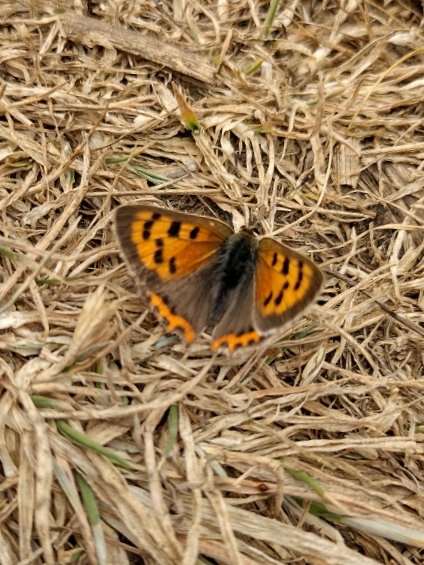
My second Butterfly Count was during a morning as I picked Blackberries (Rubus) at the local woodland park, where I saw 5 Gatekeepers, 1 Speckled wood (Pararge aegeria) and 1 Small copper (Lycaena phlaeas).
Speckled woodSmall copper
The Small copper is one I had never seen before. It is a small butterfly with a wingspan of 32-35mm. The caterpillars feed on Common Sorrel (Rumex acetosa), Sheep’s Sorrel (R. acetosella) and sometimes the Broad-leaved Dock (R. obtusifolius). They can be found in heath, moor and grassland together with woodland clearings or on waste ground.
At my allotment I have seen lots of Cabbage whites, along with the odd Peacock and Small tortoishell as well as a small blue Butterfly (that never settled so I was unable to identify it properly but was most likely a Holly blue- Celastrina argiolus). Thankfully I have also noticed plenty of bees during my butterfly observations, including honey, bumblebees and solitary bees.
Lughnasadh (also known as Lammas) a time when harvests begin to be ready for picking, occurred at the beginning of August. During this time I love to wander through natural environments, spending time observing the changes of the seasons. On my walk the previous weekend I observed Sloes (from Blackthorn- Prunus spinosa) and Elderberries (from Elder- Sambucus) already ripening alongside the Blackberries.
I must confess that I often struggle to enjoy the hottest days of summer. To me extremely hot temperatures are often overwhelming and I would love nothing better than to hibernate underground during the hottest times. I find the days exhausting and uncomfortable (due to the constant itchiness and sore skin). At these moments I rely on my mental strength to keep in mind that ‘this too shall pass’. I also try to remind myself that I love the changing seasons, including summer, and all they bring with them. Gratitude helps as each day I look for the little things that bring me joy such as the shining sun, the amazingly beautiful wildlife around me and the cooler night time temperatures. So until the heat reduces significantly I will keep taking things slowly, keep hydrated, take plenty of rest and be kind to myself. I am under no pressure to get things done at this time which is why this post took so long to complete.
I have been watching a wild flower grow, in the small garden that I look after in front of my flat. Initially unable to identify it (as I didn’t recognise the foliage) I patiently waited throughout autumn and winter to see what emerged. Then in late spring it developed stalks and flowerheads enabling me to see it was a Field scabious- (Knautia arvensis).
This perennial is blooming now. Bees are loving the flowers.
Field scabious is usually found in places such as grassland, meadows, grassy verges and hedgerows. This self set is obviously enjoying similar conditions in my little plot; thriving in an area against a brick wall with dry, partially shady conditions. It is wonderful to see it attract so many beneficial insects so am happy for it to remain where it is.
The allotment is coming on leaps and bounds. The strawberries (which rarely make it home) were a sweet reward as I watered daily through the recent heatwave and continue to ripen. The Blackflies on the Broad beans were eventually joined by seven spot (Coccinella septempunctata) and Harlequin (Harmonia axyridis) ladybirds, together with lots of their larvae; proof that if you leave pests, predators will appear to deal with them; nature really is wonderful.
The recent higher temperatures have encouraged butterflies to fly around. Lately I have seen Small tortoishells (Aglais urticae), Peacocks (Aglais io), Marbled whites (Melanargia galathea) and Speckled woods (Pararge aegeria).
Also on one sunny day last week, while eating lunch outside, I heard a bird song that I didn’t recognise. I recorded it on the Chirp-o-matic app (the name makes me think of Wallace and Gromit) to discover that it was a Yellowhammer (Emberiza citrinella). The rhythm and length of notes makes it sound like they’re saying ‘a little bit of bread and no cheese’. In fact this phrase is used by birders to identify it by the song alone and can be heard on the RSPB website.
Unfortunately I couldn’t see the bird which was a shame as I would have loved to see its yellow plumage. Part of the bunting family, both males and females have yellow colouring mixed with some brown (the males can be distinguished as they are more vibrant). These birds are currently on the red list for UK conservation status and therefore Protected by The Wildlife and Countryside Act 1981. Found on farmland, they eat seeds, insects, worms, caterpillars, spiders and snails and weigh in at about 25-36g weight (a similar size to a sparrow).
To encourage yellowhammer numbers, the RSPB has produced information for farmers so they can take action to help these birds; However the actions can be applied by anyone living near farmland, and can be found here.
It was lovely to have a week off a few weeks ago. On one day I spent time walking around a Bluebell (Hyacinthoides non-scripta) wood with my partner. The sun shone through the deciduous trees giving a beautiful dappled light; perfect conditions for both Bluebells and Wild garlic (Allium ursinum) which bloom at the same time (sometimes together) in deciduous woods during May. However on our walk we only saw bluebells. I have come across Wild garlic before though. It is important not to confuse Wild garlic with Lily-of-the-valley (Convallaria majalis) before these plants bloom, as they have similar foliage and while Wild garlic is edible, Lily-of-the-valley is poisonous.
Blooms of Wild garlic are like all from the Alium family; completely different to the tiny bell shaped flowers of Lily-of-the-valley.
Once in bloom, Wild garlic is clearly identifiable (as shown above), plus it has a clear garlicky aroma when it is disturbed. The leaves can be eaten raw or cooked (blanched and eaten on their own like spinach or used as an ingredient). The flowers (wonderful for pollinators) are also edible and can be used in salads. An example of a recipe found on the Woodland trust website can be found here (together with information on responsible foraging). Wild garlic is one plant used to identify ancient woodland, with damp chalky soil, as it takes a long time to establish itself in great quantity.
Also along the walk, a male Tawny (Strix aluco) owl could be heard in the distance. Plus, on one Oak (Quercus) tree a Great spotted woodpecker (Dendrocopos major) was seen moments before it hid on the far side of the trunk. As we watched closely, we noticed a couple of Tree creepers (Certhia familiaris) too. These birds were climbing as well as flying to and from a hole left from where a branch had snapped away from the trunk. Presumably they had a nest there and were finding spiders and insects to feed their young. I was engrossed as I watched them for some time. Unfortunately the Woodpecker never returned into view but I thanked it for showing us the Tree creepers.
Around the edges of the woodland (near some fields) lots of ferns were unfurling. It was lovely to notice a Click beetle (Athous haemorrhoidalis) resting on a frond.
About 15mm in length, these beetles can be found in May through to August, amongst headgerows and in meadows. Their young larvae eat roots which means this insect can become a pest on root crops in this country. They received their common name due to the noise they make as they flick themselves into the air to upright themselves if they ever land on their backs (unfortunately we didn’t witness this).
As we were leaving, we eventually saw two Fallow deer (Dama dama). Even though deer are difficult to spot due to their cautious nature, I was hoping to see some on our walk (they are common in the area we visited). It was so amazing to have witnessed them eating, completely unaware of our presence. Fallow deer eat trees, grass, flowers, shrubs and brambles.
Another deer I have seen, in woodlands attached to gardens where I work, are Muntjac (Muntiacus reevesi). Both Fallows and Muntjacs were introduced into the UK from Asia and thrive in the UK. Deer can be seen as a nuisance if they enter gardens, however information on wildlife friendly ways to keep them away, the height of fencing required as well as deer resistant plants can be found on the RHS website, along with the British Deer Society .
What a mixed bag of weather we’ve had in the UK recently. It seems strange experiencing the current dry, warm weather given the snow, frost and april showers we had during the previous weeks.
Deciduous trees are turning green, as leaves unfurl and wildflowers continue to bloom. Snake’s-head fritillary (Fritillaria meleagris), Speedwells (Veronica), White Dead-nettle (Lamium album), Red Dead-nettle (Lamium purpureum), Yellow archangel (Lamium galeobdolon), Forget-me-nots (Myosotis) and Cowslips (Primula veris) are all flowering at the moment, with English Blubells (Hyacinthoides non-scripta) beginning to open up too.
Dainty Cowslips found on a verge.
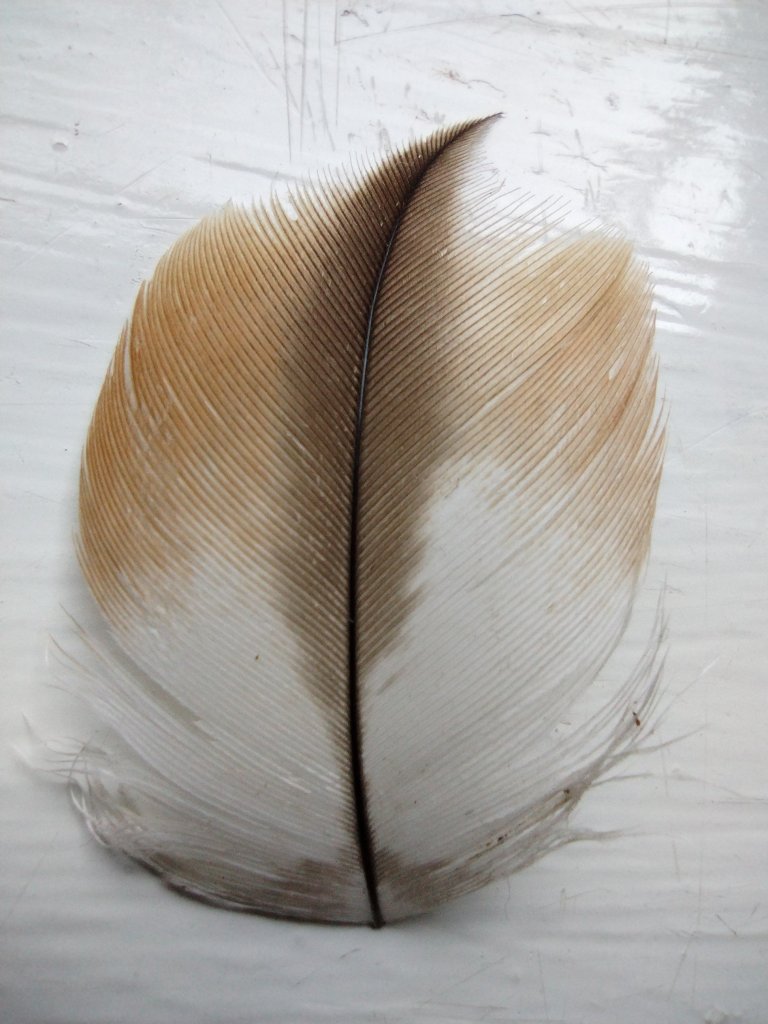
Last week I caught a glimpse of a blue butterfly, my first sighting of the year, most likely a Holly blue (Celastrina argiolus). I also found another Red kite (Milvus milvus) feather as I worked last Tuesday (see below).
Even Tadpoles have begun to emerge, including in the pond we have near our plot on the allotment; hopefully they will help keep the slug and snail numbers down this year.
Slugs and snails have been in the news a lot this month because the Metaldehyde slug pellets ban has finally come into force in the UK. Perhaps we could view these creatures in a different way, after all they do good in nature; we can’t blame them going for an easy meal of soft tender leaves which just happen to be our prized plants. Interestingly only a small number of the 44 species in the UK are responsible for the damage we experience in gardens while the others feed on dead organic matter. I read an interesting article by Dr Andrew Salisbury, from the RHS, in The Guardian on this subject.
On my allotment I find wool pellets, copper barriers and cloches are helpful; along with growing seedlings on in pots before planting them out. Transplanting larger, stronger plants is better as they are able to withstand any damage, I also spend time collecting slugs and snails from hidden damp dark places and moving them to an area far away where they will cause less damage to crops. Encouraging predators (frogs, toads, hedgehogs, birds, slow worms (Anguis fragilis) and ground beetles) is always a great idea too, along with not having areas for them to hide near vulnerable plants.
A biological control that can be used, for slugs only, are Nematodes (Phasmarhabditis hermaphrodita). Watered into the ground these eventually kill the slugs as they infect them with bacteria once they’ve entered the slugs body. I have never gone for this option as I find the other measures suffice.
The other option is to grow plants which slugs and snails do not eat. Ones I’ve noticed they avoid include Ajuga, Aquilegia, Digitalis, Fuchsia, Geum Penstemon and Pulmonaria (further examples can be found on the internet).
I can’t believe March has arrived already. Blackthorn (Prunus spinosa), Sweet violet (Viola odorata) and Daffodils are in full bloom.
It wasn’t so long ago that we had the stormy weather and Snowdrops were at their best; the year seems to be advancing in leaps and bounds now.
The temperature last Thursday reached 16°C which encouraged butterflies to flutter about. I noticed several Brimstones (Gonepteryx rhamni) as well as the Red admiral (Vanessa atalanta) below.
A Red admiral feeding from a Daphne, a delight for the senses, both visual and aroma.
Along with these beautiful sightings, there were a couple of amazing nature experiences that particularly stood out over the past few weeks.
The first was due to the recent storms. While clearing up tree debris a few days later, I found a Red kite (Milvus milvus) feather which had blown to the ground. I have since added it to my version of a nature table (a vintage printing tray) along with my other treasure finds.
I love the shape, colour and pattern of this Red kite feather.
The second took place last Wednesday. While carefully tidying up another garden, to allow for the new spring growth which is already appearing, I noticed a young male Blackbird (Turdus merula) following and closely foraging next to me, just like Robins (Erithacus rubecula) often do in gardens. At one point, it appeared to watch me as I worked (seemingly unphased as I kept my movements to a minimum, so as to not alarm him). Eventually it moved further away but started to make a low repetitive ‘pok pok’ call, at both me and my colleague who was a short distance away (presumably thinking we were predators). This interactive experience was particularly moving; I am used to Robins being close by and making themselves known but never a Blackbird before. The call I heard the blackbird make can be heard on the Sussex Wildlife Trust website.
February has a duality to it; on one hand plants have begun to bloom (bringing the excitement of Spring around the corner) while on the other, the weather reminds us that it’s still Winter and we must be patient for a little longer. Last week three storms arrived, including Eunice with high strength winds leading to rare red weather warnings for wind and floods in the Bristol channel area and South East (with the after effects still being experienced in other areas of the UK). Bad weather usually arrives in February, in fact last year we had snow.
However, while nature continues at its own pace, Spring activities still occur earlier as decades pass. I read an article by Miranda Bryant in the Guardian recently regarding indicators of Spring, flowering and bird activities, occuring earlier since 1987. Pre 1987 plants flowered a month later than they did between that year and 2019 (In fact this was particularly evident in 2019 and yet again in 2020). The Woodland Trust’s Natures calender also shows this trend. The article can be accessed in the following link- The Guardian .
It is too early to notice any indication of patterns in this blog yet, although one thing I have witnessed this year, not seen before are daisies appearing in lawns already.
Other cultivated plants that have begun to bloom in gardens, as usual at this time of year are:
It’s lovely to write for my blog after so long. I have enjoyed a quiet period for a month or so; slowly taking time for self care, reflection and planning the allotment during a time when I suffer with Seasonal affective disorder (SAD).
I love this time of year. I love reading while snuggling under a blanket. I love the sights, sounds and general feeling of winter (especially in the new year after the distracting lights of Christmas) however my brain doesn’t. Each year from the beginning of October to the end of February I indergo a form of wintering. While wildlife winters through hibernation, migration or seeing the winter out with reduced activity. As hibernation is not possible, for me it is the latter; embracing the darker, quiter months as I spend most of my time at home. I have come to realise this wintering is essential in order for me to maintain a healthy mind.
I am still affected by the reduced amount of light but now I am able to see the other side of the winter solstice. For information on and how to find help for SAD, please follow the following links;
At this time nature becomes more important then ever to me. I look for small moments of comfort each day. Some of the wonderful nature I have witnessed during December and so far in January have been;
– The growth and blooming of early flowering plants. A reminder that gardens never completely sleep. Occasionally I’ve noticed a foraging Buff-tailed bumblebee queen visit them too.
The emergence of Snowdrops (Galanthus).Other bulbs beginning to show themselves like these daffodils (Narcissus).Helleborus beginning to bloom.
– The intoxicating scent of the Sarcococca which is located by the entrance to my flat. – Birds being more visible and starting to get more vocal. I especially enjoy hearing and seeing Carrion crows (Corvuscorone), one of my favourite birds, at this time. – Foxes (Vulpes vulpes) being visible as they search for food during the day and hearing a female fox at night (January and February are their mating season). – The beauty of frosts, together with the knowledge it will be a cold but very sunny day. – Glorious sunrises and sunsets.
The sun captured moments before it disappeared below the horizon.
– Night sky delights.
The Wolf moon, the first full moon of 2022.
– Trees silhouetted against the sky. This also allows you to notice nests too.
The large object in the tree is a Drey.
Squirrels and their homes are also easier to spot now (as shown in the last photo). A squirrel’s Drey, for both Greys (Sciurus carolinensis) and Reds (Sciurus vulgaris) are approximately the size of footballs. They are located near trunks where branches fork outwards and located about six meters above ground. They can be differentiated from bird nests which are often smaller, tidier and found further along branches and higher up the tree. Dreys are made with soft materials like moss, feathers, grass, leaves (not usually seen in bird nests) bark or pine needles. However, if squirrels find natural holes in trees, such as those made by woodpeckers, then they will make use of these too. Squirrels will have separate summer and winter dreys, the latter are more weather resistant while the summer ones are more airy.
The temperature has fluctuated during the previous two weeks, with a few light frosts and hotter than average November days. Leaf fall is well under way now too keeping us busy at work. I never cease to be in awe of the beautiful leaf colours as the sun shines; They make fireworks look monochrome in comparison.
Fungi observations were still numerous. Here are some that I have seen over the past few weeks;
The Prince (Agaricus augustus)Golden waxcap (Hygrocybe chlorophana)Russula queletiiFalse saffron milkcap/ Orange milkcap (Lactarius deterrimus)
Amazingly I have still seen the occasional Buff-tailed bumblebee (Bombus terrestris) queen; plus the previous Friday I also noticed a Common carder bee (Bombus pascuorum) near a compost bin in one garden.
Common carder bee
The Rowan (Sorbus) berries on the tree outside my flat are almost gone, mostly due to a local flock of starlings (Sturnus vulgaris); however other visitors enjoying the bounty have been two Song thrushes (Turdus philomelos) and two blackbird (Turdus merula) couples.
I enjoy watching Starlings, seeing their shiny purple and green plumage and listening to their social interactions and mimicry. Starlings have a wide repertoire of calls because they imitate sounds, especially other bird calls (usually 15-20 distinctive sounds); even their murmurations are beautiful to watch.
Other birds visiting the tree, not interested in the berries, were a male and female Chaffinch (Fringilla coelebs), my family of Blue tits (Cyanistes caeruleus) along with a newcomer, a rather vocal Coal tit (Periparus ater). It was lovely to be able to hear a new call coming from the Rowan, it can be heard here (RSPB).
It is Halloween, British Summer Time ended last night and initially today was a stereotypically autumnal day; windy and very wet. However now it’s less blustery and the sun is shining. Throughout the day, I’ve kept hearing Carrion crows (Corvus corone) call too; I love their haunting sound. Autumn has definitely taken hold over the past few weeks and there have been lots of treats to see.
Fungi continued to appear, showing biodiversity in untreated lawns. I managed to spot one of my favourites again this year, the Shaggy mane (Coprinus comatus) in various stages of development.
Also called Shaggy inkcaps or Lawyers mane.Here the gills have turned black and have begun to ‘drip’ onto the lawn, resembling ink.
I also saw Yellow club fungus (Clavulinopsis helvola).
The photo was taken after the grass had been mown so the very tip of the fungi had been cut off.
As with other fungi, Yellow club fungus has no negative affect on lawns. It likes acidic mossy lawns appearing between September and November.
There was one more fungi that I noticed (see below), possibly a Honey waxcap (Hygrocybe reidii) although I am not entirely sure my identification of this one is correct.
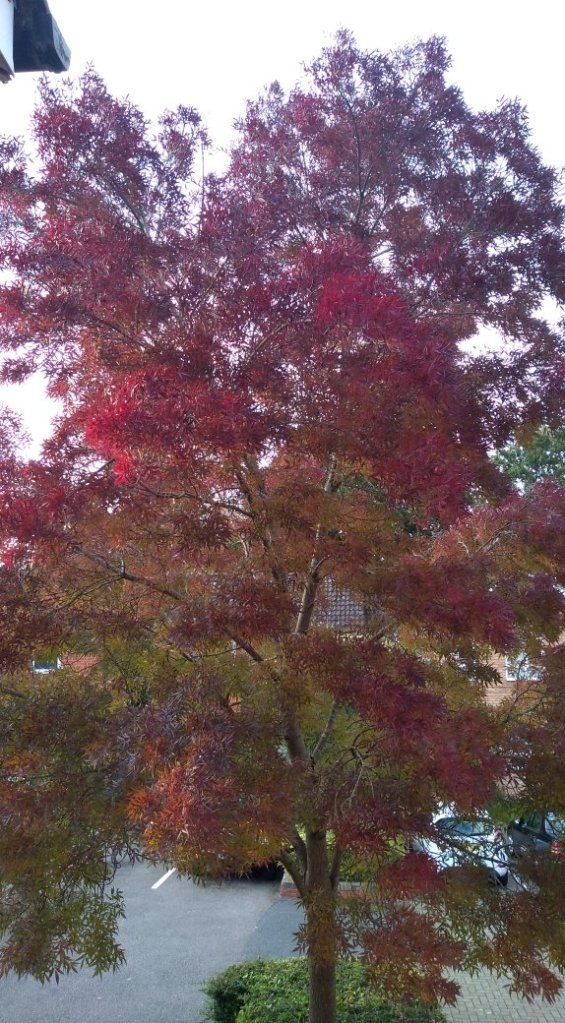
The tree that has already shown it’s autumn colours is the Claret ash or ash ‘Raywood’ (Fraxinus angustifolia ‘Raywood‘). There are a couple in the car park, one of which is now completely bare.
The deep claret coloured leaves glow bright red in the sunlight.The bark of the Claret ash.
I have noticed the occasional pollinator still flying around during the last fortnight. One observation was some Common wasps (Vespula vulgaris) visiting Common ivy (Hedera helix) flowers. Evidence that Ivy is a wonderful source of pollen and nectar late in the year along with that fact that wasps have a purpose.
Along with pollination, there are many wasps that are useful predators of spiders and insects which are fed to their young. Unfortunately the adult wasps need for sugar means they are often disliked by humans, but can we really blame them for having a sweet tooth just like us or trying to get to something that is easily accessible? A fascinating article about wasps and their usefulness in the world, published by the Natural History Museum, can be viewed here.








 Bee in the Moment