Posted in nature

Flowers Bloom in Spite of the Weather

Much needed rain arrived last Wednesday evening, lasting through the night; followed by another short downpour later in the week. Unfortunately, these weren’t enough to replenish the parched ground which currently resembles crazy paving. It’s hard to believe we experienced a cold damp winter when cracks in the earth are so deep.

Somehow, even with of the lack of rain, wildflowers still bloom regardless. Buttercups (Ranunculus), Cow parsley (Anthriscus sylvestris) and Stitchwort (Stellaria) have joined the early spring bloomers; replacing the faded Lesser Celandine (Ficaria verna). Unlike the pinks of the ornamental Cherry trees (currently blooming), the predominant colours lower to the ground are blue, yellow and white.

Another plant I noticed was Ground ivy (Glechoma hederacea).

Usually found on damp ground, amongst woodlands, hedgerows, wasteland and in lawns, It’s violet flowers appear between March and June. Surprisingly, it was flowering last week, even with the current dry conditions.

The common name, Ground ivy, is rather misleading as it belongs to the same family as dead-nettles (Lamiaceae) and isn’t ivy. This evergreen perennial most likely obtained the name due to its spreading nature, which occurs overground, rooting from stolons. In fact this plant has numerous common names including, Alehoof, Gill-over-the-ground, Creeping Charlie, Run-away Robin and even (during medieval times) Our Lady’s Vine. A more comprehensive list can be viewed on the RHS website, along with how to grow it if you want to introduce it into your garden.

This herb releases a scent when disturbed. As I crushed some leaves, the smell reminded me of a slightly medicinal thyme aroma, actually quite pleasant.

In times past Ground ivy was used to flavour beer, thanks to its bitter taste (before it was replaced with hops) and as a rennet substitute in cheese making.

I am always intreagued at a plants ability to thrive in unusual places or difficult situations; I love spotting plants growing in such circumstances. Last week I was amazed to see a foxglove (Digitalis) growing without soil on an old wall.

Normally I would only see plants such as Buddleja, Ferns or Yellow corydalis (Pseudofumaria lutea) thriving in this way; their shallow root systems able to anchor themselves amongst the bricks.

Last week wasn’t solely dominated by plant observations. After the previous weeks sighting of the Tawny Mining bee (Andrena fulva), see Auburn Beauty Spotted, it was nice to follow up with sightings of some Mining bee nests. Unfortunately I don’t know whether these nests had or were housing Tawny or Ashy Andrena cineraria) mining bees.

The second nest was spotted on Saturday, while going for a lovely walk with friends. On that sunny day we also witnessed three Speckled wood (Pararge aegeria) butterflies flitting about; clearly enjoying the sunshine and great company as much as I was.

Posted in nature

Amazing Auburn Beauty Spotted

Annual honesty (Lunaria annua), Shepherd’s purse (Capsella bursa-pastoris) and Hedge garlic (Alliara petiolata) were all blooming last week, which is great for the increasing numbers of pollinators I saw flying around.

Some flowers began to open up on a Crab apple (Malus spectabilis) I saw in in one garden too.

As alluded to above, more insects were prominent throughout last week compared to earlier in the month. I saw my first male Orange-tip butterfly (Anthocharis cardamines) and undisturbed Seven-spot ladybirds (Coccinella septempunctata) of the year.
Yet more species of bee were buzzing about too; I observed female Early bumblebees (Bombus pratorum) one Hairy-footed flower (Anthophora plumipes) bee queen, along with several female Red-tailed (Bombus lapidarius) bumblebees.
A great Bumblebee ID guide can be viewed at Blooms for Bees; this website also includes ways to encourage bees into your garden.

Then on Thursday, as I was clearing wildflower seedlings from a path, I noticed a beautiful redhead resting next to me.

This photo doesn’t do the vibrant colouration of this bee justice.

I recognized it was a bee but was initially unsure of the species. Upon further investigation, via Google lens, I discovered it was a female Tawny mining bee (Andrena fulva).

Given the place I saw the bee, I was unable to locate it’s nest, in fact it may have flown in from another garden anyway. Their burrow is usually located in lawns (sometimes flower beds); identifiable from a mound of earth with a hole at the top for the entrance. Often described as having a volcano like appearance it can be differentiated from ants nests which are flatter and have no distinguishable hole at the summit. After several weeks these mounds are no where to be found, so they can be left undisturbed without any worry of damage to lawns.

These solitary bees (which do not sting) can be seen between April and June in gardens and parkland as well as along the edges of fields and orchards.

The appearance of these beautiful bees coincides with the flowing of Cherry (Prunus), Pear (Pyrus), Hawthorn (Crataegus), Blackthorn (Prunus spinosa), Maple (Acer), Willow (Sallows) and Apple (Malus) trees, along with other plants such as Buttercups (Ranunculus) and Dandelions (Taraxacum). Nectar and Pollen from these blooms is collected for the bee larvae that develop in the nest beneath the ground. Once the young become pupa, they continue to hibernate through winter to eventually emerge the following spring.

Males are smaller than the female Tawny bees and are a dull brown colour. They do not take any part in creating nests or rearing the young, the females will undertake these jobs alone.

Posted in nature

Hints of Summer with Winter Showers; Must be April.

Last week had very mixed weather. Easter Sunday was sunny and warm (a hint that summer isn’t far away) replaced by snow showers and frost on Monday and Tuesday; eventually cold days with occasional sunny spells remained.

I took advantage of the glorious weather last Sunday and went for a walk around my local woodland park. More Brimstone (Gonepteryx rhamni) butterflies were flitting about, along with one Comma (Polygonia c-album) and several Peacock (Aglais io) butterflies too.
Blackthorn was still blossoming in earnest, attracting these butterflies as well as bees and hoverflies.

A Peacock butterfly feeding in the sun.

Pollinators weren’t the only wildlife noticeable; lots of Squirrels (Sciurus carolinensis) were running between and up the surrounding trees while birds were singing.

I even noticed a couple of Blackcaps (Sylvi atricapilla). I’m not sure if these birds are resident to the woodland or migrated from Europe or northern Africa. Since the 1960’s records of these Warblers remaining in the UK all year round exhist and since then numbers have increased. Those not living the UK full time visit from April or May and remain until September or October.

It is the first time I have ever seen Blackcaps (presumably a pair given how they were interacting with each other).
As they were so high up in the tree, completely unaware I was watching from below, I was unable to actually see their caps (males have black caps while females have a chestnut colouration to the top of their head) however I was able to identify them from their bird song. An example of this can be heard on the RSPB website.

This wasn’t the only amazing experience I had with a bird last week. On the following Tuesday I was privileged to witness a Wren (Troglodytes troglodytes) flying around me as I worked, singing as it did so. At one point it landed on a shrub within a few feet from me; I remained as still as I possibly could, watching this amazing spectacle. Usually remaining near cover Wrens are usually heard but not seen so this was lovely to see; plus I managed to obtain footage.

Posted in nature

Tuesday was a School Day

The lovely sunshine we’ve had on and off recently has encouraged lots of wildflowers to start blooming over the past week. Amongst the Daffodils were Daisies (Bellis perennis), Snake’s head Fritillary (Fritillaria meleagris),

Snake’s-head fritillary has become naturalised in the lawn of this woodland area of the garden.

Dandelions (Taraxacum),

Perfect for pollinators, especially bees but also butterflies.

Cowslip (Primula veris),

Primroses on my allotment adds a little colour at this time.

Green alkanet (Pentaglottis sempervirens) and Forgot-me-nots (Myosotis). Even brave Tulips were beginning to open up.

Last Tuesday I learnt another plant, the Marsh marigold (Caltha palustris).

This particular plant was in a raised water feature made from an old rectangular metal container which replicated it’s natural growing conditions. In the wild, Marsh marigold grows in damp conditions such as ponds, marshes and wet woodland and flowers from March to July. It’s common name ‘Kingcup’ is a reference to the large buttercup like flowers resemblance to large golden cups (therefore cup of the kings); Even the latin Caltha means goblet.

A wonderful addition to ponds in gardens, this perennial provides shelter for amphibians as well as nectar for pollinators (Bees, beetles and flies).

However, one word of warning, the sap can be an irritant as it contains glycoside protoanemonin, especially in the older growth.

Magnolias and Ornamental cherry trees, including my Prunus incisa ‘Kojo-no-mai’ on the allotment, joined the wonderful display of Blackthorn (Prunus spinosa) blossom.

Sunny blue skies are the perfect backdrop to this huge Magnolia and Ornamental cherry (see below).
Along with the Cowslips, this ‘Kojo-no-mai’ cherry provides some pollen and nectar on my allotment.

I also noticed that Horse chestnut (Aesculus hippocastanum) trees were showing evidence of flower development alongside recently unfurled leaves; although they won’t bloom until May.

Will it be a good year for playing Conkers?

With all these flowers appearing, it was wonderful to see more bees take advantage of all the pollen and nectar available. On the sunniest days I even caught glimpses of the first Brimstone (Gonepteryx rhamni) and Peacock (Aglais io) butterflies of the year; venturing out of hibernation when it is warm enough too.

Posted in nature

A Splash of Purple

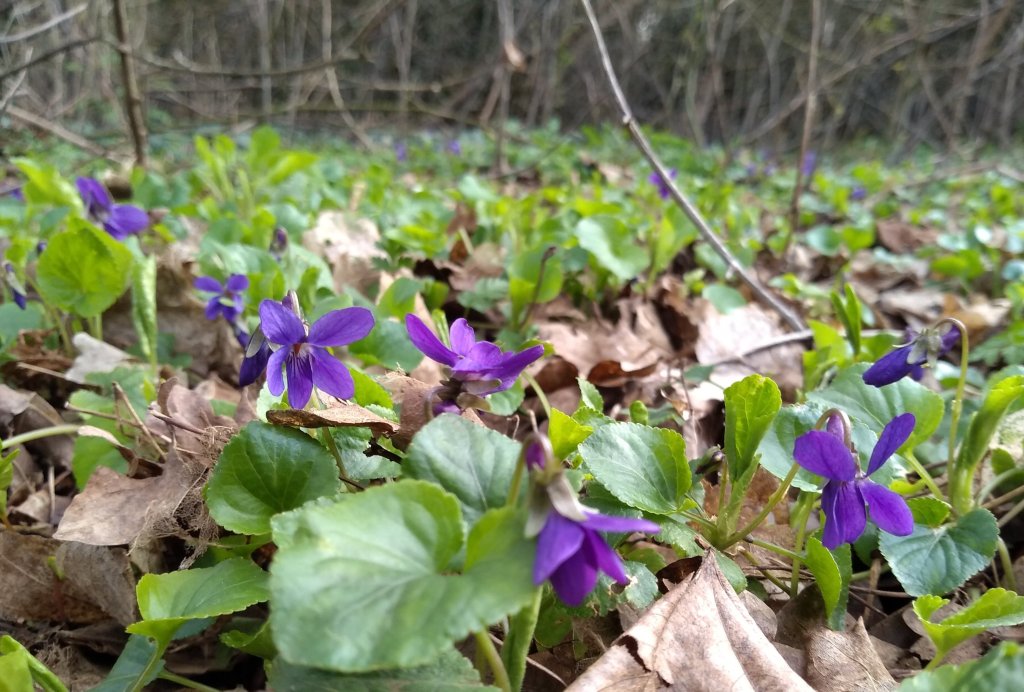
The Common Dog Violet (Viola riviniana) has begun to bloom, both in the wild (in woodlands, heaths and amongst hedgerows)
as well as gardens.

This splash of purple usually arrives in April and lasts until June. If you are lucky, you may notice certain Fritillary butterflies feed from and lay their eggs on this plant (a spectacle I’ve yet to witness).

Willows were blooming last week too. There is one mature Goat Willow (Salix caprea) that I see regularly as I work. Another common name for the Salix caprea is Pussy willow, due to the male catkins resemblance to cats paws before they bloom.

Only males catkins turn yellow once they open.

Willow trees are dioecious; therefore females catkins, grow on separate trees to the male ones. Unlike the male catkins shown above, female ones are green and longer in length. Catkins appear on the trees before the leaves do.

So many catkins were open that the tree seemed alive with the sound of bees.
I love the reddish tinge in the bark.

I am not sure how old this specific tree is but the species can live for about 300 years and grow up to 10 meters tall. The specimen in the garden I work at has definitely reached it full height.

The Kilmarnock willow (Salix caprea ‘Kilmarnock’) is a much smaller version of the Goat willow tree (grafted onto a dwarfing rootstock). I often see this tree in gardens and they were blooming last week too.

Unlike its larger counterpart, the Kilmarnock willow is a great addition to the average sized garden as it too is loved by bees.

The pollen covered Buff-tailed bumblebee pictured here clearly enjoyed visiting the male catkins on this Kilmarnock willow.

Goat willow trees are usually found in woodland, hedgerows and scrub, especially near waterways such as lakes, streams and canals.

Willows are a fantastic source of pollen and nectar for bees and other pollinators. They’re also a good food source for Sallow kitten (Furcula furcula), Sallow clearwing (Synanthedon flaviventris), Dusky clearwing (Paranthrene tabaniformis) and Lunar hornet clearwing (Sesia bembeciformis) moth caterpillars too. Even birds forage for insects amongst their branches.

As the wood burns well it is used to make charcoal. Plus it’s also used for wattle in timber frame houses.

My favourite fact is that the words witch, wicked and Wiccan are derived from Willow.

Traditionally, it was used to help treat toothache by chewing the bark and used to relieve diarrhoea, arthritis, sore throats, stop bleeding and clean wounds. In fact Aspirin, derived from salicin, was sourced from Willows.

The bacteria Brenneria salicis can cause Watermark disease in Willows which causes dieback and eventual death to the trees if left untreated.

If you are looking to add a small tree to your garden, the Kilmarnock willow is definitely worth looking into; unless you have a large garden then choose a mature male Goat willow instead (the bees will thank you for it).

Posted in nature

Natures beauty

A lovely mix of Snowdrops and Crocus.

Record breaking February temperatures, sun shining, bees foraging, and spring flowers popping up everywhere. How can you not feel cheerful? Last Thursday was the first grass cut of the season, on Saturday I saw a couple of Brimstones flitting about and on Monday I noticed Blackthorn flowering. Time to report Nature’s Calendar timings.

Posted in nature

The Birds and the Trees

On the 31st January, I undertook the RSPBs Big Garden bird watch. Most birds, I’d normally see, were clearly hiding but I did notice some within the hour. Those birds I saw were; 1 Carrion crow (Corvus corone), 2 Robins (Erithacus rubecula), 1 Coal tit (Periparus ater), 1 Blackbird (Turdus merula) and 2 Mistle thrush (Turdus viscivorus). I enjoy taking part in this citizen science project each year; it’s interesting to see how the results differ each time.

Due to the frozen ground last week, I was still able to go for my regular exercise in the local woodland park. Various tree species were waking up from their winter sleep. Beech (Fagus) and Oak (Quercus) had started budding while others were developing catkins.

Last years leaves and new buds on a Beech tree.
Old Oak leaves alongside new buds.

As well as the Hazel (Corylus avellana) other trees had catkins hanging from them too. Hazel catkins are the earliest to flower in the year, from January to March (see my previous post A Snowy Adventure).

Then the Alder (Alnus glutinosa) is the next tree to bloom with both male and female catkins. The male catkins are longer than the female ones which flower from February to March. Also hanging from the Alder trees were some small dark brown shapes. These woody cone-like fruit develop from the previous seasons fertilised female catkins; these can remain on the tree (even when the seeds have been shed) well into the following year alongside the newly formed catkins. I also noticed leaf buds growing on the trees last week too. When the buds burst, I shall update the Woodland trust Nature’s calendar with my findings.

Unfortunately I was unable to capture decent photos on location so I collected part of a fallen branch to take home.

One small female catkin above a group of larger male catkins. On the tree (before fertilisation when they develop into the rounder, woody fruit) the female catkins point upwards while the male ones hang down.
A magnified view of two unfertilised female catkins.
A leaf bud with one of last years fertilised female catkins.
A magnified view of the Alder tree seeds that had remained in last seasons female catkin.

I find Alder trees fascinating and the rough, fissured bark beautiful.

Alder are native to Britain and found on wet land, next to water or in marshes and woodlands. They naturally thrive in moist conditions although can also grow in drier areas such as the edges of mixed woodland. Alder wood is durable when wet and actually becomes stronger rather than rot when submerged in water; a characteristic that makes them useful in flood mitigation, boat building, sluice gates, and even the construction of Venice which is mostly built on Alder piles. Alder wood is also used in the creation of charcoal, gunpowder and making clogs.

The pale wood turns a deep orange colour at the point at which it’s cut (while the rest of the wood remains pale); leading to a superstition, in Ireland, that it was bad luck to walk past an Alder tree on your travels. However, traditionally alder branches were also taken into houses to prevent Woodworm. Alder wood is particularly liked by various species of beetle larvae (collectively referred to as Woodworm). It is hoped that the beetles will lay eggs in the Alder rather than the furniture or fixtures; the branches once infested can then be removed.

There is also a traditional use for Alder flowers as a green dye; believed to be used as camouflage by outlaws like Robin hood and fairies.

For fun, I looked up Alder wands used in the Harry potter series. Only one is mentioned, that owned by Quirinus Quirrell. The wands qualities are described on the Wizarding world website.

The roots of Alder are nitrogen fixers. Nitrogen from the air is fixed into the soil, replenishing the levels and aiding soil fertility, through the bacterium Frankia alni.

As well as improving soil, Alder are great for wildlife too. The seeds are eaten by Redpoll (Acanthis flammea), Siskin (Spinus spinus) and Goldfinch (Carduelis carduelis). The leaves are food for the caterpillars of the Alder kitten (Furcula bicuspis), Pebble hook-tip (Drepana falcataria), Autumn green carpet (Chloroclysta miata) and Blue-bordered carpet (Plemyria rubiginata) moths. Bees visit the catkins for an early source of nectar plus Alders provide habitats for the Checkered skipper (Carterocephalus palaemon) butterfly, Small pearl-bordered fritillary (Boloria selene) butterfly, some species of Crane fly, Otters (which create nests amongst the roots) along with mosses, lichens and fungi that like damp conditions.

However, these trees are also threatened through infection by the Phytophthora fungus (together with some other broadleaf tree species). In Alder this disease is referred to as Alder dieback and eventually causes the death of any infected tree. For more information see the Forest research website. There aren’t many Alders in my local woodland park compared to other tree species so it would be sad to see them disappear. Given my newly acquired knowledge I will keep a special lookout for any ill health in these trees; thankfully no infection is being exhibited at the moment.

Posted in Allotment, nature

Magic on the Winter Solstice

As a gardener and wildlife lover following the seasons is important to me. I celebrate seasonal festivals throughout the year to acknowledge the importance of nature in my life.

During the winter solstice I take time out to observe the sunrise, reflect on the past twelve months as well as think about the year to come. I also go for a walk to collect greenery for my home and give presents to the local wildlife. This year I planted some Heather and Mahonia for any winter foraging bumblebees and made fat balls for my bird feeder.

I am glad that even in tier 4 I can still go for walks amongst nature and visit my allotment for exercise; for me these are essential for healthy body and mind.

Last week I checked on plant growth on my plot. I currently have seedlings and cuttings safe in a small greenhouse; all remain healthy and continue to grow. I also noticed buds on my fruit trees along with borage still growing in the beds.

On monday I also witnessed a Kestrel (Falco tinnunculus) hover above a road (More information on Kestrels can be found at the RSPB). I don’t get to see these amazingly beautiful birds often enough. It was a magical sight on the longest day of the year which began with me watching the sunrise at Stonehenge (online) while at home and listening to bird song; plenty of positivity on a gloomy day.

Posted in nature

A Rare Visit

Last Sunday five Greenfinch (Chloris chloris) came to visit the Rowan tree outside my flat. Seeing these lovely finches is a rare occurrence for me, I tend to hear their wheezy call rather than see them; although even this isn’t often. The Greenfinch call can be heard on the RSPB website.

Along with Chaffinch (Fringilla coelebs) the greatest decline in bird numbers over the years has been in Greenfinches; due to the parasite Trichomonas gallinae. This parasite was first recorded in the UK in 2005 and believed to be transmitted via bird saliva around food and water sources especially in gardens. Greenfinch are social birds that often rely on garden feeding stations and bird baths. It is incredibly important to keep on top of good hygiene around these areas, if you feed birds, in order to prevent the spread of this parasite. Clean bird feeders, tables and bird baths thoroughly each week and fill little and often is the best strategy to combat it’s spread. For further information see the BBC news report on the Trichomonas gallinae parasite.

On a more positive note from last week, it was lovely to hear the occasional gentle buzzing of a Buff-tailed bumblebee (Bombus terrestris) around Mahonia japonicas which are currently blooming; it is such a relaxing sound.

Unfortunately the bee was camera shy.

This plant is great for bumblebees and will flower well into spring. If like me, you prefer not to have spiky plants in your garden then there is a Mahonia for you. Mahonia eurybracteata subsp. ganpinensis ‘Soft Caress’ (see the RHS website) is smaller than Mahonia japonica and as the name suggests can be handled without risk of skin being punctured. Along with Heathers (see my post from 18th November this year What Present Would you Buy for Bees?) this plant is on my list of must buys.

Posted in nature

Gardens and Nature Never Sleep

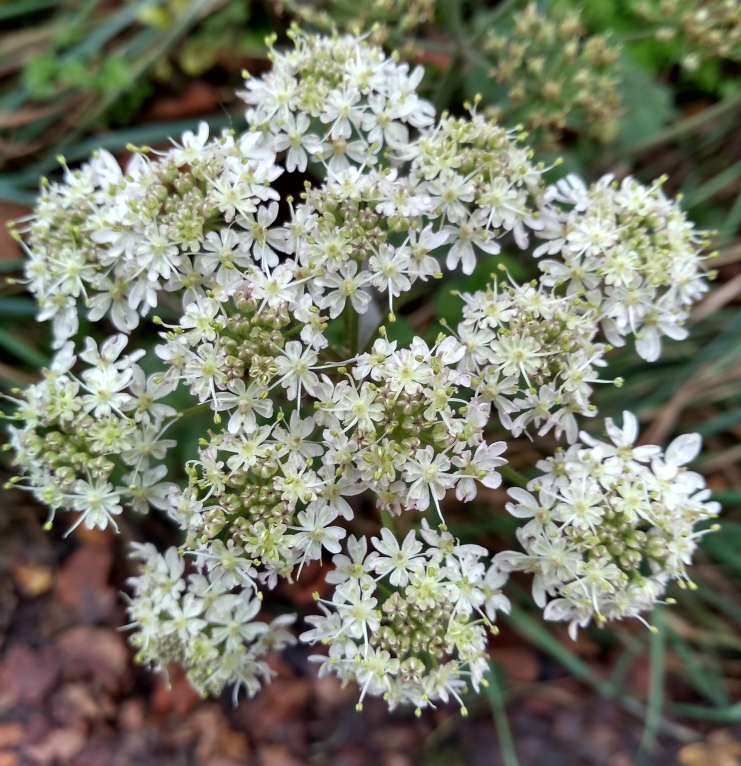
It is always nice to see flowers begin to bloom while others, that have performed throughout the year, wain. On one walk last week I came across a patch of Common Hogweed (Heracleum sphondylium) flowering.

It usually blooms between June and September so it must have been having one last flourish.
Common hogweed is from the same plant family as Ground elder (Aegopodium podagraria) and Cow parsley (Anthriscus sylvestris). All three native umbellifer plants are great for pollinators like hoverflies, Soldier beetles, some butterflies along with short-tongued bees, because these insects need flat flowers in order to gain access to pollen and nectar. Common hogweed is a tall wildflower growing up to six feet in damp conditions along waysides, open woodland, next to riverbanks and amongst rough grassland. It is also called Cow parsnip and had some other interesting names in the past, including Limberscrimps (in Cornwall), Wippul-Squip (Northamptonshire), Cowbumble (gloucestershire).

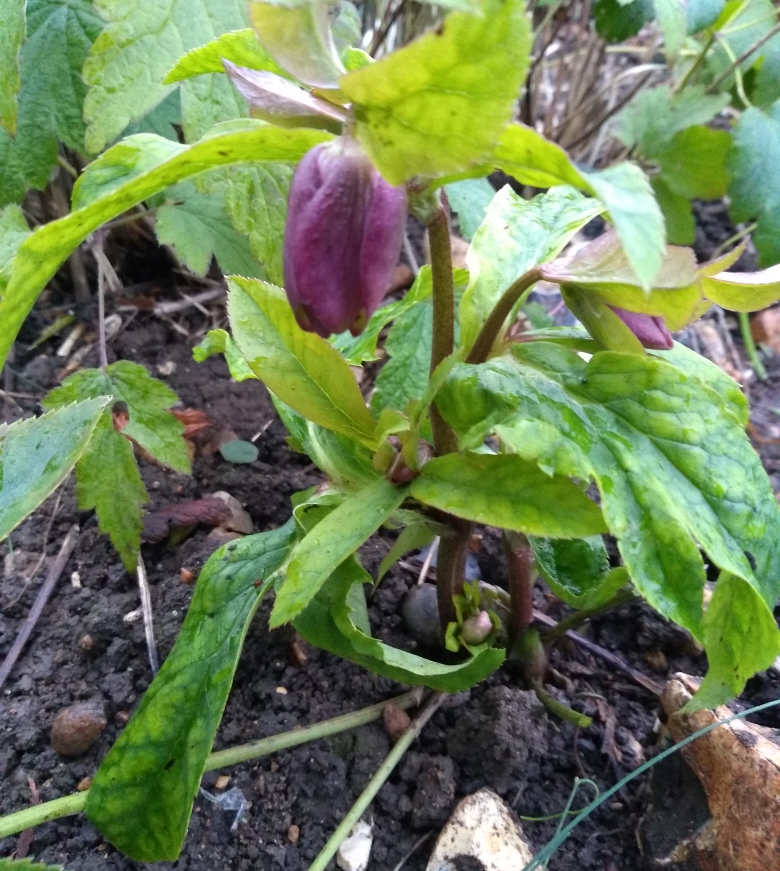
Gardens also continue to show signs of life at this time. The phrase ‘putting gardens to bed’ in winter is often a misnomer and rarely happens. They are never entirely in hibernation as something is usually awake, even if it is only visiting birds. Plus winter or spring flowering plants begin to bloom and grow now. Last week I noticed Hellebores starting to flower

along with Snowdrops (Galanthus)

and Daffodils (Narcissus)

peaking through the soil.

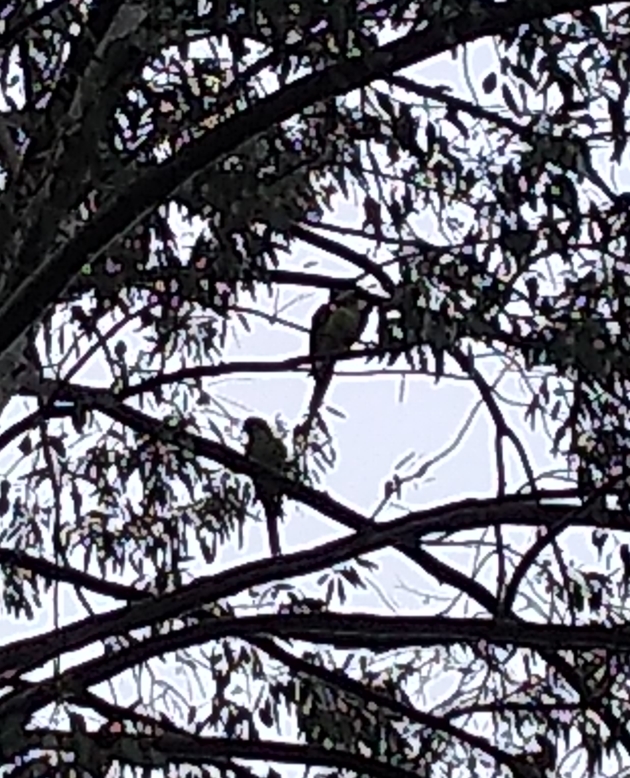
A bird that is easier to see these days are Ring-necked parakeets (Psittacula krameri). They were particularly prominent in one garden I worked at last week where a group kept flying between several trees, before eventually settling within a Eucalyptus tree.

Two parakeets silhouetted in a Eucalyptus tree.

These birds and trees were introduced into this country from warmer areas of the world, yet both species can cope with the colder uk climate.

The evergreen Eucalyptus tree leaves are a bluish green colour when mature. Eucalyptus oil is obtained from the mature leaves, known for its antiseptic properties together with a distinctive aroma.  Immature leaves are more rounded and a bluish shade. The tree flowers from July to October and are especially liked by bees and other pollinators.

Ring-necked parakeets (Psittacula krameri) are parrots that originated from Asia. The history of their introduction to the UK is explained by the RSPB here.

These birds have successfully breeded in this country for years to become a familiar sight in the south-east, particularly urban areas of Hertfordshire, Kent, Surrey and Sussex; their range extending further and further from London. Although they can be observed (and more often heard) throughout the year winter, when the trees are bare, is the best time to see them perched upon branches; unless you are lucky enough to have them visiting bird tables in your garden. They eat a variety of food, having developed an omnivorous diet as they naturalised over here (even though they remain vegetarian in Asia). While they usually eat seeds, fruit, nuts and berries they have been known to feast on scraps left out, including meat scraps. In fact it’s believed they can survive UK winters because they feed from bird tables.

Ring-necked parakeets are very social and can be seen in large flocks containing hundreds of birds. This can make them very noisy and therefore a nuisance in some peoples eyes. Yet whatever your opinion on these birds there is no denying their beautiful colours which seem to become more vivid at this time of year. Even on bleak days beauty exists; sometimes you just have to amend your focus to see it.