Posted in Allotment, nature

Very Very Hot Summer Days

Within the past month the temperature has reached the highest on record in the UK at 40.2 Celsius. Here in the south, rain still evades us leading to hosepipe bans in some counties. Plus as I write this blog another heatwave begins. While the parched grass will recover once rain eventually falls, and some insects may benefit from these conditions, this drought is not good for nature in general (including humans due to amber and red heat warnings for health issues and fires). We need to use resources more thoughtfully and manage the land better so that nature (to me humans are part of nature not separate from it) isn’t placed under unnecessary pressure due to extreme weather conditions anymore.

Most wildlife isn’t adapted to this current weather and certainly has no chance against wild fires, especially Badgers (Meles meles) and Hedgehogs (Erinaceus europaeus– whose numbers have been in decline for many years for other reasons too). Even birds with second broods will be finding these times difficult; that is why it’s so important to place water sources at both ground level and higher up for birds and Hedgehogs at this time. Plus insects like Butterflies and Bees suffer when flowers start to whither early due to water shortage. Nature can recover from the odd hot dry year but unfortunately this is a trend, year on year, due to climate change so we need to be concerned and act now. Stephen Moss has written a wonderful article regarding this issue recently, it can be read here.

Given the information from the article mentioned above, it will be interesting to see how this prolonged drought will affect the results of the Big Butterfly Count this year (which took place from the 15th July to the 7th August) and consequently next years results too.

I have undertaken a few counts this year. The first time I looked out for Butterflies was on a warm afternoon, in a garden containing a Buddleia along with some Lavender (Lavandula) and Mint (Mentha) that was flowering. During that time, I identified;
5 Red admirals (Vanessa atalanta)
5 Commas (Polygonia c-album)
2 Peacock (Aglais io)
5 Gate keepers (Pyronia tithonus)
1 Meadow brown (Maniola jurtina)
2 Small tortoishell (Aglais urticae)
together with 1 Hummingbird Hawkmoth (Macroglossum stellatarum). The Hummingbird Hawkmoth is fascinating. I have observed two individuals visiting Buddleia this year in different gardens that I work at. It is so amazing to watch it collect nectar as it hovers next to flowers.

On separate occasions (at the previously mentioned garden) I also noticed a Large skipper (Ochlodes sylvanus) and a Ringlet (Aphantopus hyperantus) too. That garden also has an allotment attached to it where I got to observe the full lifecycle of a ladybird on one bean plant (thanks to the Blackfly being present). On this occasion it was the Harlequin (Harmonia axyridis) ladybird.

Larvae (on the right, looking for Blackfly to munch on) and on the left a pupae (from which the adult emerges).
An adult Harlequin ladybird.

My second Butterfly Count was during a morning as I picked Blackberries (Rubus) at the local woodland park, where I saw
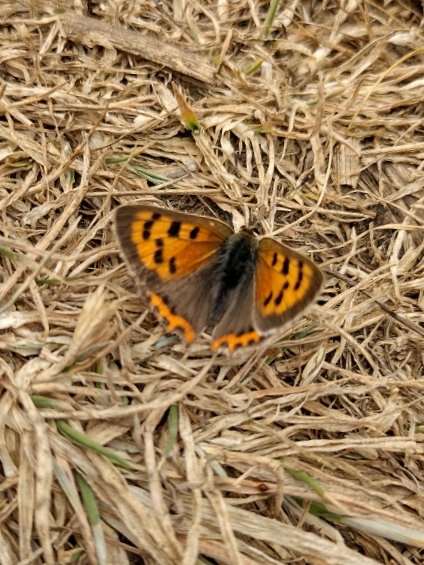
5 Gatekeepers, 1 Speckled wood (Pararge aegeria) and 1 Small copper (Lycaena phlaeas).

Speckled wood
Small copper

The Small copper is one I had never seen before. It is a small butterfly with a wingspan of 32-35mm. The caterpillars feed on Common Sorrel (Rumex acetosa), Sheep’s Sorrel (R. acetosella) and sometimes the Broad-leaved Dock (R. obtusifolius). They can be found in heath, moor and grassland together with woodland clearings or on waste ground.

At my allotment I have seen lots of Cabbage whites, along with the odd Peacock and Small tortoishell as well as a small blue Butterfly (that never settled so I was unable to identify it properly but was most likely a Holly blue- Celastrina argiolus). Thankfully I have also noticed plenty of bees during my butterfly observations, including honey, bumblebees and solitary bees.

Lughnasadh (also known as Lammas) a time when harvests begin to be ready for picking, occurred at the beginning of August. During this time I love to wander through natural environments, spending time observing the changes of the seasons. On my walk the previous weekend I observed Sloes (from Blackthorn- Prunus spinosa) and Elderberries (from Elder- Sambucus) already ripening alongside the Blackberries.

I must confess that I often struggle to enjoy the hottest days of summer. To me extremely hot temperatures are often overwhelming and I would love nothing better than to hibernate underground during the hottest times. I find the days exhausting and uncomfortable (due to the constant itchiness and sore skin). At these moments I rely on my mental strength to keep in mind that ‘this too shall pass’. I also try to remind myself that I love the changing seasons, including summer, and all they bring with them. Gratitude helps as each day I look for the little things that bring me joy such as the shining sun, the amazingly beautiful wildlife around me and the cooler night time temperatures. So until the heat reduces significantly I will keep taking things slowly, keep hydrated, take plenty of rest and be kind to myself. I am under no pressure to get things done at this time which is why this post took so long to complete.

Posted in nature

Worm Moon Shining

The full moon in March, is commonly named the Worm moon in the UK as it coincides with the appearance of worm casts. Worm casts begin to appear as the soil warms up enabling worm activity on the top layers of soil. They are often the bain of those who love prestine lawns but easily dealt with by raking, to break them up before mowing (thus preventing small bare soil patches that encourages wild flower and moss growth). However, apart from this slight inconvenience for some, obviously worms are hugely beneficial creatures in nature. They help create a healthy soil ecosystem, aid the decomposition of organic matter, improve soil structure and increase available nutrients for plants.

In the UK there are 27 species of earthworm, which can be categorised into three types, Anecic, Endogeic and Epigeic. The latter are surface dwellers which breakdown vegetation lying on the ground. These small, usually red worms (or stripey in the case of Tiger worms- Eisenia fetida) are often seen in composts. The other two types of worm burrow. The most commonly seen in gardens are the Anecic worms (which pull leaves down into the soil). These large reddish brown worms are responsible for worm casts in lawns and burrow vertically while the paler coloured Endogeic worms burrow horizontally and live further down in the soil.  More information on earthworms can be discovered here on the Earthworm Society website.

Another notable date that occurred last week on the astronomical calender (in the northern hemisphere) was the Spring equinox. The moment in March when day and night length are equal and officially the first day of spring.  (Meteorologically this already occurred on the first of the month). Whichever date you prefer to observe as it’s start, Spring has definitely arrived here in the UK.

Nature seemed to celebrate the arrival of Spring with several days of unseasonably warm weather, together with the appearance of more butterflies, with Peacocks (Aglais io), Commas (Polygonia c-album) and yet more Brimstones (Gonepteryx rhamni) fluttering about, together with lots more bumblebees. So far I have seen lots of Buff-tailed bumblebee (Bombus terrestris) and a few Red-tailed bumblebees (Bombus lapidarius). Even Seven-spot ladybirds (Coccinella septempunctata) came out of hiding last week.

More trees are blossomimg too. Magnolias, Camellias, Forsythia, Gorse (Ulex) and Willows (Salix) are flowering now, joining the Blackthorn (Prunus spinosa). Plus yellow and green carpets of Lesser Celendine (Ficaria verna) have been popping up everywhere.

Posted in Allotment, nature

Emergence from Wintering

It’s lovely to write for my blog after so long. I have enjoyed a quiet period for a month or so; slowly taking time for self care, reflection and planning the allotment during a time when I suffer with Seasonal affective disorder (SAD).

I love this time of year. I love reading while snuggling under a blanket. I love the sights, sounds and general feeling of winter (especially in the new year after the distracting lights of Christmas) however my brain doesn’t. Each year from the beginning of October to the end of February I indergo a form of wintering. While wildlife winters through hibernation, migration or seeing the winter out with reduced activity. As hibernation is not possible, for me it is the latter; embracing the darker, quiter months as I spend most of my time at home. I have come to realise this wintering is essential in order for me to maintain a healthy mind.

I am still affected by the reduced amount of light but now I am able to see the other side of the winter solstice. For information on and how to find help for SAD, please follow the following links;

Mental Health Foundation

Mind

At this time nature becomes more important then ever to me. I look for small moments of comfort each day. Some of the wonderful nature I have witnessed during December and so far in January have been;

– The growth and blooming of early flowering plants. A reminder that gardens never completely sleep. Occasionally I’ve noticed a foraging Buff-tailed bumblebee queen visit them too.

The emergence of Snowdrops (Galanthus).
Other bulbs beginning to show themselves like these daffodils (Narcissus).
Helleborus beginning to bloom.

– The intoxicating scent of the Sarcococca which is located by the entrance to my flat.
– Birds being more visible and starting to get more vocal. I especially enjoy hearing and seeing Carrion crows (Corvus corone), one of my favourite birds, at this time.
– Foxes (Vulpes vulpes) being visible as they search for food during the day and hearing a female fox at night (January and February are their mating season).
– The beauty of frosts, together with the knowledge it will be a cold but very sunny day.
– Glorious sunrises and sunsets.

The sun captured moments before it disappeared below the horizon.

– Night sky delights.

The Wolf moon, the first full moon of 2022.

– Trees silhouetted against the sky. This also allows you to notice nests too.

The large object in the tree is a Drey.

Squirrels and their homes are also easier to spot now (as shown in the last photo). A squirrel’s Drey, for both Greys (Sciurus carolinensis) and Reds (Sciurus vulgaris) are approximately the size of footballs. They are located near trunks where branches fork outwards and located about six meters above ground. They can be differentiated from bird nests which are often smaller, tidier and found further along branches and higher up the tree. Dreys are made with soft materials like moss, feathers, grass, leaves (not usually seen in bird nests) bark or pine needles. However, if squirrels find natural holes in trees, such as those made by woodpeckers, then they will make use of these too. Squirrels will have separate summer and winter dreys, the latter are more weather resistant while the summer ones are more airy.

Posted in nature

Bees in Winter

Honey bees (Apis mellifera) overwinter in hives, huddling round the queen to keep warm, occasionally venturing out on warmer days. Bumblebees (Bombus) on the other hand have an annual lifespan with new queens, having mated during the summer and autumn months, hibernating underground until spring when they can begin a new colony; also sometimes waking up too early on warm days and foraging.

However over the past 10 years, in urban areas of Southern England, a trend has been seen with certain bumblebee species.
Initially Buff-tailed bumblebees (Bombus terrestris), but since then Early bumblebees (Bombus pratorum) and Tree bumblebees (Bombus hypnorum) have begun to nest in winter rather than hibernate. Consequently winter flowering plants such as Mahonia and Winter Heathers (Erica), Winter honeysuckle (Lonicera fragrantissima), Winter aconite (Eranthis hyemalis), Hellebores (Helleborus) and Snowdrops (Galanthus) are garden essentials; enabling these bees to access pollen and nectar during the colder months.

Solitary bees on the other hand will survive throughout winter in burrows or cavities as eggs, with their own supply of nectar and pollen close to hand (as the adults don’t survive winter). These include Mining and Mason bees which emerge early in spring taking advantage of Willow (Salix), Blackthorn (Prunus spinosa) and Hawthorn (Crataegus monogyna) in bloom. Leafcutter and Carder bees emerge later still. The one exception are Furrow bees; like Bumblebees, the female will hibernate during winter and lay eggs in spring.

I have noticed lots of Mahonias blooming over the last few weeks, their bright yellow flowers and perfume is wonderful to experience during dull days. Somehow the colour shines more vividly against grey skies.

Mahonia x media

Another shrub that has been blooming recently is Viburnum farreri, it’s lovely scent wafting through the air too.

Posted in nature

Nature’s fireworks 🍁🍂

The temperature has fluctuated during the previous two weeks, with a few light frosts and hotter than average November days. Leaf fall is well under way now too keeping us busy at work. I never cease to be in awe of the beautiful leaf colours as the sun shines; They make fireworks look monochrome in comparison.

Fungi observations were still numerous. Here are some that I have seen over the past few weeks;

The Prince (Agaricus augustus)
Golden waxcap (Hygrocybe chlorophana)
Russula queletii
False saffron milkcap/ Orange milkcap (Lactarius deterrimus)

Amazingly I have still seen the occasional Buff-tailed bumblebee (Bombus terrestris) queen; plus the previous Friday I also noticed a Common carder bee (Bombus pascuorum) near a compost bin in one garden.

Common carder bee

The Rowan (Sorbus) berries on the tree outside my flat are almost gone, mostly due to a local flock of starlings (Sturnus vulgaris); however other visitors enjoying the bounty have been two Song thrushes (Turdus philomelos) and two blackbird (Turdus merula) couples.

I enjoy watching Starlings, seeing their shiny purple and green plumage and listening to their social interactions and mimicry. Starlings have a wide repertoire of calls because they imitate sounds, especially other bird calls (usually 15-20 distinctive sounds); even their murmurations are beautiful to watch.

Other birds visiting the tree, not interested in the berries, were a male and female Chaffinch (Fringilla coelebs), my family of Blue tits (Cyanistes caeruleus) along with a newcomer, a rather vocal Coal tit (Periparus ater). It was lovely to be able to hear a new call coming from the Rowan, it can be heard here (RSPB).

Posted in nature

Bees in Autumn

The Autumn equinox finally arrived last Wednesday. It was lovely to notice bees still flying around when the sun shone. While these insects are synonymous with spring and summer, some are still active in September.
Common carder bees (Bombus pascuorum) were the most noticeable last week but I also saw a new Buff-tailed (Bombus terrestris) bumblebee queen visiting some Hylotelephium as well.

Common carder bee
Buff-tailed bumblebee queen

I also observed a couple of active bee nests in some lawns too. It was difficult to identify the specific species although given the time of year and colouration they were possibly Common furrow-bees (Lasioglossum calceatum) also called Slender mining bees. These bees are active from Spring until mid Autumn and nest in short grass. 

Posted in Allotment, nature

A Couple of Welcome Visitors

During the previous week there were the few days of unusually high temperatures for the time of year; a final flourish for late summer?

The heat encouraged lots of bees, especially Honey bees (Apis mellifera) to visit Hylotelephium (once called Sedums) which began to bloom. The sound was amazing and it was so relaxing to work near them; you could almost feel the buzz it was so intense.

How many bees can you spot?

Things have been ticking over nicely on the allotment for the past month. Corn and Squash are developing nicely while the supply of Sweetpeas and Beetroot keep coming. Plus the Potatoes have been dug up and Apples are ready to pick too.

Time spent planning next years harvest is in full swing, while changes to the allotment occur. I began to create a space for a wild flower area next to a patch of long grass, where a resident frog is no doubt loving the huge supply of slugs this year. Plus work has begun on transforming the veg patches into raised beds.

Away from the allotment, on Friday 10th September, I noticed a rather large moth in the hallway. It was an Old lady/ black underwing (Mormo maura) moth. The wingspan of the Mormo maura is between 55 and 65mm.

The common name of Old Lady is due to the colouration and pattern on the forewings, which resemble the shawls of old Victorian ladies. There is only one generation per year and adults fly between July and August; as I noticed this one in September it must be near the end of its lifespan. A nocturnal moth it is attracted to light (and sugar if you place feeding stations for moths). Clearly the open window had encouraged it into the building. The main habitat for this moth are gardens and waste ground, particularly in damp locations. In spring, after overwintering, the caterpillars will feed on various trees and shrubs, such as Blackthorn (Prunus spinosa).

Then last Friday, another moth found its way to the hall. Also a nocturnal moth attracted by light, the Snout moth (Hypena proboscidalis), so called for obvious reasons.

There are two generations per year of the Hypena proboscidalis, adults initially fly between June and August and again later in autumn. The wingspan of the Snout moth is approximately 30 to 38mm. Like the Old lady moth it also frequents gardens and wasteland, along with woodlands; essentially it can be found anywhere nettles (Urtica dioica) are found, which the caterpillars feed on.

Posted in Allotment, nature

I’m Yellow and Black but not a Bee; What am I?

Cooler temperatures and very wet weather meant that insect observations were few and far between last week.

In sunnier moments, bees were still visible but I haven’t noticed many moths, butterflies or ladybirds recently; I do hope that changes soon.

However there were a few momentous insect observations last week. I discovered a Mining bee nest on the allotment. As there was an Ashy mining bee (Andrena cineraria) on the plot last year then it could be evidence of another one making its home there.

The other insect, one I got to learn about later in the week, was a stunning parasitic wasp; possibly an Amblyteles armatorius (however identification is difficult to be completely certain).

If it was an Amblyteles armatorius then it’s hosts can be several species of moth caterpillar, such as the Yellow Underwing (Noctua pronuba).

The yellow and black parasitic wasp was 15mm in length (antennae included) and is often seen in June; although there is a second generation later in the year too. Adults can be noticed feeding on pollen from plants with umbellifer flowers such as Cow parsley (Anthriscus sylvestris) or Hogweed (Heracleum sphondylium). There was Lovage (Levisticum officinale) in flower in the garden where the parasitic wasp was noticed, so perhaps it had visited that before flying off to find another plant.

Posted in nature

The Mystery is Finally Solved


At the beginning of the second lockdown I started walking different routes to explore my local neighborhood further. On one of these investigations, I came across a large tree that I didn’t recognise. I was intrigued as seed pods had remained on the branches throughout winter. I suspected that it was from the legume (Fabaceae) family and determined to eventually discover what tree it was.

Every so often I would check on its development, then about a month ago leaves began to appear but it was only in last week that the mystery was finally solved. On route to the allotment I noticed that beautiful scented flowers were hanging from the tree and the sound of lots of bees buzzing all over it was incredible. Finally I could identify it as a False acacia (Robinia pseudoacacia), a large hardwood tree which at full height can reach 25 meters.

Named by Carl Linnaeus, Robinia was in honour of two Royal gardeners to Henry IV of France; Jean Robin (1550-1662) who was also a botanist, along with his son Vespasien Robin (1579-1662). Pseudoacacia was given to the tree because of the similarity of the leaves and spines (thorny growth on the shoots and young branches) to those of an Acacia; Pseudoacacia literally translates as False acacia.

The lime green pinnate leaves (containing 3-11 pairs of leaflets) will turn yellow in autumn, so the tree has interest later in the year too.

However that is where the similarity stops as Acacias are part of the Mimosa (Mimosoideae) family. In fact this tree, as I suspected, is from the legumes (Fabaceae) family. The flowers and seed pods resemble those of peas and beans plus the roots have nitrogen fixing nodules. In some countries, like South Africa and Australia, suckering roots can lead it to become invasive.

The scent coming from the flowers was similar to orange blossom and very obvious from a distance as I walked towards it. The White Flowers, with a hint of yellow at the base hang down in groups (racemes) and appear in May and June.

Posted in Allotment, nature

Blossom Watching

Warm sunny weather has finally replaced the wet conditions we seemed to be stuck in all May.

As I write this, meteorological summer has begun so the change in weather is rather fitting.

It has been fascinating to follow the seasons so far this year; paying particular attention to the timing of tree blossom arrival. After the Blackthorn (Prunus spinosa), the ornamental Cherries (Prunus) took over alongside the Crab apples (Malus). Then for the last few weeks Rowan (Sorbus), Horse chestnuts (Aesculus hippocastanum) and Hawthorn (Crataegus) have been blooming and continue to do so.

More wild flowers are joining in the visual performance as Red clover (Trifolium pratense) and Common vetch (Vicia sativa) started putting on a show too.

Even on the allotment, the Lacy Phacelia (Phacelia tanacetifolia) has begun to bloom alongside the vibrant Geums, which is a great combination.

The bees have been enjoying their nectar and pollen, along with a Hairy shield bug (Dolycoris baccarum) who came to visit on them Saturday (see photo below).

We do have blackthorn hedges nearby so I guess it had been overwintering on those.

I’ve noticed that the Chive flowers are particularly loved by worker Red tailed bumblebees (Bombus lapidarius); this isn’t too much of a surprise as I know they have short tongues, plus once they have found a good food source they will repeatedly visit the same plant.

Seven-spot ladybirds (Coccinella septempunctata) numbers are increasing on allotment too. Plus one Female Wolf spider (Pardosa amentata) carrying a blue egg sac was spotted.

It is always a joy to share my plot with beneficial insects, as I don’t use insecticides.

It was nice to have a long weekend, it gave me a chance to walk through the local woodland park which I hadn’t done for a few weeks. Lots of butterflies were flitting about, including one Speckled wood butterfly (Pararge aegeria).