Posted in nature

A Rare Sighting of Hares

While I mostly witness nature in amphibian, insect or plant form, just occasionally I get to see mammals too.

Last week I briefly observed two adult Hares (Lepus europaeus) as I traveled from a job; a garden at a house surrounded by farmland.

They were out in an open field some distance away from the driveway, yet close enough to be able to appreciate their size as well as distinguish the black tips on their long ears along with their distinctive hind legs.

As Hares are usually seen alone, I’m guessing these two were a pair. Perhaps aware of the movement of the electric vehicle, one suddenly crouched down as the other sat bolt upright alongside it. It was lovely to witness these two together in this way. Previously, I’ve only ever seen one Hare far in the distance running across an open field, presumably after being disturbed.

Hares are the UK’s fastest mammal, when disturbed they have a top speed of 45 mph and move in a zig zag formation.

While mostly solitary, these mammals occasionally live apart from one another in loosely connected groups. This explains why, in early spring, when two Hares are seen ‘boxing’ they’re not two males fighting for dominance but actually a female fighting off a male.

Their preferred habitat is a combination of farmland or undisturbed grassland surrounded by woods; enabling easy access to grass and crops for food while giving some protection.

Rather than burrows, Hares live in a form (an exposed depression on the ground). They remain close to their form during the daytime, becoming more active and feeding at night. The two I saw must have been in their form. I wonder if they had a litter? Hares can have three to four litters within a year (between March and July) giving birth to two- four leverets each time. Hares can live for up to four years.

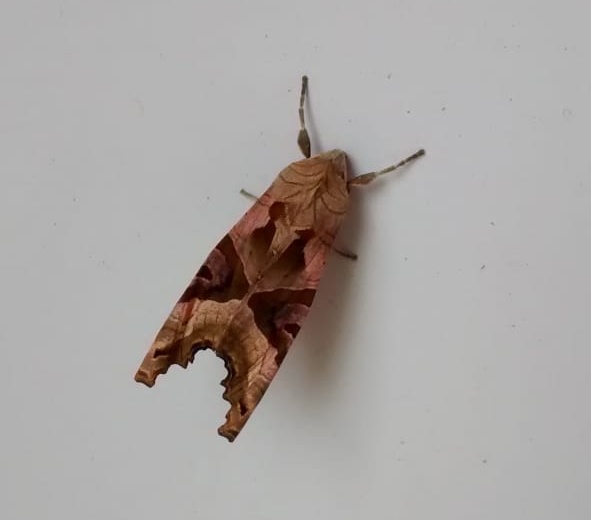
There was one other prominent sighting from last week, that of a Angle shades Moth (Phlogophora meticulosa). I noticed it on Thursday, resting on the milk bottle carrier as I collected my milk delivery.

This is the moths I see more than any other, perhaps because I am surrounded by the perfect habitat for them; a mixture of gardens, parks, woodland and hedgerows containing an abundant food source for their caterpillars. Angle shades caterpillars will feed upon Common Nettle (Urtica dioica), Red Valerian (Centranthus ruber), Broad-leaved Dock (Rumex obtusifolius), Bramble (Rubus fruiticosus) and Hazel (Corylus avellana).
As this is a night flying moth, I carefully transferred it to the nearby wall where it could gain shelter from the daylight.

Posted in nature

Common Insects but an Uncommon Viewing Experience

It was great to still witness pollinators flying around last week. Even though, due to the colder weather numbers have greatly reduced, some insects are still foraging. I noticed the odd hardy Buff-tailed bumblebee (Bombus terrestris) as well as a few Honey bees (Apis mellifera) visiting autumn flowering perennials and shrubs. Currently the most wonderful spectacle is Common Ivy (Hedera helix) in full bloom. Loved by pollinators including butterflies, bees and hoverflies, ivy is a useful plant to have in flower at this time of year. It supports up to fifty species altogether, such as providing food for Holly blue Butterflies (Celastrina argiolus), along with the Small dusty wave (Idaea seriata), Angle shades (Phlogophora meticulosa)
and Swallow-tailed (Ourapteryx sambucaria) moths. Mature Ivy plants flower in September and October on clustered umbels. Eventually, pollinated flowers develop into fruit that provides food for Thrushes (Turdidae), Blackbirds (Turdus merula), Blackcaps (Sylvia atricapilla) and Wood pigeons (Columba palumbus). Ivy also provides shelter for hibernating insects over winter.

However the most prevalent insects I witnessed covering the ivy flowers last week were the Common wasp (Vespula vulgaris). They weren’t nesting amongst it but feeding on the abundant nectar. My confidence in their complete focus on the ivy flowers, and not being bothered by my presence, enabled me to unusually observe them up close. Each time I came across ivy covered with wasps, I would take a few moments to watch and listen. Unlike bees, their buzzing was very faint; you had to listen carefully to hear it. I had never been close enough to appreciate the wonderful pattern on their abdomen before or watch their activity as they hurriedly switched from one flower to another.

I would have been observing male and worker wasps obtain nectar from the ivy (which also visit other umbellifier flowers). Queens are active in spring, collecting nectar from Cotoneaster and other spring flowering shrubs.

These much hated creatures are useful pollinators (as the photo below proves) when not pestering us as we eat outdoors. We can’t really blame them trying to access an easy source of food or protecting nests when we stumble upon them.

Wasps also help keep insect numbers down which once captured, are chewed up and fed to the larvae.

Although I haven’t seen any yet, I am ever hopeful that I will see Ivy bees (Colletes hederae) as I look at ivy. Recorded for the first time in southern Britain as far back as 2001, these solitary bees feed on ivy nectar and are therefore only seen when ivy flowers. Since they were first noted in Britain the species has been spreading northwards, nesting in sandy soil. For further information see (Wildlife Trust).

More fungi started to appear last week too; I saw
– Common bonnets (Mycena galericulata)

– Shaggy ink caps (Xylaria hypoxylon) and

– Candlesnuff (also referred to as candlestick or stag’s horn) fungus (Xylaria hypoxylon).

You have to look closely to identify this minute fungi, found on decaying wood, it has a blackened base.

Lastly I was utterly surprised to witness a Fox (Vulpes vulpes) run across my allotment as I worked early on Saturday afternoon. It looked healthy so presumably had been disturbed with all the activity from allotmenteers tidying their plots.

Posted in nature

Childhood Memories and Hedgehogs

In a week of much needed rain, I remained dry while waiting for the bus on Thursday. I arrived at the bus stop with plenty of time to spare and began to notice the flowers around my feet.

The most prolific were Daisies (Bellis perennis), Dandelions (Taraxacum officinale) and Buttercups (Ranunculus bulbosus). Childhood memories using these in flower based activities came back to me. Buttercups to discover if someone liked butter, Dandelions to tell the time (presumably when we weren’t wearing watches) and Daisies for making daisy chains or discovering if someone loved you (or loved you not).

Daisies remain a favourite flower of mine because seeing them lifts my spirits. Yet the thing I love most about Daisies is that the name means day’s eye (from the Old English dæges-eage) because the petals open up during daylight hours and close as night falls. Even in Welsh they are called llygad y dydd meaning the eye of day. The following photo, taken early in the morning, shows their progress as they open.

Other plants I noticed flowering were;

-Red dead-nettle (Lamium purpureum). This pretty non-stinging plant is good for Garden Tiger (Arctia caja), White Ermine (Spilosoma lubricipeda) and Angle Shades (Phlogophora meticulosa) moth caterpillars which feed on it’s leaves, while the flowers are great for Bumblebees (Bombus) and the Red Mason bee (Osmia bicornis).

-Shepherd’s purse (Capsella bursa-pastoris). The seed pods of this resemble heart shaped purses which contain copper coloured seeds that look like coins.

-Germander speedwell (Veronica chamaedrys). Speedwells at one time were considered a good luck charm for travellers for ‘speedy’ travel as they are often found along verges.

Initially the last plant I saw was unknown to me. It took some time but I eventually discovered that it is Wild Turnip (Brassica rapa).

Hedgehog Awareness Week took place last week (British Hedgehog Preservation Society). It publicises the continued decline in Hedgehog numbers along with information on how to help reverse this. I decided to learn more about hedgehogs at this time by reading ‘The Hedgehog Handbook’ by Sally Coulthard as I travelled by bus. Each chapter gives a monthly account on what hedgehogs are doing and how to help them.
This is a wonderfully informative book contains lots of useful advice that I can put into practice and I loved reading it.

Posted in nature

Last weeks Highlights

I have been away for a few days, emersed in beautiful countryside. Below are a few special highlights from last week.

Firstly this Angle Shades Moth (Phlogophora meticulosa) was resting on the door, early Wednesday morning, as I set off on holiday.

Then, on Thursday, I visited Chirk Castle. While looking around the old Laundry building I noticed something swoop from the ceiling and land on a beam.

This juvenile Swallow (Hirundo rustica) wasn’t too far from the nest, which was therefore easy to locate. The hint of a red throat was present but not easy to spot in this photo due to distance and low lighting.

The swallow nest in the rafters.

Lastly I awoke early on Sunday, relaxed with a cup of tea and listened to the dawn chorus. The 5th was International Dawn Chorus Day (celebrated on the first Sunday in May each year). The change of scenery brought with it a change in bird song to listen to. I heard a Collard dove (Steptopelia decaocto), Goldfinch (Carduelis carduelis) and House Sparrows (Passer domesticus) along with the Blackbirds (Turdus merula) and Bluetits (Parus caeruleus) that I usually hear.