Last Sunday five Greenfinch (Chloris chloris) came to visit the Rowan tree outside my flat. Seeing these lovely finches is a rare occurrence for me, I tend to hear their wheezy call rather than see them; although even this isn’t often. The Greenfinch call can be heard on the RSPB website.
Along with Chaffinch (Fringilla coelebs) the greatest decline in bird numbers over the years has been in Greenfinches; due to the parasite Trichomonas gallinae. This parasite was first recorded in the UK in 2005 and believed to be transmitted via bird saliva around food and water sources especially in gardens. Greenfinch are social birds that often rely on garden feeding stations and bird baths. It is incredibly important to keep on top of good hygiene around these areas, if you feed birds, in order to prevent the spread of this parasite. Clean bird feeders, tables and bird baths thoroughly each week and fill little and often is the best strategy to combat it’s spread. For further information see the BBC news report on the Trichomonas gallinae parasite.
On a more positive note from last week, it was lovely to hear the occasional gentle buzzing of a Buff-tailed bumblebee (Bombus terrestris) around Mahonia japonicas which are currently blooming; it is such a relaxing sound.
Unfortunately the bee was camera shy.
This plant is great for bumblebees and will flower well into spring. If like me, you prefer not to have spiky plants in your garden then there is a Mahonia for you. Mahoniaeurybracteata subsp. ganpinensis ‘Soft Caress’ (see the RHS website) is smaller than Mahonia japonica and as the name suggests can be handled without risk of skin being punctured. Along with Heathers (see my post from 18th November this year What Present Would you Buy for Bees?) this plant is on my list of must buys.
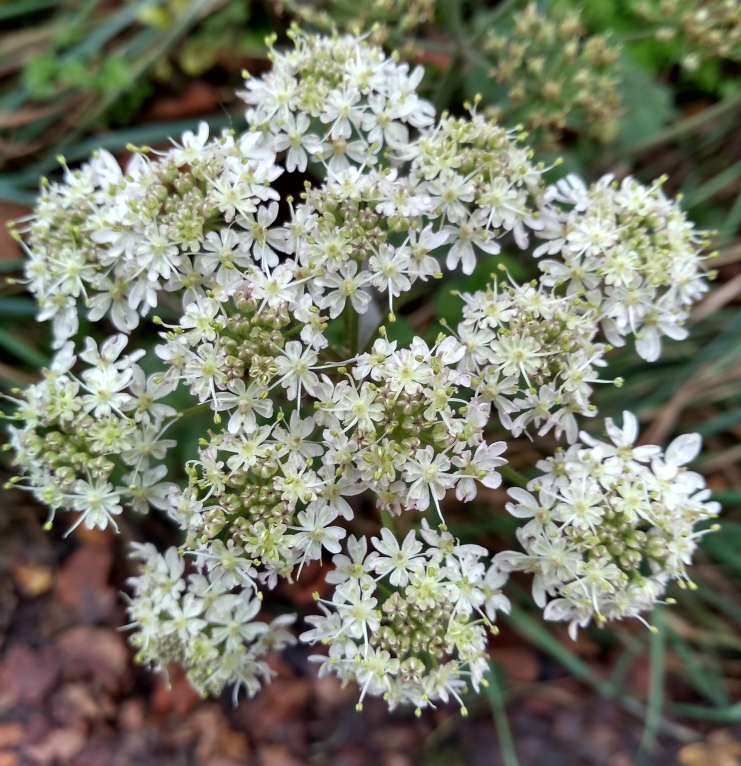
It is always nice to see flowers begin to bloom while others, that have performed throughout the year, wain. On one walk last week I came across a patch of Common Hogweed (Heracleum sphondylium) flowering.
It usually blooms between June and September so it must have been having one last flourish. Common hogweed is from the same plant family as Ground elder (Aegopodium podagraria) and Cow parsley (Anthriscus sylvestris). All three native umbellifer plants are great for pollinators like hoverflies, Soldier beetles, some butterflies along with short-tongued bees, because these insects need flat flowers in order to gain access to pollen and nectar. Common hogweed is a tall wildflower growing up to six feet in damp conditions along waysides, open woodland, next to riverbanks and amongst rough grassland. It is also called Cow parsnip and had some other interesting names in the past, including Limberscrimps (in Cornwall), Wippul-Squip (Northamptonshire), Cowbumble (gloucestershire).
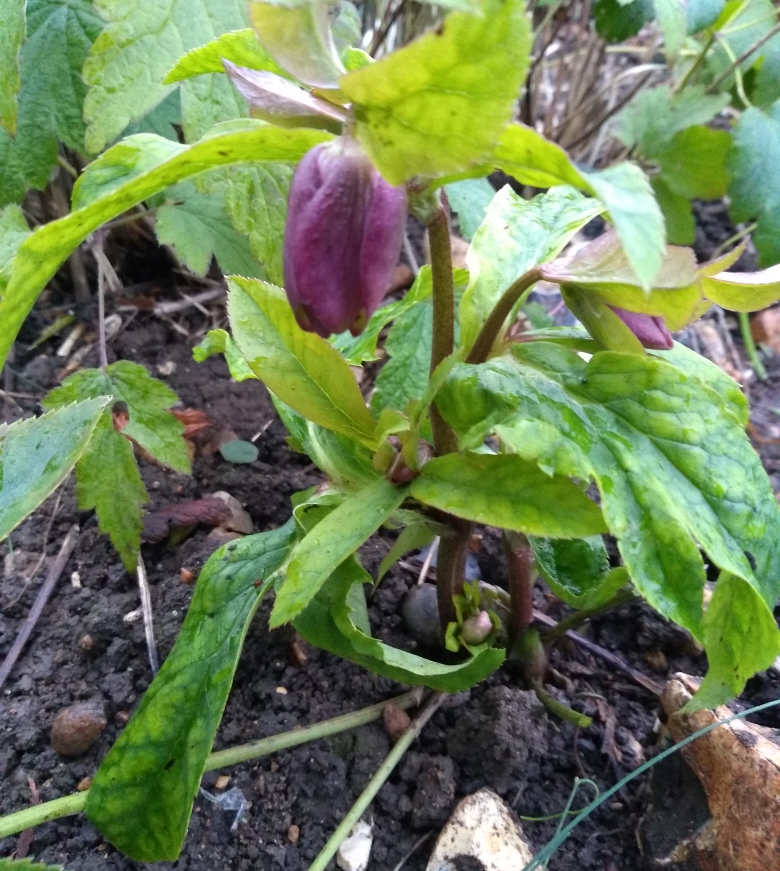
Gardens also continue to show signs of life at this time. The phrase ‘putting gardens to bed’ in winter is often a misnomer and rarely happens. They are never entirely in hibernation as something is usually awake, even if it is only visiting birds. Plus winter or spring flowering plants begin to bloom and grow now. Last week I noticed Hellebores starting to flower
along with Snowdrops (Galanthus)
and Daffodils (Narcissus)
peaking through the soil.
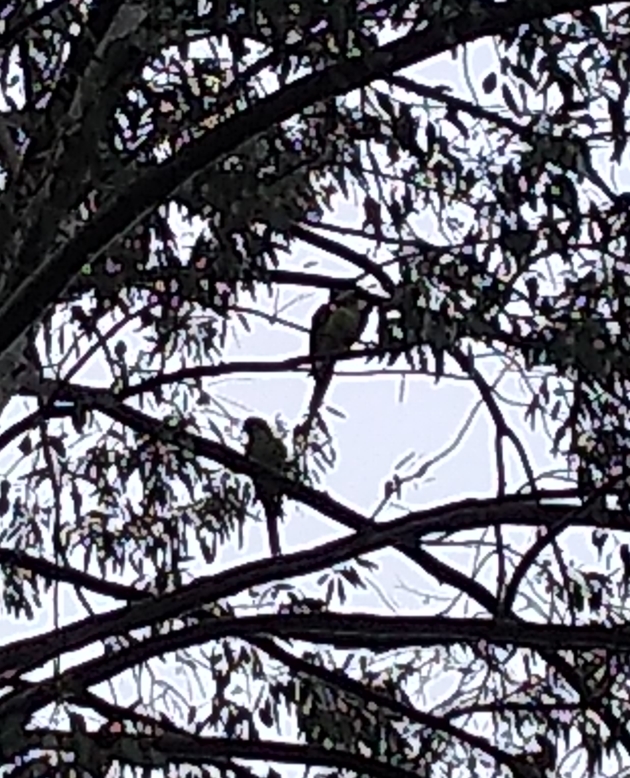
A bird that is easier to see these days are Ring-necked parakeets (Psittacula krameri). They were particularly prominent in one garden I worked at last week where a group kept flying between several trees, before eventually settling within a Eucalyptus tree.
Two parakeets silhouetted in a Eucalyptus tree.
These birds and trees were introduced into this country from warmer areas of the world, yet both species can cope with the colder uk climate.
The evergreen Eucalyptus tree leaves are a bluish green colour when mature. Eucalyptus oil is obtained from the mature leaves, known for its antiseptic properties together with a distinctive aroma. Immature leaves are more rounded and a bluish shade. The tree flowers from July to October and are especially liked by bees and other pollinators.
Ring-necked parakeets (Psittacula krameri) are parrots that originated from Asia. The history of their introduction to the UK is explained by the RSPB here.
These birds have successfully breeded in this country for years to become a familiar sight in the south-east, particularly urban areas of Hertfordshire, Kent, Surrey and Sussex; their range extending further and further from London. Although they can be observed (and more often heard) throughout the year winter, when the trees are bare, is the best time to see them perched upon branches; unless you are lucky enough to have them visiting bird tables in your garden. They eat a variety of food, having developed an omnivorous diet as they naturalised over here (even though they remain vegetarian in Asia). While they usually eat seeds, fruit, nuts and berries they have been known to feast on scraps left out, including meat scraps. In fact it’s believed they can survive UK winters because they feed from bird tables.
Ring-necked parakeets are very social and can be seen in large flocks containing hundreds of birds. This can make them very noisy and therefore a nuisance in some peoples eyes. Yet whatever your opinion on these birds there is no denying their beautiful colours which seem to become more vivid at this time of year. Even on bleak days beauty exists; sometimes you just have to amend your focus to see it.
At this time of year eating food containing vitamins C and D (the latter also obtained via sunshine) can help keep you well and fight infections.
One great source of these vitamins is Rosehip syrup. Haws can be foraged now; further information on how to collect and use rose hips can be found on the Woodland Trust website.
Another fruit especially helpful for obtaining vitamin C are Oranges.
Last week I found a fungus with the common name, Orange peel fungus (Aleuria aurantia); it’s called this because it looks similar to discarded orange peels.
This fungus sits flat, directly on soil, gravel or grass (having no stem) between August and November in the UK. They were so bright that I noticed them from across the garden. I loved their vivid cheerful colour, as well as the shape as the folds enveloped each other; reminding me of flowers.
Once again, watching birds on my local Rowan tree has become my therapy as I remain inside more.
Last week, along with the usual suspects of Blue tits (Cyanistes caeruleus), Starlings (Sturnus vulgaris), a Robin (Erithacus rubecula) and Blackbird (Turdus merula) was a Song thrush (Turdus philomelos) feasting on some berries as well as a female Chaffinch (Fringilla coelebs) making a pit stop.
Another bird I noticed last week, while working in one garden, was a Wren (Troglodytes troglodytes). I followed a loud bird call towards a hedgerow where I managed to discover this distinctive small bird. It was wonderful being able to connect the call to a Wren; partly because I didn’t recognise the call but mainly because I got to see a Wren (highly unusual in itself, as they often hide themselves away). I wasn’t sure why it was emitting an alarm call, possibly a cat was on the other side of the hedge, hopefully I wasn’t the reason. Almost as soon I saw the Wren it disappeared further into the hedge; my fleeting glimpse ended. The Wren alarm call can be heard on the following link British birdsong.
It was lovely to see Buff-tailed bumblebees (Bombusterrestris) flying around Heathers last week. Heathers are a little out of fashion these day. Hardly ever used in modern garden designs, these plants are usually found in established gardens or only placed in container displays.
However, I think this trend should be reversed. I’d like to see their inclusion in more gardens as they are valuable to pollinators at this time of year.
The photo above shows that Heathers are wonderful additions to gardens in late autumn through to early spring, when Buff-tail Bumblebees still forage on milder days. These shrubs even add visual interest when other plants have started to die back; another reason to include them. For advice on growing Heathers see the RHS website.
Buff-tailed bumblebees are increasingly being seen late in the year as they establish nests well into October and November. Therefore worker bees visiting blooms now and throughout mild winters is not unusual (See the Bumblebee Conservation Trust website) for further information.
To add Heathers (or other winter flowering shrubs) is a wonderful present to give bumblebees, to help them survive into next year.
This years fireworks have been matched by the incredibly vivid colours on deciduous trees. Due to the weather in 2020, nature has put on a spectacular display in the UK.
We had quite a few cold and frosty mornings last week. I like waking up to them because it means the sun will shine in a clear sky.
Last Thursday, was one such morning. At one job, leaves had to be cleared near an old swimming pool, which has become a natural pond over years of neglect and a wildlife haven throughout the year. I was conscious of needing to be careful when undertaking this task, due to possible wildlife hiding amongst the debris. I knew there were newts in the pool during the summer and wondered if some might be keeping warm under the fallen leaves; this meant the job would take longer to complete.
Unfortunately there was a group of four in one leaf pile. I didn’t take photos as I didn’t want them to be exposed for too long. Instead I quickly relocated them to a hidden corner nearby and covered them in a thick layer if leaves so they wouldn’t be disturbed again. Consequently I was unable to identify them quickly enough.
In the UK we have three native species of Newt. (See the ARC Trust for identification)
The most likely species candidate for the ones I found is the Smooth newt (Lissotriton vulgaris) However they could have been Palmate newts (Lissotriton helveticus). Less likely was that they were Great crested newts (Triturus cristatus) as they weren’t dark or warty enough.
I often see frogs in gardens so it’s always a bonus to see other amphibians for a change. I am glad some survived through to Autumn.
The ARC trust have the Garden dragon watch where you can help with a survey, to keep track of Newts living in gardens.These wonderful creatures aren’t quite dragons but in my imagination they a mini version of a fantastic beast.
Last week ended with a wonderful announcement in the news, the Great fox-spider (Alopecosa fabrilis), presumed extinct since 1993, has been refound alive (see the BBC News report). This highlights, both the amazing work undertaken by naturalists, as well as the importance of protecting wildlife and their habitats.
As an amateur naturalist and gardener, I haven’t undertaken such groundbreaking work but I try to do my bit whenever and wherever I can. I think of J.R.R. Tolkien’s quote ‘Even the smallest person can change the course of the future.’ from The Fellowship of the Ring (The Lord of the Rings trilogy) in these moments. We can all play a small part in saving nature’s wonderful diversity so that it has a future.
With this at the forefront of my mind I think back to one small act I hope made a difference last week. I noticed a female Common carder bee (Bombus pascuorum), identified by the white hairs on the sides of its thorax. It isn’t unusual to see these females fly this late in the season, (possibly a new queen getting ready for hibernation before starting a new nest in spring). However the one I saw was very still; I was concerned it was worn out and required help so I gathered some Verbena bonariensis and Salvia flowers to revive it. Thankfully my instinct was probably correct because it fed from the nectar contained within the posy I laid next to it.
Along with some cultivated plants, a few wild flowers were still blooming, Red clover (Trifolium pratense) and Yarrow (Achillea millefolium). Even though the latter flowers through to November, Red clover usually only blooms until October. The Common carder bee feeds from the Red clover flowers along with Honeybees (Apis mellifera) and Red-tailed bumblebees (Bombus lapidarius).
I also learnt some new fungi last week. The Golden waxcap (Hygrocybe chlorophana) which grows on grassland.
This fungi is on red list for threatened fungi in some European countries such as poland and Switzerland but not in the UK
Plus the other fungi I noticed, the Shaggy scalycap (Pholiota squarrosa) at the base of a tree stump.
This is often found next to broadleaf trees stumps, particularly beech (Fagus), and occasionally spruces (Picea) between August and November.
The photo above proves the importance of being careful when tidying gardens so hiding insects don’t become injured.
It’s best to leave cutting down perennials until spring if you can; not only do insects, like these Seven-spot ladybirds (Coccinella septempunctata), shelter amongst them but they provide food for birds too.
It was great to still witness pollinators flying around last week. Even though, due to the colder weather numbers have greatly reduced, some insects are still foraging. I noticed the odd hardy Buff-tailed bumblebee (Bombus terrestris) as well as a few Honey bees (Apis mellifera) visiting autumn flowering perennials and shrubs. Currently the most wonderful spectacle is Common Ivy (Hedera helix) in full bloom. Loved by pollinators including butterflies, bees and hoverflies, ivy is a useful plant to have in flower at this time of year. It supports up to fifty species altogether, such as providing food for Holly blue Butterflies (Celastrinaargiolus), along with the Small dusty wave (Idaea seriata), Angle shades (Phlogophora meticulosa) and Swallow-tailed (Ourapteryx sambucaria) moths. Mature Ivy plants flower in September and October on clustered umbels. Eventually, pollinated flowers develop into fruit that provides food for Thrushes (Turdidae), Blackbirds (Turdus merula), Blackcaps (Sylvia atricapilla) and Wood pigeons (Columba palumbus). Ivy also provides shelter for hibernating insects over winter.
However the most prevalent insects I witnessed covering the ivy flowers last week were the Common wasp (Vespula vulgaris). They weren’t nesting amongst it but feeding on the abundant nectar. My confidence in their complete focus on the ivy flowers, and not being bothered by my presence, enabled me to unusually observe them up close. Each time I came across ivy covered with wasps, I would take a few moments to watch and listen. Unlike bees, their buzzing was very faint; you had to listen carefully to hear it. I had never been close enough to appreciate the wonderful pattern on their abdomen before or watch their activity as they hurriedly switched from one flower to another.
I would have been observing male and worker wasps obtain nectar from the ivy (which also visit other umbellifier flowers). Queens are active in spring, collecting nectar from Cotoneaster and other spring flowering shrubs.
These much hated creatures are useful pollinators (as the photo below proves) when not pestering us as we eat outdoors. We can’t really blame them trying to access an easy source of food or protecting nests when we stumble upon them.
Wasps also help keep insect numbers down which once captured, are chewed up and fed to the larvae.
Although I haven’t seen any yet, I am ever hopeful that I will see Ivy bees (Colleteshederae) as I look at ivy. Recorded for the first time in southern Britain as far back as 2001, these solitary bees feed on ivy nectar and are therefore only seen when ivy flowers. Since they were first noted in Britain the species has been spreading northwards, nesting in sandy soil. For further information see (Wildlife Trust).
More fungi started to appear last week too; I saw – Common bonnets (Mycena galericulata)
– Shaggy ink caps (Xylaria hypoxylon) and
– Candlesnuff (also referred to as candlestick or stag’s horn) fungus (Xylaria hypoxylon).
You have to look closely to identify this minute fungi, found on decaying wood, it has a blackened base.
Lastly I was utterly surprised to witness a Fox (Vulpes vulpes) run across my allotment as I worked early on Saturday afternoon. It looked healthy so presumably had been disturbed with all the activity from allotmenteers tidying their plots.
Leaf colours slowly started to change last week and it definitely began to look like Autumn; even so the occasional bee was still visiting flowers.
Unlike last year, which was amazing for fungi, 2020 has been fairly quiet up to now. The few I have noticed have usually been Fairy ring mushrooms (Marasmius oreades) or Clustered domecaps (Lyophyllum decastes).
However on Tuesday, I did see several groups of Fairy Inkcaps, also called Fairy bonnets (Coprinellus disseminatus) in one garden. I was fascinated to see them appear to grow from the gaps of a garden wall; especially as this agaricus fungi feeds on decaying wood.
Confusingly, Coprinus is Latin for ‘Living on Dung’ which these mushrooms don’t do. Plus most Inkcaps dissolve into black ink as they mature, but not these. The fruiting bodies of this fungus were gaining nutrients from a nearby raised bed, made of old sleepers, that was attached to the wall. I love how the mushrooms look set against the brickwork, almost as though nature is breaking through a human creation.
Although I saw lots of Fairy mushrooms last week, I didn’t notice any fairies.






 Bee in the Moment