Posted in nature

Relaxing Holiday Adventures

Over the last few weeks Buddleja have been in flower, encouraging butterflies to visit and making them more visible. I have begun to notice Red admirals (Vanessa atalanta) and Peacocks (Aglais io) alongside Large (Pieris brassicae) and Small white (Pieris rapae) butterflies.

Having some time off work enabled me to take more walks. In my local woodland park I started to see a lot more Commas (Polygonia c-album) and Small heath (Coenonympha pamphilus) butterflies too. On a few occasions they flitted around me as I stopped to watch them; an absolutely joyful experience, almost like they were interacting with me in their own way.

Thankfully in the two weeks, I managed to venture further afield. On one occasion, I saw a Ringlet (Aphantopus hyperantus) butterfly while visiting an Arboretum in Herefordshire.

Woodlands are their habitat and they can be seen during July and August. The Caterpillars of this butterfly feed on various grasses, such as Tufted Hair-grass (Deschampsia cespitosa), Common Couch (Elytrigia repens), and other meadow grasses (Poa spp.).

Spending some time away on holiday gave me the chance to explore other environments, including those next to water, thus enabling me to notice different wildflowers.

One walk took me past a canal. Water mint (Mentha aquatica) and Purple Loosestrife (Lythrum salicaria) were growing all down the canal edge.
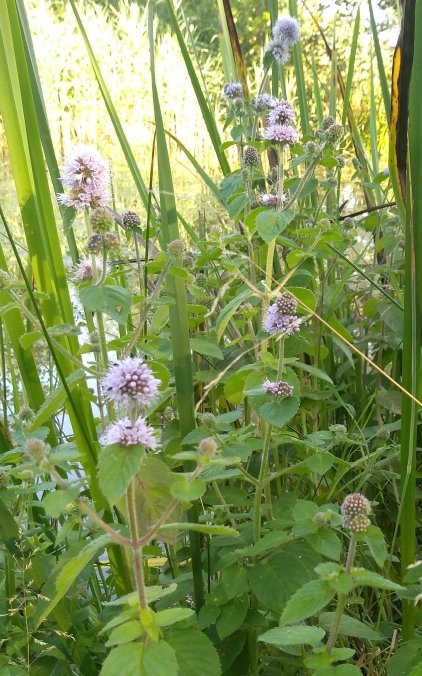
Water mint

Both plants grow in shallow water and boggy conditions so are often found in fens and marshes as well as along the margins of ponds, streams, rivers and of course canals, as I discovered. They require habitats with full sun or dapled shade to bloom and are great for pollinators. Water mint flowers from the beginning of July up to November while Purple loosestrife only blooms between June and August. Purple Loosestrife can be visited by insects with long tongues and particularly enjoyed by butterflies and Red-tailed Bumblebees (Bombus lapidarius). It is also eaten by caterpillars of the Small Elephant Hawk-moths (Deilephila porcellus).
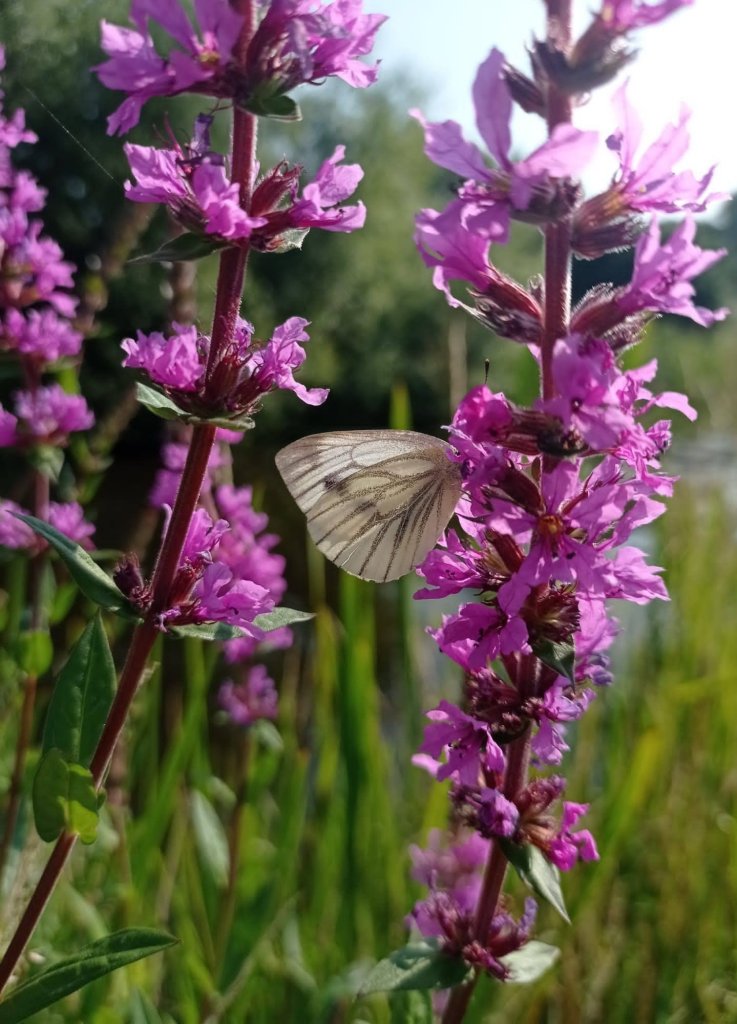
A Large white butterfly visiting some Purple Loosestrife.

As well as butterflies there were several dragonflies and damselflies, including this Blue-tailed damselfly (Ischnura elegans) dancing over the water.

This Blue-tailed damselfly was seen resting on a nettle leaf.

However, most of the bees I saw on that walk were interested in the plant I encountered at the first lock, Himalayan balsam (Impatiens glandulifera).

While the lock was completely swamped by this plant, it was only section I saw it in. It’s the first time I had come across Himalayan balsam, although I know of its reputation.

The pretty flower of the Himalayan balsam is popular with pollinators, especially bees. Here a bee is seen climbing into the flower to obtain nectar and pollen.

First introduced into the UK in 1839, from the Himalayas, this plant soon escaped formal gardens and naturalized in the wild becoming a nuisance in waterways. It grows fast and can become invasive very quickly as, up to 800 seeds from each pod, explode as far as 7 meters from the parent plant and even travel downstream. It isn’t long before a thicket is created where the plant out-competes other species to reduce biodiversity, cause erotion of riverbanks and affect water quality. All this means it is considered a weed in waterways and often removed by work-parties whenever possible. In fact it had been previously cleared from a lot of this canal. Control methods include pulling and cutting before they get a chance to set seed. It can take a few growing seasons before control over this plant is established. Management of this plant is mentioned under schedule 9 of the Wildlife and Countryside Act 1981. Interestingly, in Hertfordshire, control of this plant involves collection of the flowers to produce pink Gin (further information can be found at Herts Wildlife Trust).

The following week I visited a beach in Kent, it was so relaxing to hear the sounds of the seaside. One plant I noticed growing amongst the rocky area near the shingle was Alfalfa (Medicago sativa).

I know this plant as a green manure on allotments and gardens, adding nitrogen to soil for crops the following season. It’s also used as silage for livestock in agriculture plus alfalfa sprouts are used in some cuisines. I have never seen it in the wild or even flowering. There wasn’t a great swathe of it so clearly the plants were due to the odd escapee into the wild; perhaps a few seeds having blown there or been disposed by a bird. It was certainly good for local pollinators.

A Small white butterfly visiting the Alfalfa.
Posted in nature

Bring me Sunshine 🦋

The last few weeks have been opposites in terms of the weather. A wet previous week turned into the hottest of the year so far (with no relief overnight). Although too hot for my comfort, it was perfect weather for butterflies, and a great start for the Big Butterfly Count. Finally I was beginning to witness an increase in the amount of butterflies. I was getting worried this years reduction in butterfly sightings (due to the cold spring and wet summer experienced in 2021 up to this point) would continue. However by the end of the first week, I saw a Speckled wood (Pararge aegeria) and a Brimstone (Gonepteryx rhamni). Then, while on a walk around my local woodland park (early on the following, sunny and very warm, Sunday morning) I witnessed lots of butterflies making the most of the sunshine.

In one open area of the park, the grass had been allowed to grow, with many species of wildflower blooming amongst it. One of the plants I saw was Common centuary (Centaurium erythraea) which blooms between May and October. Overshadowed by the other wildflowers and grasses, initially this shorter plant was difficult to spot; in fact had it not been next to a mown walkway, I may not have seen it. Thankfully it’s pink and yellow colouration stood out enough, from the more muted colours surrounding it, as I wondered past trying to identify butterflies.

Common centuary represents delicacy and felicity in the Victorian Language of Flowers.

This plant is found in a many places, from heathlands and woodlands to cliff tops and quarries. A natural meteorologist, the flower closes when the weather is dull and damp to reopen once the weather brightens up. While I’m not sure this is a practical weather indicator to use (when a simple observation of the sky, in that moment, will give you the information you require) it’s a pretty cool reaction to weather conditions.

There were many butterflies flitting about on that Sunday morning. Most prominent were Gatekeepers (Pyronia tithonus), Small skippers (Thymelicus sylvestris)

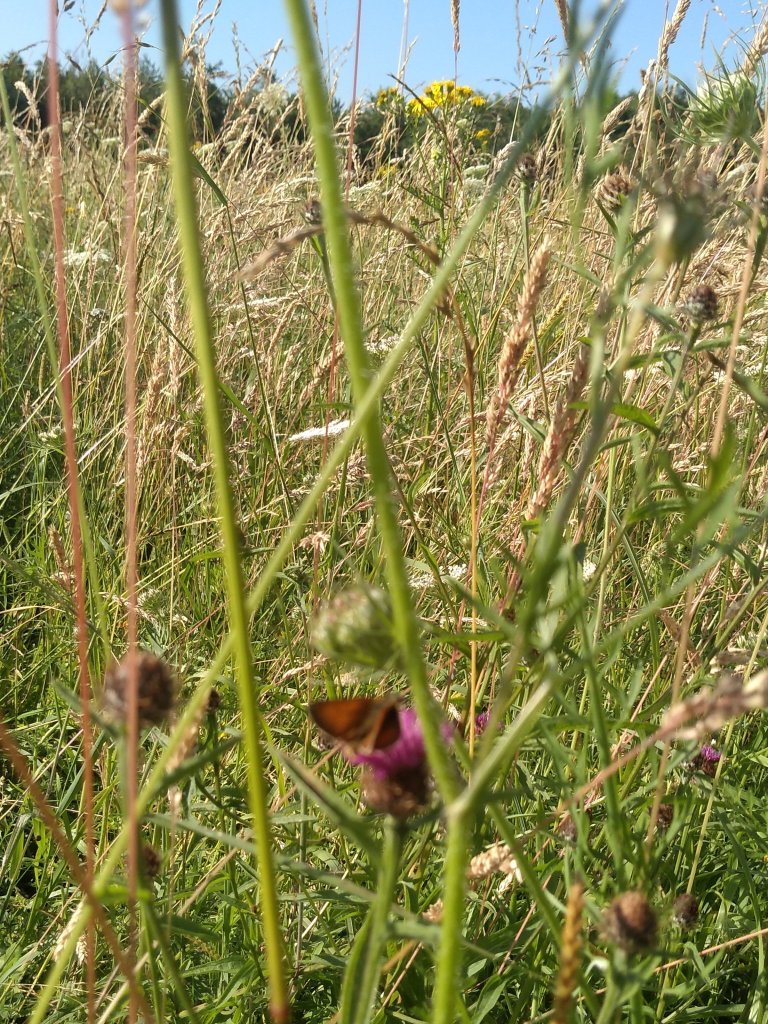
A small skipper visiting some Knapweed (Centaurea).

and Small heath (Coenonympha pamphilus) butterflies; probably due to the grass being allowed to grow fully. All these species of butterfly are associated with grassland and their caterpillars feed on grasses.
Marbled white (Melanargia galathea) caterpillars also feed on grasses while the adults feed on many purple coloured flowers, including knapweeds; so it was lovely to see one of these butterflies flying around the meadow too.

Another plant that was growing amongst the long grass was Ragwort (Jacobaea vulgaris). This is a favourite nectar source of the Gatekeeper butterfly, along with other plants including Bramble (Rubus fruticosus), Wild marjoram (Origanum vulgare) and Wood sage (Teucrium scorodonia).

Ragwort is great for many pollinators, including these Small heath butterflies.

I also got to see another insect with a strong connection to Ragwort, a caterpillar of the day flying moth, the Cinnabar (Tyria jacobaeae).

This wasn’t the only caterpillar I noticed. Earlier in the week, I saw a caterpillar of the Knot grass moth (Acronicta rumicis), seen below on a bramble leaf.

This caterpillar will be part of this years second brood, the adults of which appear in August and September. The Caterpillars have a varied diet, eating a wide range of herbaceous plants; this one clearly eating out (and pooping on) bramble. The photo of the adult moth can be seen at Uk Moths.

Posted in nature

Understated Beauty

It was nice to notice a moth last week after a long absence, especially as Moth Night was held between 8-10th July in 2021. Each year Atropos, the Butterfly Conservation and the Centre for Ecology & Hydrology organise a citizen science moth recording event while celebrating these wonderful beautiful creatures. More information on Moth night can be found at Moth night.

With a wingspan of 18-25 mm, the moth I saw on Tuesday was a Garden carpet moth (Xanthorhoe fluctuata).

This common moth can be found from April to September, in many areas of the UK but particularly in gardens and allotments. Although this moth flies during the night, as with my sighting last week, they can be discovered at rest on buildings during the day.

The caterpillars of the Garden carpet will eat through Garlic Mustard (Alliaria petiolata), Shepherd’s-purse (Capsella bursa-pastoris), wild Horse-radish (Armoracia rusticana), Hairy Bitter-cress (Cardamine hirsuta) along with cultivated cabbages amongst other plants.

A useful moth ID app that I use a lot is ‘What’s Flying tonight’ produced by the Butterfly Conservation, UK moths and the Centre for Ecology & Hydrology.

Posted in nature

A Long Wait

A Tree bumblebee (Bombus hypnorum) resting on a Lime tree (Tilia) leaf.

Often one of the earliest bumblebees to emerge, I thought I wouldn’t notice any Tree bumblebees this year. Colonies of this bee are mostly active from March to July so by now my chances had reduced.

The first record of these bees in this country was in Wiltshire, in 2001. Now they are seen in Scotland (by 2013) and Northern Ireland (in 2017) having become one of the most common eight in the UK (see PDF from the BBCT below); especially making use of bird boxes for their nests.

Early in the year, they forage for nectar and pollen at plants such as Winter heathers (Erica carnea), Pussy willow (Salix caprea), Apple (Malus), Cotoneaster, Ceanothus and Chives. While later on, in early summer, they will favour the flowers of Lime trees, Fuchsias Raspberries and Blackberries

Posted in Allotment, nature

Witnessing the Solstice Dawn Arrive

On the eve of the Summer solstice I love to go to sleep early with my curtains open so I can wake up naturally and see the sunrise; it helps me align with the seasons and appreciate nature in a different way. This year I awoke at 3:50am and immediately opened the window so I could enjoy the dawn chorus. Initially the predominant birdsong was that of Blackbirds (Turdus merula), occasionally punctuated by the calls from a Wood pigeon (Columba palumbus), a murder of very vocal Carrion crows (Corvus corone), along with a male Pheasant (Phasianus colchicus) in the distance too. The crescendo came around 4:10am but it wasn’t until finally at 4:42am, when things had quietened, that I heard a few more birds singing. There was a lone Dunnock (Prunella modularis) and then a Greenfinch (Chloris chloris) at about 4:50am; followed much later by Blue tits (Cyanistes caeruleus) which I observed in the Rowan (Sorbus) tree nearby.

It’s interesting to notice an order to the bird song. Blackbirds are the first to be heard, almost like they are an alarm call for the other songbirds; clearly eager to catch the worms.

I also learnt another birdsong last week, heard around midday on Thursday. Hidden somewhere amongst the treeline next to a field, was a Common Whitethroat (Curruca communis); the song can be heard here on the RSPB website.

This warbler visits the UK from Southern Africa (from countries south of the Sahara) between April and October. Once the males arrive on these shores, they will establish territories and build nests for prospective partners (approximately ten to fourteen days before the females arrive).

These birds are about the same size as Great tits (Parus major) and named after the white plumage on their throats. Males can be differentiated from female due to their grey heads. They feed on insects as well as fruit and berries later in the year.

After being concerned that I wasn’t seeing many butterflies and ladybirds the previous week, last week
it finally became warm and sunny enough for them to venture out once again. It was lovely to witness a couple of Small tortoisehell butterflies (Aglais urticae) along with some bumblebees visit a Scabious plant in one garden.

Plus there was a loveliness of Seven-spot ladybirds (Coccinella septempunctata) at the allotment, hunting down on all the aphids which also appeared.

Posted in Allotment, nature

I’m Yellow and Black but not a Bee; What am I?

Cooler temperatures and very wet weather meant that insect observations were few and far between last week.

In sunnier moments, bees were still visible but I haven’t noticed many moths, butterflies or ladybirds recently; I do hope that changes soon.

However there were a few momentous insect observations last week. I discovered a Mining bee nest on the allotment. As there was an Ashy mining bee (Andrena cineraria) on the plot last year then it could be evidence of another one making its home there.

The other insect, one I got to learn about later in the week, was a stunning parasitic wasp; possibly an Amblyteles armatorius (however identification is difficult to be completely certain).

If it was an Amblyteles armatorius then it’s hosts can be several species of moth caterpillar, such as the Yellow Underwing (Noctua pronuba).

The yellow and black parasitic wasp was 15mm in length (antennae included) and is often seen in June; although there is a second generation later in the year too. Adults can be noticed feeding on pollen from plants with umbellifer flowers such as Cow parsley (Anthriscus sylvestris) or Hogweed (Heracleum sphondylium). There was Lovage (Levisticum officinale) in flower in the garden where the parasitic wasp was noticed, so perhaps it had visited that before flying off to find another plant.

Posted in nature

The Mystery is Finally Solved


At the beginning of the second lockdown I started walking different routes to explore my local neighborhood further. On one of these investigations, I came across a large tree that I didn’t recognise. I was intrigued as seed pods had remained on the branches throughout winter. I suspected that it was from the legume (Fabaceae) family and determined to eventually discover what tree it was.

Every so often I would check on its development, then about a month ago leaves began to appear but it was only in last week that the mystery was finally solved. On route to the allotment I noticed that beautiful scented flowers were hanging from the tree and the sound of lots of bees buzzing all over it was incredible. Finally I could identify it as a False acacia (Robinia pseudoacacia), a large hardwood tree which at full height can reach 25 meters.

Named by Carl Linnaeus, Robinia was in honour of two Royal gardeners to Henry IV of France; Jean Robin (1550-1662) who was also a botanist, along with his son Vespasien Robin (1579-1662). Pseudoacacia was given to the tree because of the similarity of the leaves and spines (thorny growth on the shoots and young branches) to those of an Acacia; Pseudoacacia literally translates as False acacia.

The lime green pinnate leaves (containing 3-11 pairs of leaflets) will turn yellow in autumn, so the tree has interest later in the year too.

However that is where the similarity stops as Acacias are part of the Mimosa (Mimosoideae) family. In fact this tree, as I suspected, is from the legumes (Fabaceae) family. The flowers and seed pods resemble those of peas and beans plus the roots have nitrogen fixing nodules. In some countries, like South Africa and Australia, suckering roots can lead it to become invasive.

The scent coming from the flowers was similar to orange blossom and very obvious from a distance as I walked towards it. The White Flowers, with a hint of yellow at the base hang down in groups (racemes) and appear in May and June.

Posted in Allotment, nature

Time to Make Daisy Chains?

It was encouraging to witness dragonflies zipping about and mating over the past week; another sure sign of summers arrival for me.

Down at the allotment, it’s been wonderful to see the addition of a pond on a neighbouring plot. I’m excited to see what inhabits it; hopefully some beneficial wildlife will find it soon, perhaps some dragonflies of our own.

The predominant flowers on on recently mown grass are still daisies (Bellis perennis) although White clover (Trifolium repens) and Bird’s-foot trefoil (Lotus corniculatus) have begun to bloom alongside them.

My White clover and Bird’s-foot trefoil seedlings, down at the allotment, are coming along fantastically; I look forward to eventually transplanting them to my wild flower patch. Unfortunately, the Yellow rattle (Rhinanthus minor) seeds didn’t take.  Perhaps the weather earlier on in the year wasn’t conducive to their germination so I’ll try to obtain plants in autumn instead. Ideally I need them to control the grass so the other wild flowers have a chance to thrive.

I love seeing daisies everywhere. I love their simplicity, abundance, cheerful yellow center along with the fact they open during the day and close at night. Seeing them always brings back memories of making daisy chains as a child, which makes me smile. When I doodle flowers, it’s the daisy shape I always begin with before venturing onto others such as dandelions and foxgloves.

Therefore, I also enjoy seeing Oxeye daisies (Leucanthemum vulgare) join in the grassland mix as well which they did last week. When the grass on the verges is left to grow long for pollinators, it is these taller daisy flowers that can be seen looking upwards towards the sun.

Other tall wildflowers that began to bloom in the unmown grass last week were Yarrow (Achillea millefolium), Common  mallow (Malva sylvestris) and White campion (Silene latifolia). These plants are also great for pollinators, especially the latter whose might time scent is a temptation for moths. In fact this flower was added into Elizabethan pot pourri due to its clove aroma.

Posted in Allotment, nature

Blossom Watching

Warm sunny weather has finally replaced the wet conditions we seemed to be stuck in all May.

As I write this, meteorological summer has begun so the change in weather is rather fitting.

It has been fascinating to follow the seasons so far this year; paying particular attention to the timing of tree blossom arrival. After the Blackthorn (Prunus spinosa), the ornamental Cherries (Prunus) took over alongside the Crab apples (Malus). Then for the last few weeks Rowan (Sorbus), Horse chestnuts (Aesculus hippocastanum) and Hawthorn (Crataegus) have been blooming and continue to do so.

More wild flowers are joining in the visual performance as Red clover (Trifolium pratense) and Common vetch (Vicia sativa) started putting on a show too.

Even on the allotment, the Lacy Phacelia (Phacelia tanacetifolia) has begun to bloom alongside the vibrant Geums, which is a great combination.

The bees have been enjoying their nectar and pollen, along with a Hairy shield bug (Dolycoris baccarum) who came to visit on them Saturday (see photo below).

We do have blackthorn hedges nearby so I guess it had been overwintering on those.

I’ve noticed that the Chive flowers are particularly loved by worker Red tailed bumblebees (Bombus lapidarius); this isn’t too much of a surprise as I know they have short tongues, plus once they have found a good food source they will repeatedly visit the same plant.

Seven-spot ladybirds (Coccinella septempunctata) numbers are increasing on allotment too. Plus one Female Wolf spider (Pardosa amentata) carrying a blue egg sac was spotted.

It is always a joy to share my plot with beneficial insects, as I don’t use insecticides.

It was nice to have a long weekend, it gave me a chance to walk through the local woodland park which I hadn’t done for a few weeks. Lots of butterflies were flitting about, including one Speckled wood butterfly (Pararge aegeria).

Posted in Allotment, nature

Finally, a Flash of Blue

For a few weeks, I have been wondering if I would notice any Holly blue (Celastrina argiolus) butterflies this year. However, the week beginning 17th May I was finally rewarded with the sighting of a male (deduced from a lack of dark edges on the wings) making the most of a brief spell of dry sunny weather. As so often with butterflies, it didn’t remain still long enough for me to photograph it.

From one year to the next, Holly blue numbers can vary significantly. This rise and fall in numbers is mostly due to the parasitic Ichneumon wasp, which feeds solely on the larvae of this butterfly. When this wasp has a successful year then Holly blue numbers fall. Consequently the reverse is also true because without adequate Holly blue larvae numbers of the wasp decrease, thus enabling Holly blue butterfly numbers to increase once again. Perhaps this explains why I haven’t seen many Holly blue Butterflies as usual this year; however other factors could be the weather (so far this May has been colder and damper than usual), or maybe I simply haven’t noticed them flying around.

This male butterfly will have been part of the Spring generation (adults which fly from March to May); however there is also a summer generation that I may have more opportunity to witness, later in the year.

As a caterpillar, the spring generation will have been feeding upon Holly (Ilex aquifolium); preferably the buds, berries and terminal leaves of female plants.

The caterpillars of the second generation of butterflies seen flying around between July and September mostly feed in Ivy (Hedera helix); although they will also feed on other plants such as bramble (Rubus fruticosus) Gorse (Ulex spp.), Dogwoods (Cornus spp.) and also Snowberries (Symphoricarpos spp).

Things are moving along at pace at the allotment as well. There are lots of seedlings on the go, fruit is developing and the potatoes are showing growth. The Rhubarb has been harvested for a while now too.

New tenants have taken over plots at the bottom and to the left of our plot. Our new neighbours having made such a headway already means that we no longer have long grass on these two sides. While it is lovely to see the plots being productive at long last, it is a little sad to think we won’t hear grasshoppers during the summer like we did last year.

The removal of the lush grass may explain why we found two frogs (Rana temporaria) on our plot last weekend. They seemed to be seeking refuge on the tiny patch of grass I purposely left for wildflowers. Thankfully for them the predominant thing growing there is still grass highlighted with a few dandelions. As I want to reduce the slug and snail population on our plot, I am happy to encourage these frogs by giving them a home amongst the long grass. Instead, I may move the wild flower area nearer to the shed.