February has a duality to it; on one hand plants have begun to bloom (bringing the excitement of Spring around the corner) while on the other, the weather reminds us that it’s still Winter and we must be patient for a little longer. Last week three storms arrived, including Eunice with high strength winds leading to rare red weather warnings for wind and floods in the Bristol channel area and South East (with the after effects still being experienced in other areas of the UK). Bad weather usually arrives in February, in fact last year we had snow.
However, while nature continues at its own pace, Spring activities still occur earlier as decades pass. I read an article by Miranda Bryant in the Guardian recently regarding indicators of Spring, flowering and bird activities, occuring earlier since 1987. Pre 1987 plants flowered a month later than they did between that year and 2019 (In fact this was particularly evident in 2019 and yet again in 2020). The Woodland Trust’s Natures calender also shows this trend. The article can be accessed in the following link- The Guardian .
It is too early to notice any indication of patterns in this blog yet, although one thing I have witnessed this year, not seen before are daisies appearing in lawns already.
Other cultivated plants that have begun to bloom in gardens, as usual at this time of year are:
As another month rolls on, an initial glance may suggest that nothing is changing. Bare trees and quiet gardens with cold weather still nipping at fingertips and noses still persist, while sunny days bring glorious colourful skies.
A stripey sunset.
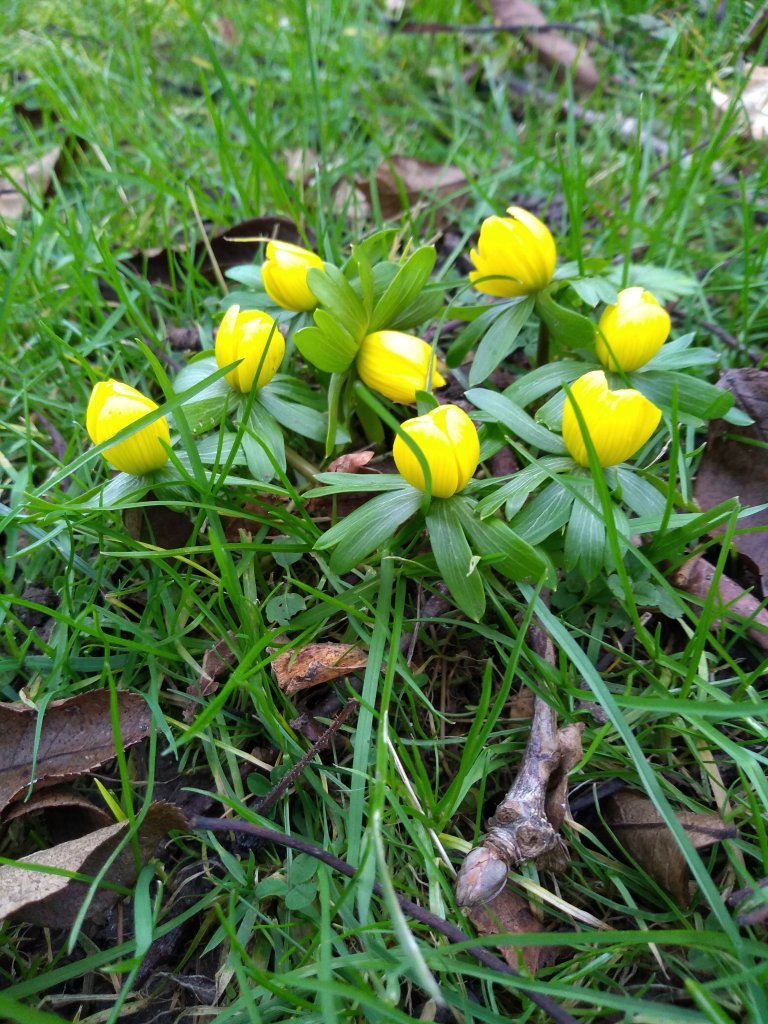
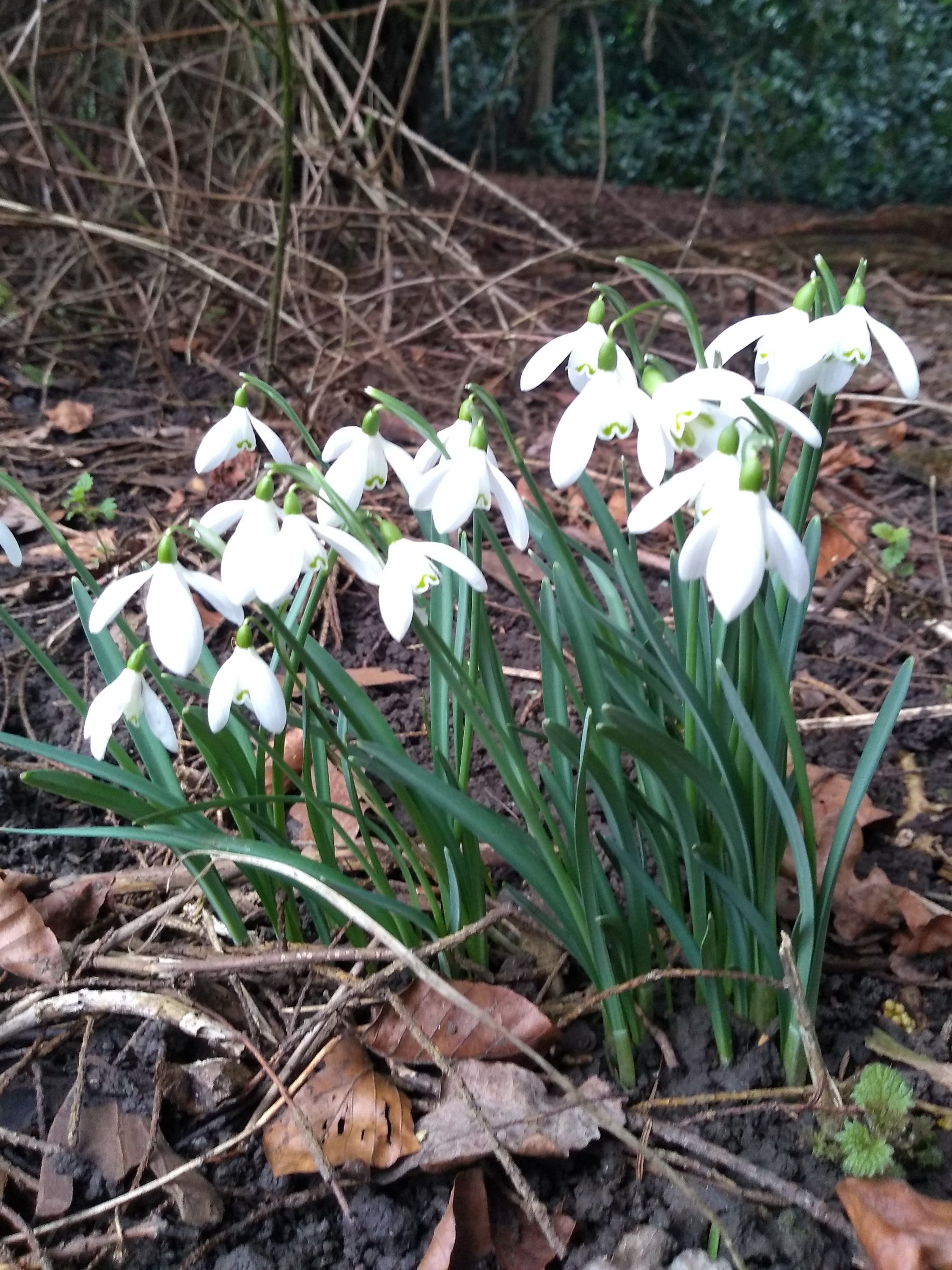
However, upon closer inspection small changes can be seen. The striking yellow of Winter aconites (Eranthis hyemalis) as well as delicate Early crocuses (Crocus tommasinianus) are beginning to bloom alongside the snowdrops (Galanthus).
The tiny red female flowers of Hazels (Corylus) have opened joining the male catkins. Plus, Blackthorn (Prunus spinosa) buds are ready to burst open (in fact on one walk, I saw a single flower already blooming).
I even witnessed a Red admiral (Vanessa atalanta) visit a flowering Mahonia on one sunny day; clearly making use of the milder weather before sheltering once again.
However the main focus of my attention, over the past few weeks, have been birds.
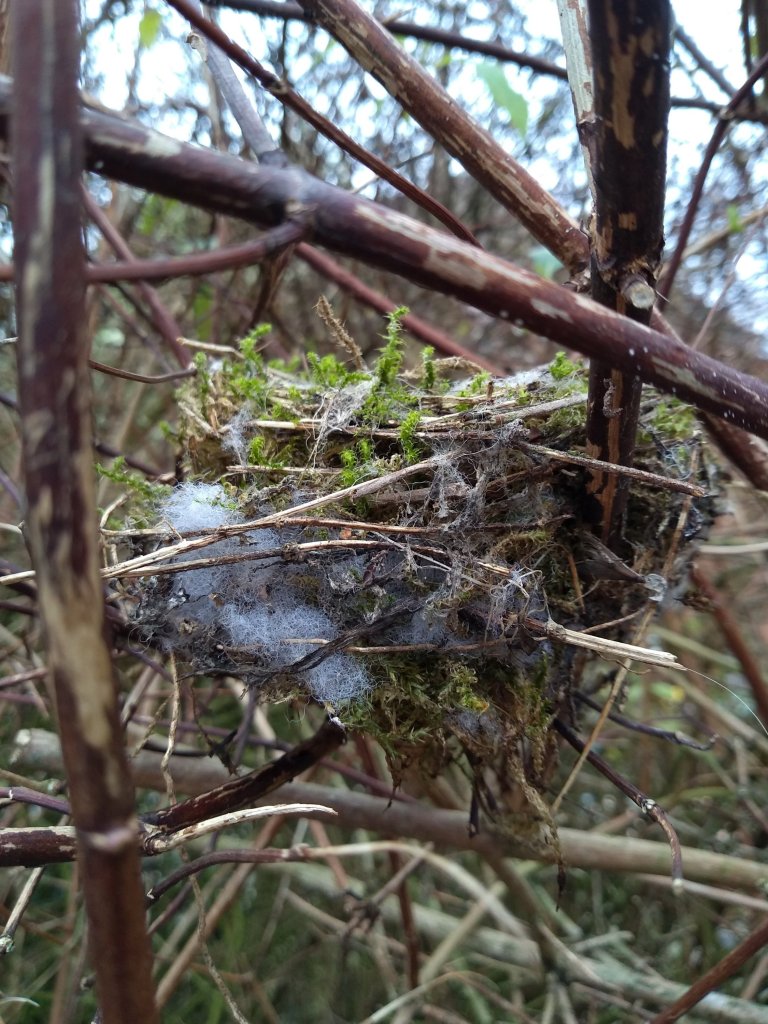
In one garden, I discovered a lovely little nest, from the previous year, in a shrub. Upon investigation I discovered it was either a Goldfinch (Carduelis carduelis) or Greenfinch (Chloris chloris) nest (most likely the former); it can be seen below.
I also saw a Lesser spotted woodpecker (Dendrocopos minor) perched on a tall tree in the distance. I was able to follow the sound of the drumming to watch it move around the trunk before flying off. Given the length of drumming and location of the red on it’s crown I was able to identify it as a male Lesser spotted woodpecker.
Then later in the week, while pruning roses, I watched a Wren (Troglodytes troglodytes) forage around the base of a hedge; I managed to film it briefly before it disappeared fully into the undergrowth.
I am currently reading ‘The Wren: A biography’ by Stephen Moss.
This charity shop find is a fascinating read. Chapters are set out month by month, each concentating on an aspect of a Wrens life. Included alongside facts about the Wren, are their involvement in human history, culture, literature, art and folklore together with beautiful illustrations. The chapter entitled February, for example, focuses on courtship and population. As with other books written by this author, such as ‘The Robin’, this book is definitely worth emmersing yourself in.
Lastly, once again I partook in the Big Garden Birdwatch. My results this year were- 7 Starlings (Sturnus vulgaris), 4 Magpies (Pica pica), 2 Bluetits (Cyanistes caeruleus), 2 Blackbirds (Turdus merula)- a male and female, 2 Wood pigeons (Columba palumbus), 1 Dunnock (Prunella modularis) as well as a Carrion crow (Corvus corone).
Although there weren’t any major surprises in what I saw, it was lovely that the Dunnock made an appearance (usually I only get to hear them). However the Red Kite (Milvus milvus), Ring-necked parakeets (Psittacula krameri), Great tit (Parus major) and Robin (Erithacus rubecula), that I regularly observe, all decided to have a lie in the previous weekend, most only making an appearance once my chosen hour had ended.
It’s lovely to write for my blog after so long. I have enjoyed a quiet period for a month or so; slowly taking time for self care, reflection and planning the allotment during a time when I suffer with Seasonal affective disorder (SAD).
I love this time of year. I love reading while snuggling under a blanket. I love the sights, sounds and general feeling of winter (especially in the new year after the distracting lights of Christmas) however my brain doesn’t. Each year from the beginning of October to the end of February I indergo a form of wintering. While wildlife winters through hibernation, migration or seeing the winter out with reduced activity. As hibernation is not possible, for me it is the latter; embracing the darker, quiter months as I spend most of my time at home. I have come to realise this wintering is essential in order for me to maintain a healthy mind.
I am still affected by the reduced amount of light but now I am able to see the other side of the winter solstice. For information on and how to find help for SAD, please follow the following links;
At this time nature becomes more important then ever to me. I look for small moments of comfort each day. Some of the wonderful nature I have witnessed during December and so far in January have been;
– The growth and blooming of early flowering plants. A reminder that gardens never completely sleep. Occasionally I’ve noticed a foraging Buff-tailed bumblebee queen visit them too.
The emergence of Snowdrops (Galanthus).Other bulbs beginning to show themselves like these daffodils (Narcissus).Helleborus beginning to bloom.
– The intoxicating scent of the Sarcococca which is located by the entrance to my flat. – Birds being more visible and starting to get more vocal. I especially enjoy hearing and seeing Carrion crows (Corvuscorone), one of my favourite birds, at this time. – Foxes (Vulpes vulpes) being visible as they search for food during the day and hearing a female fox at night (January and February are their mating season). – The beauty of frosts, together with the knowledge it will be a cold but very sunny day. – Glorious sunrises and sunsets.
The sun captured moments before it disappeared below the horizon.
– Night sky delights.
The Wolf moon, the first full moon of 2022.
– Trees silhouetted against the sky. This also allows you to notice nests too.
The large object in the tree is a Drey.
Squirrels and their homes are also easier to spot now (as shown in the last photo). A squirrel’s Drey, for both Greys (Sciurus carolinensis) and Reds (Sciurus vulgaris) are approximately the size of footballs. They are located near trunks where branches fork outwards and located about six meters above ground. They can be differentiated from bird nests which are often smaller, tidier and found further along branches and higher up the tree. Dreys are made with soft materials like moss, feathers, grass, leaves (not usually seen in bird nests) bark or pine needles. However, if squirrels find natural holes in trees, such as those made by woodpeckers, then they will make use of these too. Squirrels will have separate summer and winter dreys, the latter are more weather resistant while the summer ones are more airy.
Honey bees (Apis mellifera) overwinter in hives, huddling round the queen to keep warm, occasionally venturing out on warmer days. Bumblebees (Bombus) on the other hand have an annual lifespan with new queens, having mated during the summer and autumn months, hibernating underground until spring when they can begin a new colony; also sometimes waking up too early on warm days and foraging.
However over the past 10 years, in urban areas of Southern England, a trend has been seen with certain bumblebee species. Initially Buff-tailed bumblebees (Bombus terrestris), but since then Early bumblebees (Bombus pratorum) and Tree bumblebees (Bombus hypnorum) have begun to nest in winter rather than hibernate. Consequently winter flowering plants such as Mahonia and Winter Heathers (Erica), Winter honeysuckle (Lonicera fragrantissima), Winter aconite (Eranthis hyemalis), Hellebores (Helleborus) and Snowdrops (Galanthus) are garden essentials; enabling these bees to access pollen and nectar during the colder months.
Solitary bees on the other hand will survive throughout winter in burrows or cavities as eggs, with their own supply of nectar and pollen close to hand (as the adults don’t survive winter). These include Mining and Mason bees which emerge early in spring taking advantage of Willow (Salix), Blackthorn (Prunus spinosa) and Hawthorn (Crataegus monogyna) in bloom. Leafcutter and Carder bees emerge later still. The one exception are Furrow bees; like Bumblebees, the female will hibernate during winter and lay eggs in spring.
I have noticed lots of Mahonias blooming over the last few weeks, their bright yellow flowers and perfume is wonderful to experience during dull days. Somehow the colour shines more vividly against grey skies.
Mahonia eurybracteata ‘Soft Caress’, a Mahonia without spiky leaves.Mahonia x media
Another shrub that has been blooming recently is Viburnum farreri, it’s lovely scent wafting through the air too.
The temperature has fluctuated during the previous two weeks, with a few light frosts and hotter than average November days. Leaf fall is well under way now too keeping us busy at work. I never cease to be in awe of the beautiful leaf colours as the sun shines; They make fireworks look monochrome in comparison.
Fungi observations were still numerous. Here are some that I have seen over the past few weeks;
The Prince (Agaricus augustus)Golden waxcap (Hygrocybe chlorophana)Russula queletiiFalse saffron milkcap/ Orange milkcap (Lactarius deterrimus)
Amazingly I have still seen the occasional Buff-tailed bumblebee (Bombus terrestris) queen; plus the previous Friday I also noticed a Common carder bee (Bombus pascuorum) near a compost bin in one garden.
Common carder bee
The Rowan (Sorbus) berries on the tree outside my flat are almost gone, mostly due to a local flock of starlings (Sturnus vulgaris); however other visitors enjoying the bounty have been two Song thrushes (Turdus philomelos) and two blackbird (Turdus merula) couples.
I enjoy watching Starlings, seeing their shiny purple and green plumage and listening to their social interactions and mimicry. Starlings have a wide repertoire of calls because they imitate sounds, especially other bird calls (usually 15-20 distinctive sounds); even their murmurations are beautiful to watch.
Other birds visiting the tree, not interested in the berries, were a male and female Chaffinch (Fringilla coelebs), my family of Blue tits (Cyanistes caeruleus) along with a newcomer, a rather vocal Coal tit (Periparus ater). It was lovely to be able to hear a new call coming from the Rowan, it can be heard here (RSPB).
It is Halloween, British Summer Time ended last night and initially today was a stereotypically autumnal day; windy and very wet. However now it’s less blustery and the sun is shining. Throughout the day, I’ve kept hearing Carrion crows (Corvus corone) call too; I love their haunting sound. Autumn has definitely taken hold over the past few weeks and there have been lots of treats to see.
Fungi continued to appear, showing biodiversity in untreated lawns. I managed to spot one of my favourites again this year, the Shaggy mane (Coprinus comatus) in various stages of development.
Also called Shaggy inkcaps or Lawyers mane.Here the gills have turned black and have begun to ‘drip’ onto the lawn, resembling ink.
I also saw Yellow club fungus (Clavulinopsis helvola).
The photo was taken after the grass had been mown so the very tip of the fungi had been cut off.
As with other fungi, Yellow club fungus has no negative affect on lawns. It likes acidic mossy lawns appearing between September and November.
There was one more fungi that I noticed (see below), possibly a Honey waxcap (Hygrocybe reidii) although I am not entirely sure my identification of this one is correct.
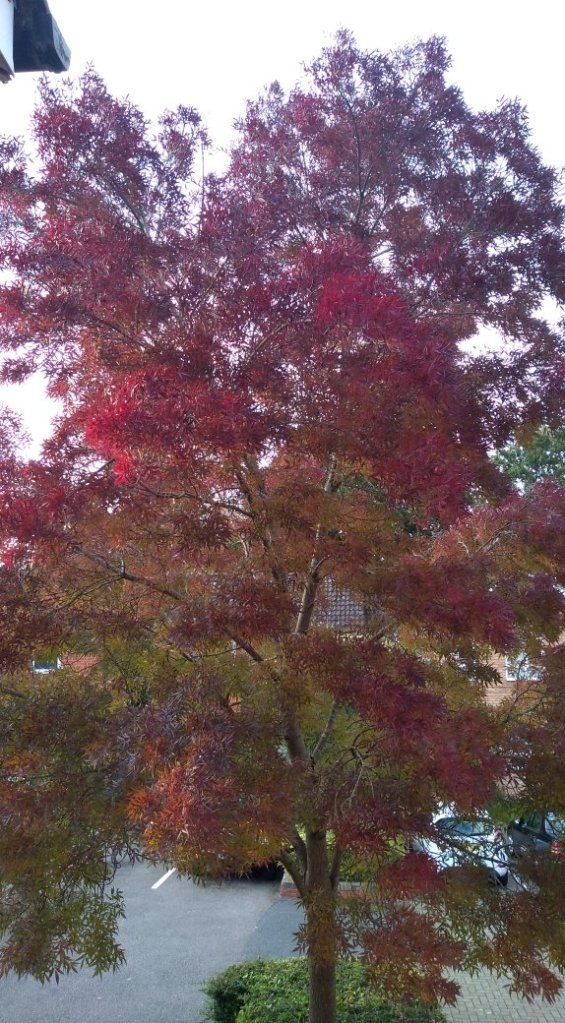
The tree that has already shown it’s autumn colours is the Claret ash or ash ‘Raywood’ (Fraxinus angustifolia ‘Raywood‘). There are a couple in the car park, one of which is now completely bare.
The deep claret coloured leaves glow bright red in the sunlight.The bark of the Claret ash.
I have noticed the occasional pollinator still flying around during the last fortnight. One observation was some Common wasps (Vespula vulgaris) visiting Common ivy (Hedera helix) flowers. Evidence that Ivy is a wonderful source of pollen and nectar late in the year along with that fact that wasps have a purpose.
Along with pollination, there are many wasps that are useful predators of spiders and insects which are fed to their young. Unfortunately the adult wasps need for sugar means they are often disliked by humans, but can we really blame them for having a sweet tooth just like us or trying to get to something that is easily accessible? A fascinating article about wasps and their usefulness in the world, published by the Natural History Museum, can be viewed here.
For the last couple of weeks conkers and sweet chestnuts have begun to fall, there isn’t a big harvest, neither are there lots of acorns or beech masts. However 2020 was a mast year (where trees produce bumper crops) so reduced harvests this time isn’t too surprising; Mast years only happen every five to ten years. However the low numbers could also be due to this years cold damp spring impacting bud development and fertilization, especially with wind pollinated trees. This issue is discussed further in an article by the Woodland Trust see Nature’s Calendar.
It has been lovely to notice Boston ivy (Parthenocissus tricuspidata), along with Virginia creeper (Parthenocissus quinquefolia) develop their bright red autumnal colour. They are so vibrant in the low autumn sunshine. I’ve also noticed the small beginnings of autumn leaf colour in many trees too.
Boston ivy growing up a wall of an old building.Virginia creeper winding its way through some shrubs.
Now that October has arrived, Cyclamen (Cyclamen hederifolium) and Crocuses (Crocus speciosus) have sprung up alongside Fungi in a few lawns. I noticed a waxcap commonly called the Witches hat (Hygrocybe conica) as well as Lilac fibrecaps (Inocybe geophylla var. lilacina); both resembling Gemstones standing out amongst the grass.
Witches hat waxcaps are so called because they look like witches hats when they blacken with age.A Lilac fibrecap
I also saw another fungi in one lawn, possibly a Blusher (Amanita rubescens), although the identification was difficult so I’m not entirely sure.
Plantlife run Waxcap watch from the 13th September. The charity want to discover previously unknown waxcap grassland sites, uncover habitat conditions and give better protection for them in the future. More information about this survey can be found here.
Something else I observed while weeding a gravel path at work was a Lunar underwing moth (Omphaloscelis lunosa).
This night flying noth had been hiding under some dandelion leaves.
Lunar underwing moths fly between August and October and their pupae overwinter in long grass which they will feed on when they become caterpillars. I managed to re-home this one under a nearby shrub.
The Autumn equinox finally arrived last Wednesday. It was lovely to notice bees still flying around when the sun shone. While these insects are synonymous with spring and summer, some are still active in September. Common carder bees (Bombus pascuorum) were the most noticeable last week but I also saw a new Buff-tailed (Bombus terrestris) bumblebee queen visiting some Hylotelephium as well.
Common carder beeBuff-tailed bumblebee queen
I also observed a couple of active bee nests in some lawns too. It was difficult to identify the specific species although given the time of year and colouration they were possibly Common furrow-bees (Lasioglossum calceatum) also called Slender mining bees. These bees are active from Spring until mid Autumn and nest in short grass.
During the previous week there were the few days of unusually high temperatures for the time of year; a final flourish for late summer?
The heat encouraged lots of bees, especially Honey bees (Apis mellifera) to visit Hylotelephium (once called Sedums) which began to bloom. The sound was amazing and it was so relaxing to work near them; you could almost feel the buzz it was so intense.
How many bees can you spot?
Things have been ticking over nicely on the allotment for the past month. Corn and Squash are developing nicely while the supply of Sweetpeas and Beetroot keep coming. Plus the Potatoes have been dug up and Apples are ready to pick too.
Time spent planning next years harvest is in full swing, while changes to the allotment occur. I began to create a space for a wild flower area next to a patch of long grass, where a resident frog is no doubt loving the huge supply of slugs this year. Plus work has begun on transforming the veg patches into raised beds.
Away from the allotment, on Friday 10th September, I noticed a rather large moth in the hallway. It was an Old lady/ black underwing (Mormo maura) moth. The wingspan of the Mormo maura is between 55 and 65mm.
The common name of Old Lady is due to the colouration and pattern on the forewings, which resemble the shawls of old Victorian ladies. There is only one generation per year and adults fly between July and August; as I noticed this one in September it must be near the end of its lifespan. A nocturnal moth it is attracted to light (and sugar if you place feeding stations for moths). Clearly the open window had encouraged it into the building. The main habitat for this moth are gardens and waste ground, particularly in damp locations. In spring, after overwintering, the caterpillars will feed on various trees and shrubs, such as Blackthorn (Prunus spinosa).
Then last Friday, another moth found its way to the hall. Also a nocturnal moth attracted by light, the Snout moth (Hypena proboscidalis), so called for obvious reasons.
There are two generations per year of the Hypenaproboscidalis, adults initially fly between June and August and again later in autumn. The wingspan of the Snout moth is approximately 30 to 38mm. Like the Old lady moth it also frequents gardens and wasteland, along with woodlands; essentially it can be found anywhere nettles (Urtica dioica) are found, which the caterpillars feed on.
It definitely feels like late summer now. Nights are noticeably drawing in, the sun is lower and my spidey senses have noticed a change in the air too.
The highlights of last week were seeing a Painted Lady (Vanessa cardui) on a Buddleja and noticing the harvests developing.
Autumn, my favourite season, is nearly here. The apples at the allotment are coming along nicely, almost ready to eat, along with the ripening blackberries. Plus hazelnuts and walnuts can be picked soon too.
Rowan berries have ripened now, their beautiful red colour showing through the green foliage. Last Thursday I noticed a female blackbird pick some before flying off with them.
It’s also been lovely to see my resident family of Blue tits on the Rowan tree (Sorbus), as I enjoy breakfast before my days work.
These small moments bring me so much joy and are a fantastic way to begin the day. I am grateful for natures restorative ability. Finding solace in it helps ground me while enabling me to remain in the moment and appreciate the small things. This time of year, when nature starts to slow down, also reminds me to take things more easily too. I do love this time of year. For me, the transition into Autumn, is a time of contemplation and preparation for the future.







 Bee in the Moment