Posted in nature

Garden Treasures

It feels like spiderweb season, the time when they become more prevalent, has arrived. I often get a face full of web when I accidentally walk into hidden ones as I work.

The spider’s web I come across most often is created by the European garden spider (Araneus diadematus). Also called the Diadem spider, Garden cross spider or Crowned orb weaver, due to the pattern on their abdomen and large circular webs they weave.

Males are 9mm in length, smaller than females (which grow to 15mm). Colouration can vary from light to dark brown and even burnt orange.

They are often found in gardens but also inhabit woodlands and meadows. The large orb webs (up to 40cms diameter) become more noticeable at this time of year in strong sunlight, due to the position of the sun, especially when glistening with dew in the mornings.

Those spiders which have survived summer will be mature adults now and start mating when autumn arrives. Males pluck the threads of the female’s web before he approaches, so he isn’t mistaken for food. However this tactic isn’t 100% successful as they can still become prey, even after mating. In late autumn a pregnant female will lay her eggs and spend every second protecting them until she eventually dies. Any adult spider still alive by November will succumb to cold weather.

The young spiderlings will survive winter inside a protective egg sac made of silk, to hatch in May the following year. Repeating the process of feeding on insects caught in webs (after being given a paralysing bite and wrapped in silk for later). They may not be the nation’s favourite garden helpers but they reduce pests and therefore should be treasured just like Ladybirds.

I also learnt a new plant last week. Standing out like a jewel amongst the other perennials was the beautiful Bog sage (Salvia uliginosa).

A Buff-tailed bumblebee (Bombus terrestris) visiting some Bog sage.

As it’s common name suggests this plant grows in damp areas. The one I saw was planted in a herbaceous border that used to be a pond which never completely dries out.

Originally from South American waterways (between Brazil to Argentina) this tall hardy perennial also requires a sunny position to survive. The beautiful blue flowers, loved by bees, bloom between August and October so this plant is a wonderful addition to gardens for extending the pollinating season.

Posted in nature

“It’s a Bird!” “It’s a Plane!” “It’s a Superperb Moth!”

Last week I began hearing the male Tawny owls (Strix aluco) territorial call as I fell asleep and again when I awoke. Usually this starts from late autumn and continues throughout winter (see BTO). Whatever the reason for him asserting his territory early, it was lovely to hear that sound return from last winter. Yet this wasn’t the only spectacle I noticed last week.

Last Wednesday, as I cut back spent Lavender, I became aware of something flying past me. I continued to watch until the insect stopped to gain nectar from some Red Valerian (Centranthus ruber); It was a Humming-bird Hawk-moth (Macroglossum stellatarum). As this was my first sighting of this superb moth, I found it impossible to maintain my composure as I hurriedly fumbled for my phone. Unfortunately it was too quick for me to photograph as it flitted between flowers, not resting as it fed. It did return momentarily but I was still unable to gain photographic evidence before it flew away once again. A visual guide can be seen on the Butterfly Conservation website. For further information on Red Valerian see the RHS website.

Apparently it is possible to hear it buzz as it flies, due to the quick movement of it’s wings; sadly all I could hear were builders working nearby.

Occasionally this daytime flying moth can be observed at other times of the year but traditionally it is seen between June and September. It usually migrates to the UK from the continent but in milder winters can overwinter in this country; in sheltered areas such as crevices, holes within trees and outbuildings.

It obtains nectar from a variety of plants in gardens, woodland edges as well as heathland on very warm sunny days. Along with the Red Valerian I noticed this one visit these moths can be seen amongst Honeysuckle (Lonicera), Jasmine (Jasminum), Buddleja, lilac (Syringa), Escallonia, Petunia and Phlox. While the caterpillars only feed on Wild Madder (Rubia peregrina) and Red Valerian along with Lady’s (Galium verum) and Hedge Bedstraw (Galium album).

Posted in nature

Pretty in Pink

Some late summer flowering plants such as Lavender, Buddleia and Nepeta have begun to wane; however others were starting to look their best. One which started performing last week was Hylotelephium spectabile (‘Brilliant’ series), also referred to as Sedums, Stonecrop or Ice plants.

Loved by pollinators (especially bees) Sedum are great plants to grow in gardens to extend the nectar and pollen season.

These hardy perennials die back to ground level over winter; however until then the seedheads can be left for structural interest allowing hiding places for hibernating insects. They are succulents and therefore like well drained soil in full sun or partial shade. Once established they can cope with dry conditions, continuing to flower until November.

Mature plants can begin to flop, so to prevent this the Chelsea Chop can be carried out. This technique of cutting every stem by a third enables the plant to grow with a bushier habit as well as prolong the flowering period. It is called the Chelsea Chop because this job is done in the last week of May, when the RHS Chelsea flower show takes place. This technique can be used with other perennials that bloom later in the year too. Further information on this can be found on the RHS website.

These Sedums look wonderful in herbaceous borders alongside other fantastic pollinator plants which flower at this time of year.

Hylotelephium spectabile (‘Brilliant’ series) alongside Asters and Echinacea
Hylotelephium spectabile (‘Brilliant’ series) planted with Geranium ‘Rozanne’
and Ceratostigma willmottianum.
Geranium ‘Rozanne’
Ceratostigma willmottianum
Posted in nature

Unusual Trees for Suburban Gardens

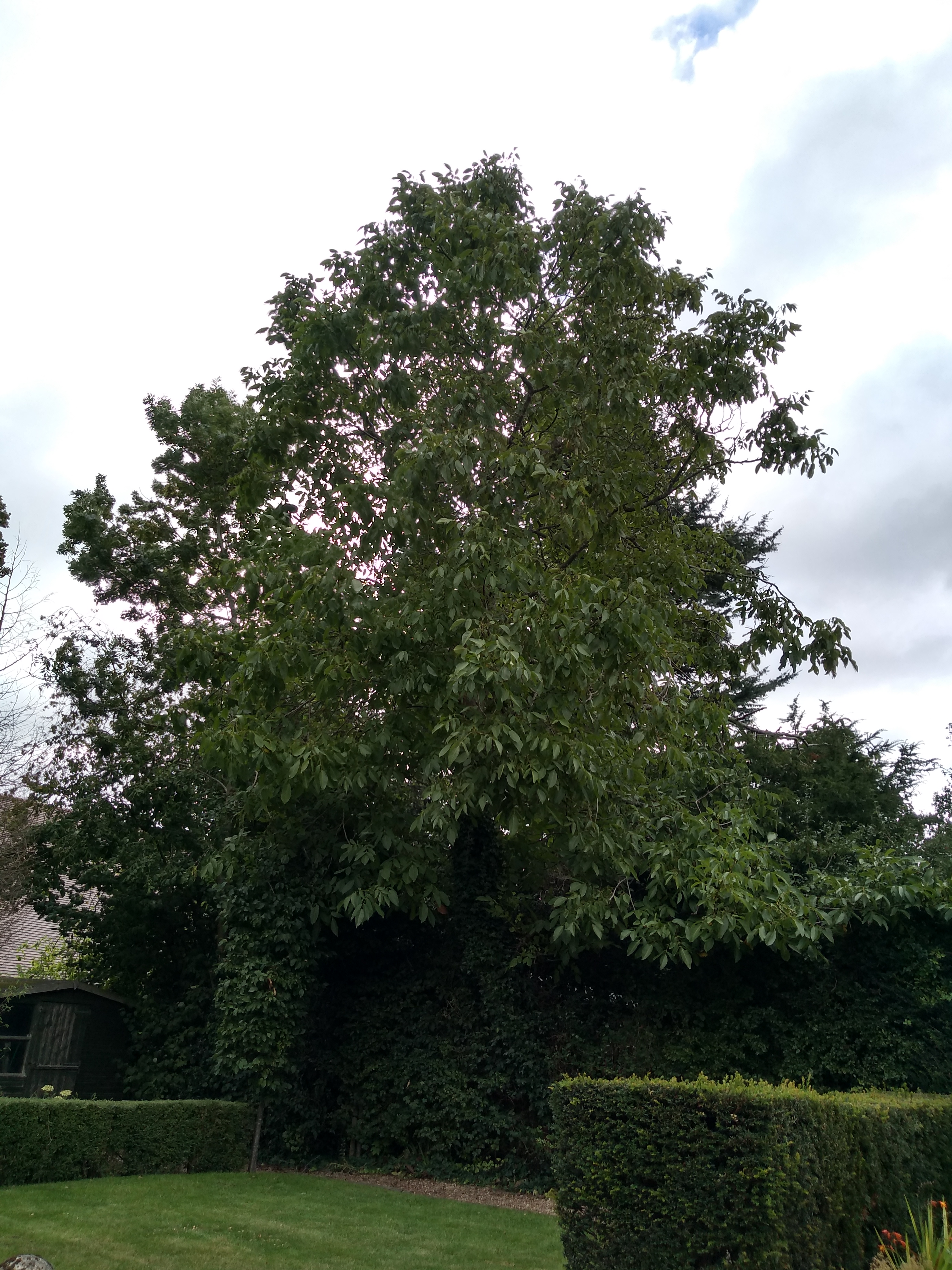
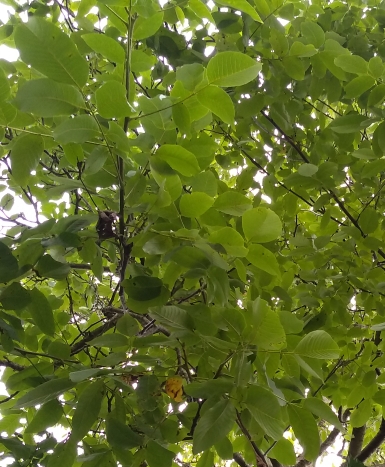
I’m lucky to work in a wide variety of gardens and occasionally come across trees which aren’t normally found in smaller suburban settings. Last week three such trees, a Walnut (Juglans regia), Quince (Cydonia oblonga) and Sweet Chestnut (Castanea sativa) were showing evidence that Autumn had arrived. Interestingly all three have links to, or were introduced to Britain by, the Romans (just like Ground Elder, Aegopodium podagraria, which they ate).

The Latin name for Walnut translates to ‘Royal nut of Jupiter’ and is referred to as ‘food of the gods, medicine for the people’. However, you’ll be lucky to get your hands on any before Squirrels (or Mice) do.

Presumably that’s the reason why these trees have naturalised in UK gardens and parks so well; as hidden walnuts are left to germinate and grow into mature trees.

The leaves of Walnut trees are a good source of food for some micro moths too.

The Sweet chestnut is another tree introduced into this country by the Romans. These days roasted Chestnuts are associated with winter and Christmas. They contain Vitamins C and Bs along with the minerals magnesium, potassium and iron.

I remember collecting Chestnuts at a local wood when I was young; I particularly enjoyed eating them raw. These days, on the odd occasion when I do discover a Chestnut tree, the nuts are usually too small to eat. Horse Chestnut (Aesculus hippocastanum) trees on the other hand are more commonly found around Britain. I noticed that Conker season had also begun last week, as I traveled to and from work. There are several myths linked with Conkers (see The Woodland Trust).
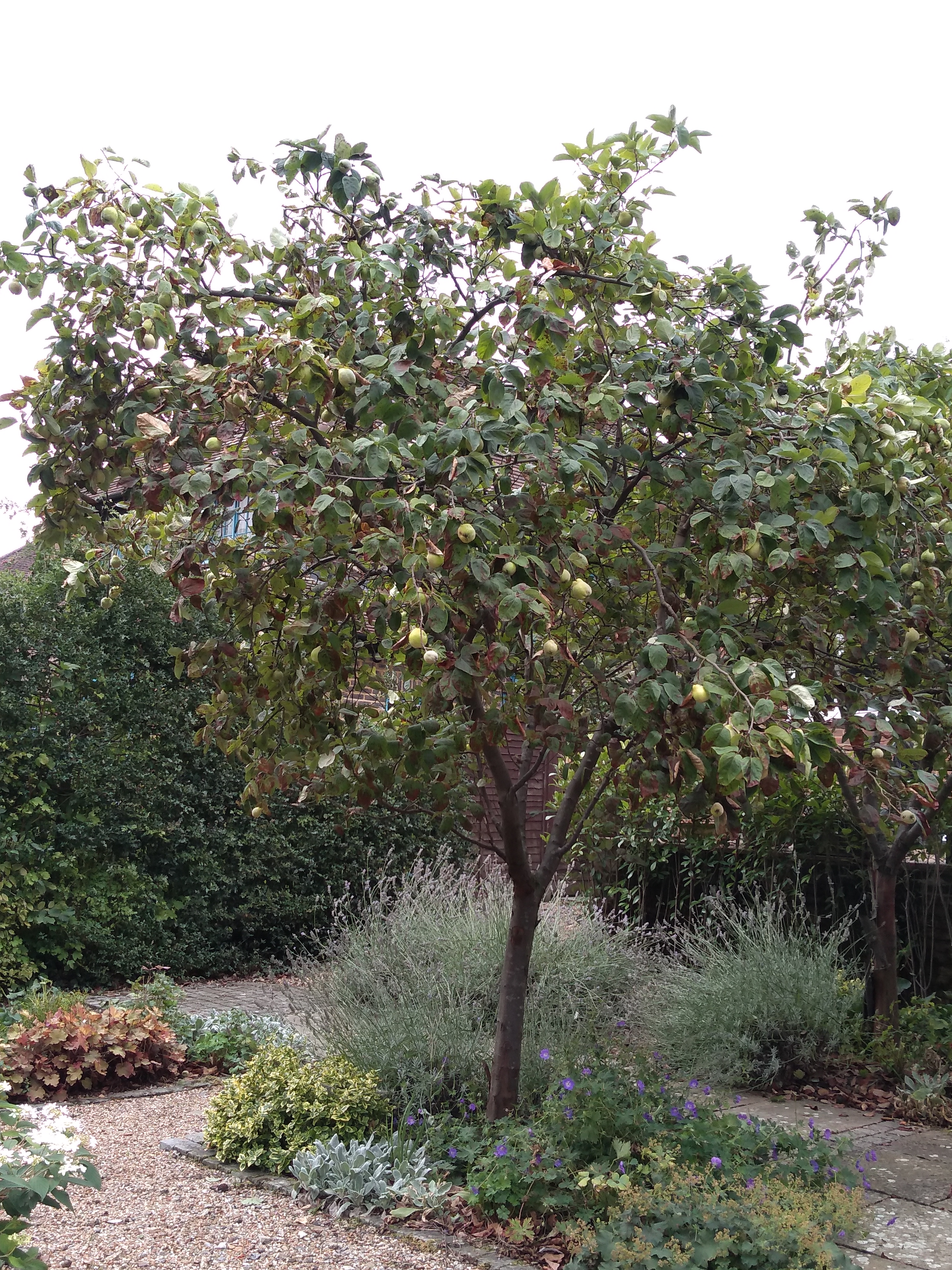
The last of the unusual trees I saw last week was the Quince. This tree is a lot smaller than the ones previously mentioned, making collection of the fruit easier. In fact the garden I worked at has four planted in a formal arrangement.

Quince fruit have tough flesh with skin that turns yellow as it ripens and has a honey aroma. They need to be cooked to soften and become edible.

Recipes for Quince Jam and Jelly can be found on the internet. Originally from Turkey and Asia, recipes using Quince can be found in Roman cooking.

There were other Autumnal signs around last week, along with the ones mentioned above, including the appearance of fungi and leaves falling. Autumn is definitely settling in even though Meteorological Autumn didn’t start until this Tuesday (1st September) with Astronomical Autumn (the Autumn Equinox) to follow on the 22nd September.

Posted in nature

🎵”It’s a Beautiful Da(hlia)…” 🎶

Actually there were lots of beautiful Dahlias at the Autumn festival I went to last Saturday. In fact even the weather was beautiful during the afternoon.

The Dahlia originates from Mexico (where its the national flower) and Central America. A perennial that grows from tubers, it is part of the Asteraceae family which also includes Daisies, Zinnias, Sunflowers and Chrysanthemums.

Because they’re not hardy and prefer light, free draining Soil, Dahlias are often lifted and stored somewhere dry over winter in the UK.

However, in southern counties, where gardens contain favourable conditions (with no heavy, soggy soils in colder climates) I have known people keep them in the ground. Sure enough the following year they reappear without fail. The lack of harsh winters in recent years no doubt enabling their survival.

Apparently Dahlia tubers can be eaten in the same way as Sweet potatoes (originally they were grown as a food source by the Aztecs). They can also flavour drinks when roasted. See Alys Fowler’s piece for the Guardian newspaper)

Over the past few years the popularity of Dahlias has increased; I must confess I am one if their fans.

I love the flowers vibrant colours but prefer the plants with single flowers, which are great for pollinators too (although I have caught sleepy bees having a nap amongst petals of other Dahlias as well; see below).

Unnamed variety from my Allotment with a Buff-tailed bumblebee snuggly sleeping inside a petal.
Formby Art: Bee seen relaxing on this Dahlia at the festival.

Some of my favourites on display last Saturday were:

Honka: Apparently popular with butterflies.
Pooh
Blueberry Hill
Carstone Firebox
Preston Park

I was also impressed by the wonderful bug hotel within the Celebration garden at the garden centre.

Posted in nature

Nature’s Bounty

During this current heatwave cooler early mornings have been my saviour. Last Saturday I was awake early, as usual, so managed to get lots done before the heat became too exhausting. Long gone are the days when I used to be a night owl. I walked to the allotment just after 8am and noticed nature’s bounty was almost ready to harvest. Not only were Blackberries and Hazelnuts nearly ready to eat but other edibles too. Some of the edibles mentioned below require cooking before they can be eaten; a link for further information is given for each one. Also it’s important not to harvest too much when foraging, please leave some for the wildlife, thank you.

The things I saw were,

– Blackberries

https://www.woodlandtrust.org.uk/trees-woods-and-wildlife/plants/wild-flowers/bramble/

– Hazelnuts

https://www.woodlandtrust.org.uk/trees-woods-and-wildlife/british-trees/a-z-of-british-trees/hazel/

– Sloes

https://www.woodlandtrust.org.uk/trees-woods-and-wildlife/british-trees/a-z-of-british-trees/blackthorn/

– Elderberries

https://www.woodlandtrust.org.uk/trees-woods-and-wildlife/british-trees/a-z-of-british-trees/elder/

– Hawthorn haws

https://www.woodlandtrust.org.uk/trees-woods-and-wildlife/british-trees/a-z-of-british-trees/hawthorn/

– Acorns

https://www.woodlandtrust.org.uk/blog/2019/09/are-acorns-edible-and-other-acorn-facts/

and Rowan berries

https://www.woodlandtrust.org.uk/trees-woods-and-wildlife/british-trees/a-z-of-british-trees/rowan/
Posted in nature

Too hot to handle

Last Friday was a scorcher. Anything above 22 degrees celsius and I start to wilt, so the 37 degrees endured that day was certainly too much for me. According to the Met Office the warmest temperature on Friday was 37.8°C, the third hottest day on record in the UK. I am fairly sure the top two hottest days on record were also recorded in recent years, which make me wonder about their impact on wildlife.

On Friday I tried to work in the shade as much as possible, while remaining hydrated (cooling techniques also used by mammals and birds). Like humans a few animals perspire to cool their bodies, namely primates and horses. These mammals also pant to keep cool (enabling cooler air to replace the expelled hotter air). Other mammals and birds use this method as well. In fact on extremely hot days I have often observed Magpies (Pica Pica) and Corvids walk around with their beaks open.

One of the Jackdaws (Corvus monedula) panting to cool down during the hottest part of the day last Friday.

In the past, I have even witnessed Magpies lie forwards on the ground wings spread out, allowing colder temperatures to reach a greater surface area. Having access to water, especially on hot days, is also important. Along with drinking the water, it allows them to have a dip; fluffing up wet feathers to enable a breeze to cool them down.

It is important to leave fresh drinking water out for hedgehogs (Erinaceinae) too. Of course hedgehogs also wonder about in the evenings and night time when it’s generally cooler.

Unfortunately last week some negative news about hedgehogs was reported; they have been added to the Vulnerable to Extinction Red List of British mammals produced by the Mammal society (please read the report on their website).

These snuffling garden helpers need our help, whatever the weather. For information on how to help them check out the websites below

Hedgehog street

The British Hedgehog Preservation Society.

Lastly, I went to check on the European gypsy moth (Lymantria dispar) on the allotment at the weekend but there was no sign of it. Therefore I will assume it was a male moth and had flown away safely into the night.

Posted in Allotment, nature

Butterfly Numbers Flying High.

With Buddleia, Lavender and Verbena bonariensis in full bloom at the moment butterfly sightings have increased significantly.

Along with plenty of Peacocks (Aglais io), Red Admirals (Vanessa atalanta) and Large whites (Pieris brassicae), I noticed a few other butterflies last week.

The first was a Gatekeeper (Pyronia tithonus) visiting Shasta daisies (Leucanthemum × superbum),

but I also saw a Comma butterfly (Polygonia c-album) pollinating some Verbena bonariensis too.

Along with these butterflies, the European gypsy moth (Lymantria dispar) reappeared, still under the Rhubarb patch on the allotment (see my ‘All you Need is Love and Nature.’ post from the 29th June 2020). However it was no longer a caterpillar but in the next stage of its life cycle, a pupa hanging from a Rhubarb leaf.

It can be in the Pupal stage for a fortnight so I will keep checking for its emergence as the adult moth, so I can hopefully see it take place. As I don’t exactly know when the Pupal stage began I’m not sure how soon it will occur. The male and female moths look very different so can be easily identified, plus the females don’t fly (see Butterfly Conservation); therefore if no moth is found then it was probably a male that has flown away.

The last insect that was noticeable last week was a Common red soldier beetle (Rhagonycha fulva).

It is always great to see these beetles as the are beneficial insects which predate aphids while their larvae eat
invertebrate pests, slugs and snails.

Posted in Allotment, nature

Spectacular Sighting

Last week began with me spotting a Grey heron (Ardea cinerea), presumably trying to catch fish while standing in the local river, as I walked passed to the first job of the day.

Yet the rest of the week remained fairly quiet until Friday morning arrived.

This is when I saw a Swallow tail (Ourapteryx sambucaria) moth.

As the moth ages it’s cream coloured wings lighten.

This one had been disturbed because they are night flying moths. The caterpillars overwinter in tree bark, and feed on Broadleaf trees such as Hawthorn (Crataegus monogyna) and Horse Chestnut (Aesculus hippocastanum) along with Ivy (Hedera helix).

Afterwards, at my allotment on Saturday I noticed a Parasitic wasp (Hymenoptera) on my Echinacea purpura PowWow wild berry, although I’m not sure which one.

There are 40 families of parasitic wasp in the UK and Ireland, from which 6,500 species have been recorded. I am pretty convinced that the one I saw wasn’t the Braconid Dinocampus coccinellae which causes the host, a dead Seven-spot ladybird (Coccinella septempunctata), to remain in situ over the wasp’s pupa cocoon as protection until it hatches. Nor does it appear to be Cotesia glomerata. This parasitic wasp lays it’s young in Large white (Pieris brassicae) caterpillars which dies as the young develops. Once they emerge they cocoon themselves beneath the caterpillar until they finally transform into adult wasps. I have Seven-spot ladybirds as well as Large white caterpillars at my plot but neither appear to be affected. Interestingly parasitic wasps can become hosts themselves. The parasitic wasps of parasitic wasps are called hyperparasoids.

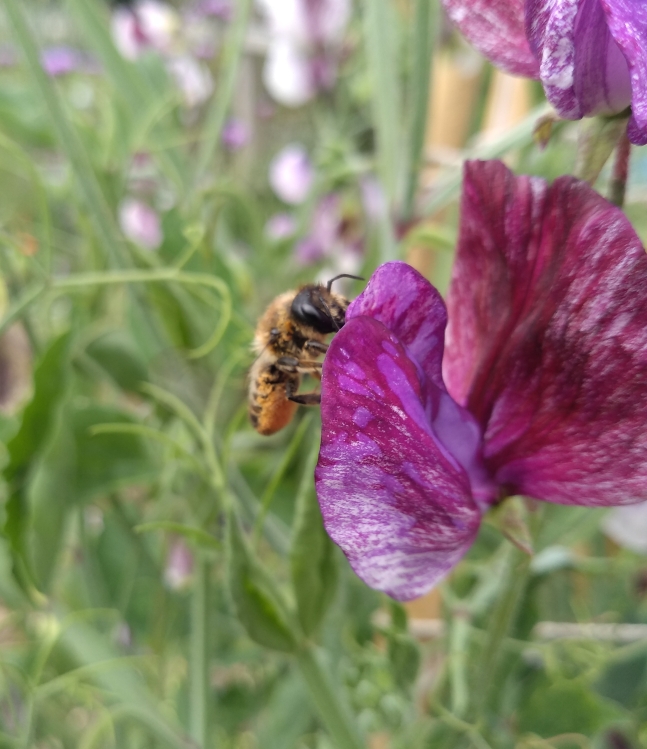
However this wasn’t the highlight of my week. Also at the allotment on Saturday I finally got to see a Leaf-cutter bee. I was so excited to see this spectacular sighting but had to stay quiet and still while I attempted to capture a photo of it.

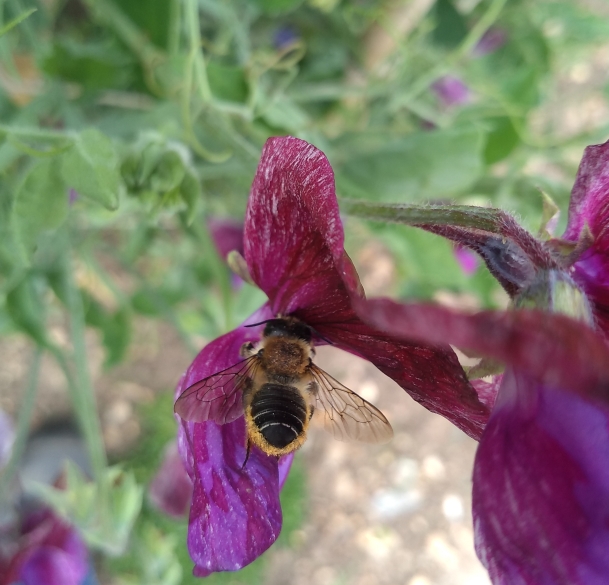
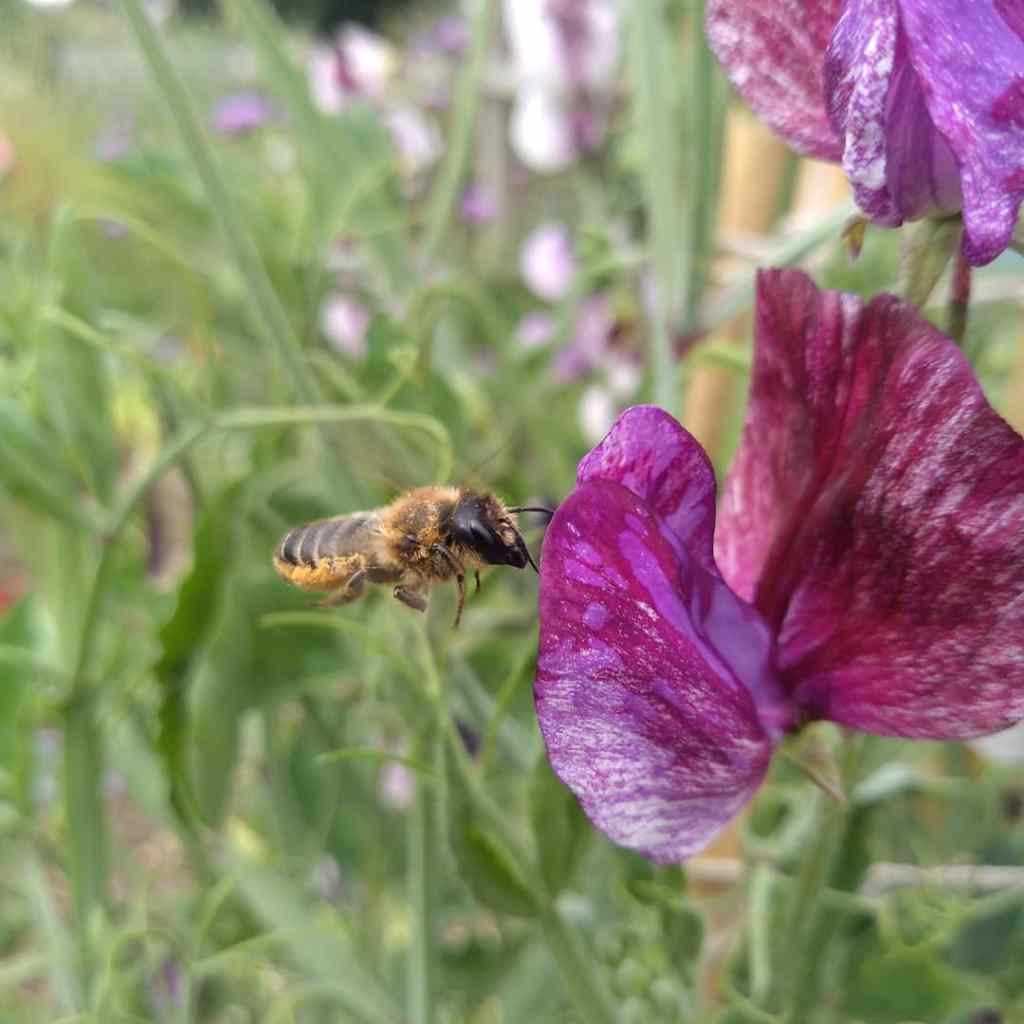
There are different Leaf-cutter bees in the UK but the one I saw was a Patchwork Leaf-cutter (Megachile centuncularis) bee. It was visiting my sweetpeas, collecting pollen and nectar for her young. The orange pollen brush underneath the abdomen clearly identifying it as a female of this species. The only thing left on my must see list, when it comes to Leaf-cutter bees, is to see one carrying a piece of leaf and also a nest. I do have a bee hotel on the allotment so here’s hoping.

Posted in nature

Song Finally Identified.

For several weeks I have heard lots of male Grasshoppers in the long grass next to my allotment plot. I have been hoping to see one so I can identify them. Finally last Saturday the opportunity arrived. Sitting on some carpet used as a weed suppressor, a Field Grasshopper (Chorthippus brunneus) was seen basking in the sun.

A Common Field Grasshopper (unsuccessfully) attempting to hide behind a stone.

At last I knew which grasshoppers were repeating that soft short chirruping ‘song’. The sound made as the hind legs are rubbed against their wings attracts females. With successful mating approximately 15 eggs are laid and remain in the soil until next year. The nymphs hatch from March onwards and after shedding their skins three or four times become adults in the subsequent summer. This common UK grasshopper feeds on grasses so they won’t go hungry living amongst the overgrown plot.

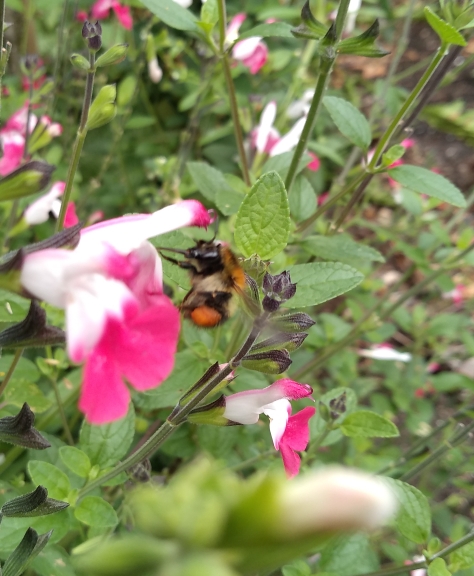
The other amazing thing I saw last week was another bee with spectacular coloured pollen baskets. A Common carder bee (Bombus pascuorum) with orange pollen baskets was visiting a Salvia flower.

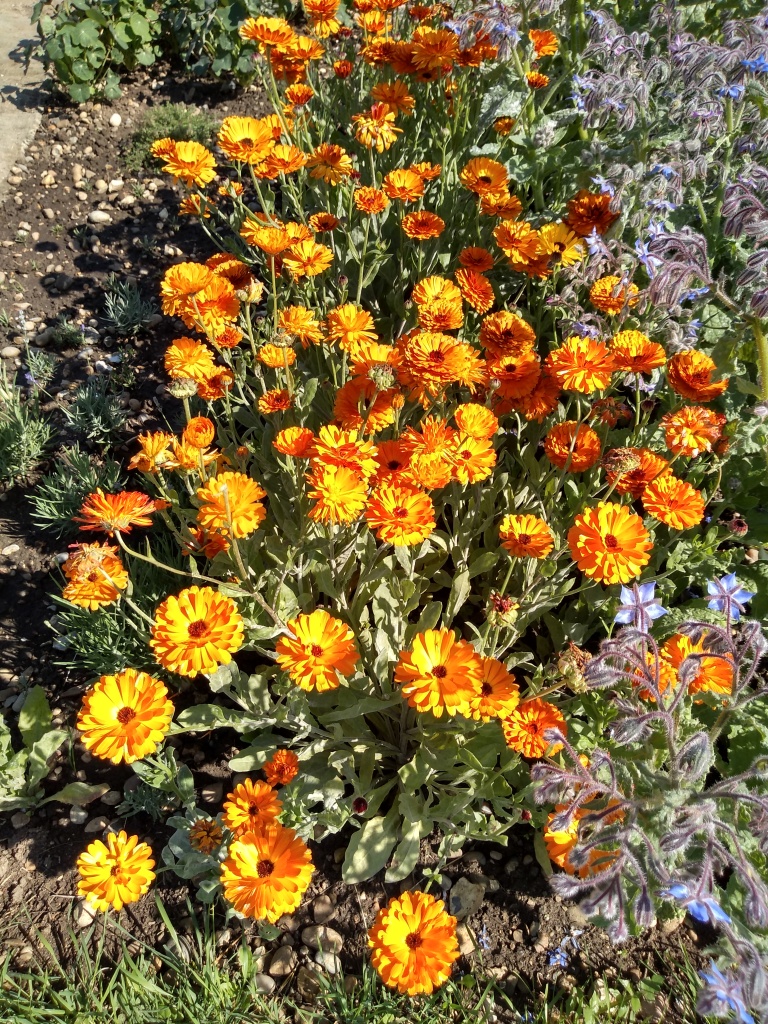
After checking a pollen colour chart, the source of the pollen it had collected was most likely from Calendula officinalis which are in full bloom at the moment (especially on my allotment).

Given the vibrant petals of Calendula I am not surprised that it’s pollen is deep orange. My Calendula is growing next to Borage which has been blooming for a while too. Loved by bees, Borage nectaries refresh every few minutes and the pollen is greyish blue in colour. I look forward to seeing bees with their pollen baskets full of Borage pollen.