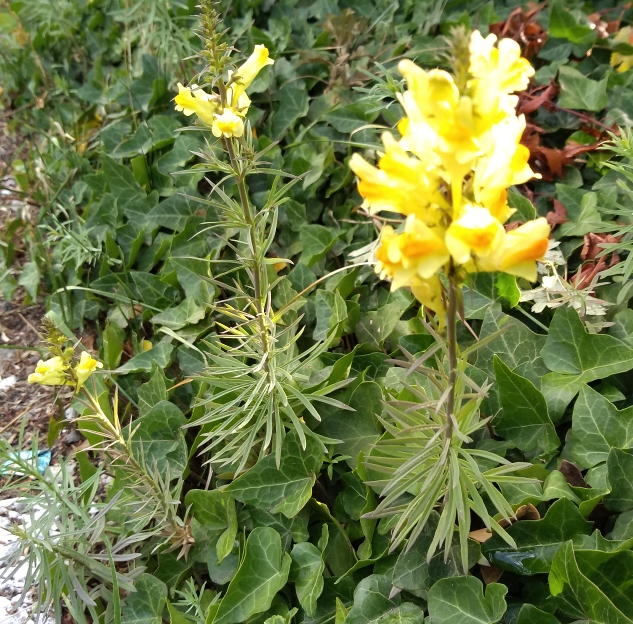
Some fields along my journey to and from work contain a lovely combination of pink Rosebay Willowherb (Chamaenerion angustifolium), purple Buddleia and white Wild carrot (Daucus carota) flowers. Not only do they compliment one another visually but they are all loved by pollinators too. Yellow toadflax (Linaria vulgaris) has started to bloom along the roadside as well.
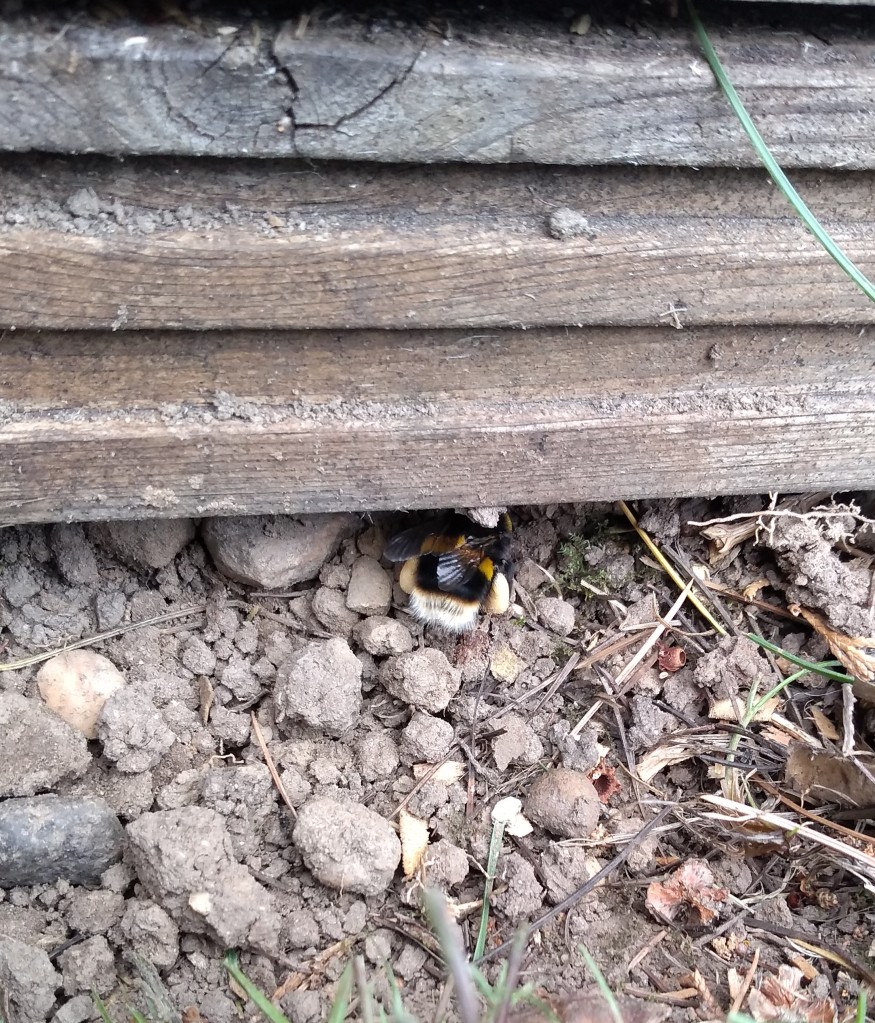
One special moment occurred on the Monday. As I worked within a border I noticed a Buff-tailed bumblebee (Bombus terrestris) queen flying around a patch of grass. Eventually she began to settle and after a few more large sweeping flights began making a nest in the lawn.
It didn’t take her long to dig into the soil beneath the grass.
She will remain under ground until spring when she will start her own colony.
It was also great to finally get some photos of insects that have have alluded my photographic capture so far this year.
– The first is the Red admiral (Vanessa atalanta),
– Some Hoverflies, including a Hornet mimic (Volucellazonaria) hoverfly,
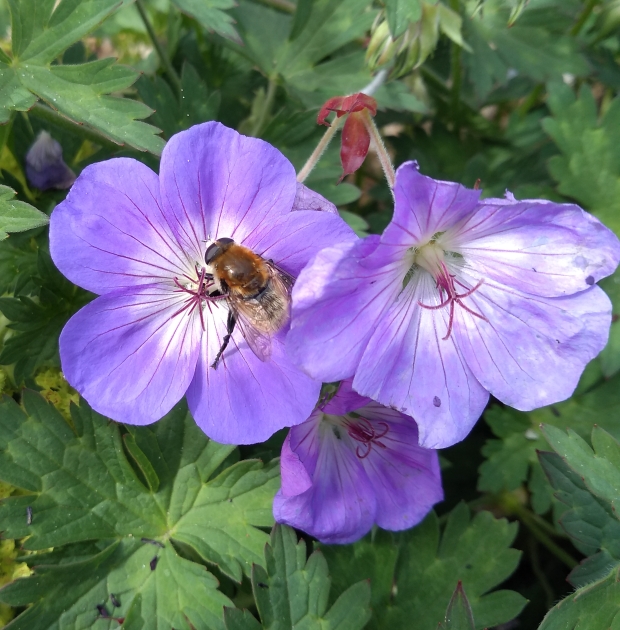
Hornet mimic Hoverfly pollinating Wisteria flowers that were still blooming.Hoverfly pollinating Geranium flowers.
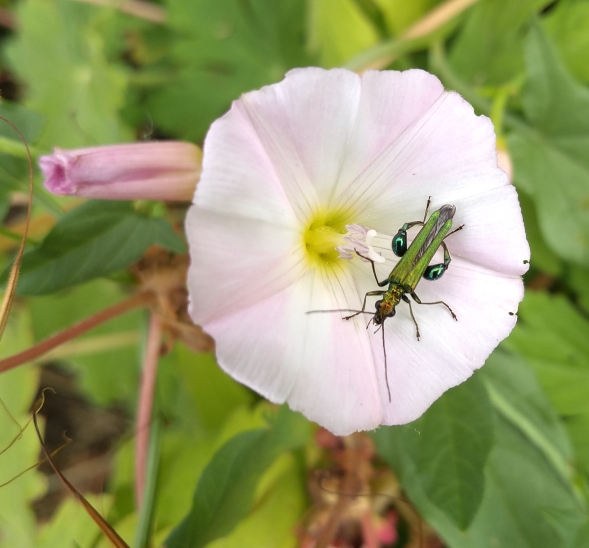
– as well as a Male False oil beetle (Oedemera nobilis), to compliment the female one seen on a walk earlier in the year.
A False oil beetle pollinating a Field bindweed (Convolvulus arvensis) flower.
The males are easily identified due to their large metallic thighs, explaining the reason behind the other common name for this insect the Swollen-thighed beetle.
Last week love was definitely in the air as I saw numerous Dragonflies and a couple of Buff-tailed bumblebees (Bombusterrestris) mating. New generations were also evident as several young species of insects and an amphibian were noticeable during the week.
Firstly a European gypsy moth (Lymantria dispar) caterpillar was discovered beneath some rhubarb that was being harvested.
Wind disperses these caterpillars when very young. So this one could have travelled several miles.
These caterpillars feed on Creeping Willow (Salixrepens) and Bog-myrtle (Myrica gale) along with a few broadleaf trees and bushes. I guess this one could have been feeding on the Rhubarb; however as it was the only caterpillar and the rhubarb patch is very healthy, it was left. This moth was believed to be instinct in the UK during the early 20th century. However in recent years a few have established themselves in Jersey but also in areas of southern England.
I was happy to see the Seven-spot ladybirds on the allotment were happily munching their way through the white fly (Aleyrodidae) on the Calendula flowers. They have definitely grown in size.
Last Wednesday was the first time this year that I saw lots of Harlequin ladybirds (Harmonia axyridis), or more precisely their pupae as I cutback a Clematis in one garden. These ladybirds established themselves in the same garden last year so it wasn’t too surprising to rediscover them there.
Photo of this Harlequin ladybird pupae has been enlarged.
On the same day I also noticed a baby frog (Rana temporaria) hopping from a rejuvenated pond.
This photo is enlarged; It was smaller than my thumbnail so it was lucky I saw a small movement in the lawn.
I helped it escape the mower blades as my colleague cut the grass.
With the topsy turvy weather at the moment some days go by when I don’t see any pollinators; while other times they fill the air between visiting flowers. Along with bees and butterflies, lots of Hoverflies and day flying moths were about too.
I also saw Field Scabious (Knautia arvensis) blooming along the verge as I walked towards my allotment.
This beautiful plant, loved by pollinators, flowers between July and October, so it isn’t that early.
Last week was uplifting, seeing nature continue to prosper. It fills me with hope for a wonderfully diverse world, something humans to reflect upon during these times.
If I create a wildlife friendly allotment nature will come. My allotment is really filling up and blooming now even though I’ve only had it since February. Most of the plants are from seed, cuttings or rescued from other gardens. For the first year I plan to let the plants develop before harvesting properly.
We’ve had so much rain in recent days that I didn’t need to visit the allotment to water during the week. So last Saturday was the first time in seven days that I visited my plot to undertake major garden tasks. It was the summer solstice and the weather was glorious.
As I walked around to check how things were, I noticed a large number of wildlife; nature had come.
The first things I saw were two Small tortoiseshell Butterflies (Aglais urticae) pollinating the Thyme ‘Lemon curd’ (Thymus ‘Lemon curd’)
whilst Oedemera beetles were taking advantage of the Dandelions (Taraxacum officinale) left on the grassy walkways.
Several Buff-tailed bumblebees (Bombus terrestris) busily flew between the flowers on a neighbouring allotment’s Hebe and flowers on my patch, including the Lacy Phacelia (Phacelia tanacetifolia)
as well as the Borage (Borago officinalis).
A Honey bee (Apis mellifera) also visited the Borage.
There was even a solitary bee buzzing about; an Ashy mining bee (Andrena cineraria) pollinating the Hebe.
Most likely this is the bee that was accidentally unearthed the previous weekend while getting rid of bindweed from around the potatoes (see photo below).
I had contacted the Bumblebee Conservation Trust to see if they could identify this silvery bee, if indeed it was a bee. Stephanie Miles answered my query explaining; ‘This is indeed a bee! It’s a male solitary bee of the genus Andrena. When these bees first hatch from the pupa they’re completely silver-haired, like this – over a day or so they dry out, lay down pigmentation, and the normal colour appears. Once the normal colour appears they can be identified to species level. You disturbed this one before it was quite ready to be seen in public!’ Therefore the Ashy mining bee seen on the Hebe seems a likely candidate.
Seven-spot ladybirds (Coccinella septempunctata) in different stages of development were resting on potato, Calendula (Calendula officinalis) and Borage foliage. There were newly formed adults along with the larvae.
A young Seven-spot ladybird before the recognisable red and black beetle develops fully.
Outside of my allotment wildflowers that are beginning to bloom included;
Two creatures were evident last week even though I didn’t actually see them.
Firstly Wrens (Troglodytes troglodytes) sung loudly in different areas, including near my home. It was a joy to hear them throughout the mornings.
These brown, diminutive birds with upturned tails, weigh about 7-10 grams; only Goldcrests (Regulus regulus) are smaller. Wrens are rarely seen as their nests (made from moss and twigs) are positioned beneath shrubs or in rock crevices. Plus they mostly feed on insects and spiders and therefore remain hidden for a large amount of time. However they make their presence known due to their powerful song which can be heard at some distance. Their distinctive song contains a trill at the end, often discribed as sounding like a machine gun (see RSPB).
Secondly, on Thursday, I discovered that female Leaf-cutter bee(s) had visited one of the gardens I help look after. The evidence was semi-circular shapes cut around the edges of Broad-leaved enchanter’s nightshade (Circaealutetiana) leaves.
The Broad-leaved enchanter’s nightshade is part of the Willowherb family.
The bits of leaf will have been carried to a nest, chewed and mixed with saliva to form walls to create the cells if the bees nest. Commonly Bee hotels are used by these solitary bees with lots of cells within each piece of bamboo or hole. Each cell contains an egg and pollen so that the larvae has a food source when it hatches. Although they become adults in autumn, the newly formed bees hibernate during winter, emerging in spring when the new generation repeats the process.
The most common Leaf-cutter bee found in gardens is the Patchwork leaf-cutter bee (Megachilecentuncularis); for more information see The Bumblebee Conservation Trust.
Common plant leaves used for this purpose by Leaf-cutter bees are those from Roses, Wisteria, honeysuckle, several tree species and Willowherbs. As at least one bee was clearly using these plants for it’s nest, patches of these wild flowers were left at the back of the borders and the client was informed. Thankfully they are a fellow bee lover and happy to allow them to remain. I feel it’s important to point out, that no lasting damage is done to the plants. Therefore if you find such holes cut in your roses, please don’t panic.
I have yet to see a Leaf cutter bee, especially one ‘surfing’ with a leaf. I would love to see one of these bees so I got incredibly excited to see this evidence. Unfortunately my search was in vain but I am one step closer.
I am constantly amazed by the natural world. Last week I saw something that, as a gardener, I’m surprised I’ve never noticed before. A few White-tailed bumblebees (Bombus lucorum) flew to and from a nest in a wall, via the damp proofing brickwork, of an old house. What I wasn’t expecting to see were the blue pollen baskets.
I had never thought of pollen as anything other than varying shades of yellow. After researching this I found that different coloured pollen often shows up in nests and hives. Charts have been produced enabling beekeepers to identify which flowers their bees have visited by the colour and shade of the pollen found. The most likely candidates in this instance, given the time of year and dark blue shade, is Purple tansy (Phacelia tanacetifolia), see the North Shropshire Bee Keepers Association website.
Phacelia is loved by bees. These photos are from a neighbouring allotment plot.
As well as Phacelia other flowers currently blooming include;
– Hedge woundwort (Stachys sylvatica),
– Pineappleweed (Matricaria discoidea),
A close up view of Pineappleweed. When crushed, the flowers have a refreshing pineapple scent.
– Stinking iris also called Roast-beef plant (Iris foetidissima),
This plant has two colour variations. It thrives in shady areas.
– Scarlet pimpernel (Anagallis arvensis) and
– Pyramidal orchid (Anacamptis pyramidalis)
This orchid is attractive to butterflies and moths.
Birds are particularly noticeable at this time of year as they feed youngsters and defend territories. Last week I was able to listen to Song thrush (Turdus philomelos), Chiff chaff (Phylloscopus collybita), Robin (Erithacus rubecula) Great spotted woodpecker (Dendrocopos major) and Swifts (Apus apus). I saw the Swifts’ arial display as they soared and dived in the distance while I ate lunch last Wednesday. They were too high and quick for me to identify visually but their vocalisations gave them away. The Swifts’ call can be heard on the RSPB website.
Ladybirds continued to show up last week, but mostly the Seven-spot ladybird (Coccinella septempunctata).
Eventually, the weather turned and rain finally arrived by Friday. It has been much needed and continued throughout the weekend. It was fantastic to watch thunder and lightening from the comfort of my sofa on Saturday afternoon.
Last week began with Spring bank holiday monday. I went for a socially distant walk around the village with my partner. Thankfully he was very patient as I constantly stopped to take photos with my phone.
There were lots of sights and sounds to observe and it really felt like a summers day (which aren’t far off). Some I have noticed for a while like Orange-tip Butterflies (Anthochariscardamines), Red-tailed bumblebees (Bombuslapidarius), Skylarks (Alaudaarvensis), Red kites (Milvusmilvus) and House sparrows (Passerdomesticus).
Yet amongst the Elderflowers (Sambucus nigra) and Brambles (Rubus fruticosus), which are blooming at this time of year,
These flowers are great for making Elderflower cordial.Looks like there will be lots of Blackberries this year.
were many more plants flowering too. The explosion of colour within our countryside is fantastic for pollinators. One insect I saw on Mondays walk, in a field busily pollinating Buttercups (Ranunculus), was the False oil beetle (Oedemeranobilis). This very small beetle is a vibrant metallic green colour. When it’s wings glistened in the sun, they changed from mid to light green.
Unfortunately this is the best photo I managed to get of this tiny beetle.
Upon my return to work, I noticed other insects flying about. Several small tortoiseshell Butterflies (Aglaisurticae) were too quick for me to photograph, however I did capture Common carder bees (Bombuspascuorum) on Common comfrey (Symphytumofficinale) and
a Cream Spot Ladybird (Calviaquattuordecimguttata)
Once again, another ladybird determined to get my attention by falling on my sunglasses while I wore them.
The Cream Spot ladybird has fourteen spots and survives winter in tree bark and Beech masts. Although it is usually found amongst hedgerows rather than gardens.
Wildflowers that were in full bloom last week were;
-Purple toadflax (Linariapurpurea),
-Field scabious (Knautiaarvensis),
– Common stork’s-bill (Erodiumcicutarium),
This plant is a good food source for Brown argus Butterfly (Aricia agestis) caterpillars, along with Meadow and Dove’s-foot Crane’s-bills (mentioned below). This butterfly is often found in southern chalk and limestone grassland but it can also inhabit places with disturbed soil like verges and coastal areas. In fact this plant was found on disturbed soil edging a field.
-Meadow crane’s-bill (Geraniumpratense),
-Creeping cinquefoil (Potentillareptans),
-Common poppy (Papaverrhoeas),
-Dove’s-foot Crane’s-bill (Geraniummolle),
-Field bindweed (Convolvulusarvensis),
-Common mallow (Malvasylvestris),
-Creeping woodsorrel (Oxaliscorniculata),
-Birds-foot trefoil (Lotuscorniculatus) and
-White clover (Trifoliumrepens).
Found amongst lawns, this is a wonderful food source for the Common blue butterfly (Polyommatusicarus) and some bumblebees
Recent weather conditions have caused dryness within nature that normally exists during summertime. Water is already required and talk of conserving water has already begun to help prevent restrictions later in the year. I shall be interested to see how nature deals with this early warm dry weather, especially with less human disturbance due to lockdown. Will it be another great year for butterflies? I look forward to discovering more as we spring into summer.
“Tell me can you feel it, tell me can you feel it, tell me can you feel it, the heat is on…”
The 80’s song from the Beverly Hills Cop soundtrack with Glenn Frey’s voice, synthesizer and saxophone was my earworm as the temperature soared last week. The temperature increased to around 27°C mid week, which meant lots more insects ventured out as it felt like summer.
I was happy to see my first Red admiral (Vanessaatalanta) butterfly of the year, however my main observations were bees including the Red-tailed bumblebee (Bombuslapidarius) and Honey bees (Apismellifera).
A Red-tailed bumblebee pollinating some geranium.Honey bees visited Nepeta.
Another bee I started seeing last week was the Tree bumblebee (Bombushypnorum). I noticed a nest inside a compost bin as I emptied grass clippings from the mower bag.
I have seen Tree bumblebees nest in bird houses before but not under compost. I made sure I avoided tipping grass onto their home and used the next bin along. I couldn’t help watching them for a little while as I stopped for a breather on the very hot Wednesday.
Moths were prominent throughout the week too. Unfortunately Box tree moth (Cydalima perspectalis) caterpillars and the signs of heavy infestation (foliage that had been eaten and covered with webbing) was noticeably present in several gardens. Therefore, I spent lots of time picking them off buxus topiary and informing clients to keep an eye out for them as well. For more information on this pest see the RHS website.
I discovered this years first sighting of a Silver Y (Autographa gamma) moth.
A Silver Y moth resting on a Heuchera leaf.
This immigrant is one of the few brown moths I can identify easily, mostly due to the clear y markings on it’s forewings but also because of their size and shape. This is a day and night flying moth which can be observed visiting flowers to obtain nectar.
However my most exciting moth sighting was the Lime hawk-moth (Mimas tiliae).
This spectacular large moth is night flying. It’s wingspan is 4.6-7.8cms and it can be found in broadleaf woodland, parks and gardens between May and July. I accidentally disturbed it as I pruned some shrubs under a Lime (Tilia sp.) tree. Thankfully it didn’t seem bothered by the disruption and it was carefully placed back near the lime tree. While adult moths of this species don’t feed, the caterpillars do. Once they have emerged from overwintering pupa, the caterpillars will eat Lime, elms (Ulmus sp.), Alder (Alnus glutinosa), Downy Birch (Betula pubescens) and Silver Birch (Betula pendula), Plane (Platanus x hispanica) along with some Cherry cultivars. This was the first Hawk-moth I have ever seen. There are a few that exist in the UK. The nearest I came to seeing one before was observing caterpillars of the Elephant hawk-moth (Deilephilaelpenor) eating away at some Fuchsia. For more information on these Hawk-moths see the Butterfly Conservation website (Lime hawk-moth and Elephant hawk-moth)
I also saw hoverflies. I am still learning about these insects and learnt another one last week.
The photo above shows a Narcissus bulb fly (Merodon equestris). The maggots eat away at the centre of bulbs from the Amaryllidaceae family. However even though the maggots are a pest, the adult hoverflies are pollinators.
At least in several gardens last week, things with three leaves appeared as several Trefoils began to flower.
In some lawns the yellow flowering Slender hop clover (Trifolium micranthum) has shown itself along with Red clover (Trifolium pratense).
Slender hop cloverRed clover
Red clover is also called Bee-bread (along with White clover- Trifolium repens) due to its popularity with bees. It’s nectar is especially loved by Common carder bees (Bombus pascuorum), Honeybees (Apis mellifera) and Red-tailed bumblebees (Bombus lapidarius). Red clover, which is less commonly found in nature than White clover, is used for livestock feed and crop rotation (due to its nitrogen fixation abilities). It is also used in herbal medicine to treat respiratory and skin ailments,along with menopausal and PMS symptoms because the flower contains isoflavones. When taken internally, isoflavones become phytoestrogens which has similar affects in the body as estrogen (see Plantlife)
I will have to wait a little longer to see White clover flowering as it blooms from June. However White clover is commonly found in verges and grassland so I’m sure to see some eventually.
Unfortunately I have never spotted a four leaf clover (or five leaved). I am ever hopeful, just for the challenge because they are so hard to spot in the wild.
Several trees are blooming at the moment. Along with Hawthorn (Crataegus monogyna- the May tree flowers referred to in the rhyme ‘Cast ne’er a clout ere May is out’) the Horse chestnut (Aesculus hippocastanum) is also in flower; they have white flowers with a pink tinge.
I also see the Red horse chestnut tree (Aesculus x carnea Briotii) on my travels, both trees have very showy flowers.
It was great to see lots of bees about last week and various species too.
The first type of bee I saw was a Hairy-footed flower bee (Anthophora plumipes) around some forget me nots (Myosotis).
I also noticed lots of Buff-tailed bumblebees (Bombus terrestris), Honey bees and Early bumblebees (Bombus pratorum) throughout the week too.
This Cotoneaster hedge was alive with Honey bees. Make sure the sound is on to listen to their relaxing buzzing.The Early bumblebees were also visiting the Cotoneaster flowers.I noticed five Buff-tailed bumblebees coming and going from a nest under some decking in one garden.
No doubt due to the recent weather, I have noticed more flowers blooming earlier than their traditional start time of June. One example is the Common nipplewort (Lapsana communis).
The Common nipplewort is part of the sunflower family.
Other plants flowering at the moment are Greater celandine (Chelidonium majus),
This isn’t a relative of the Lesser celandine (Ficaria verna) despite its name. It is part of the poppy rather than buttercup family.
– Three-cornered garlic (Allium triquetrum),
Ants spread the seeds of this wild flower.
– Red campion (Silene dioica),
A dioecious plant, male flowers bloom on separate plants to the female flowers.
– White campion (Silene latifolia),
White campion is pollinated by moths because it is night scented
– Cleavers (Galium aparine),
The flowers of Cleavers are tiny. This photograph has been enlarged so they can be seen more clearly.
– Common honeysuckle (Lonicera periclymenum),
I noticed the sweet scent first. This plant is beneficial for a variety of butterflies, like the White admiral (Limenitis camilla), bumblebees and moths. Birds such as Thrushes (Turdidae), Warblers (Sylvidae) and Bullfinches (Pyrrhula pyrrhula) also eat its berries. Plus Dormice (Muscardinus avellanarius) inhabit and feed on this plant.
– A sow thistle (Sonchus),
– A Hawkweed (Hieracium),
– Mouse-ear Hawkweed (Hieracium pilosella)
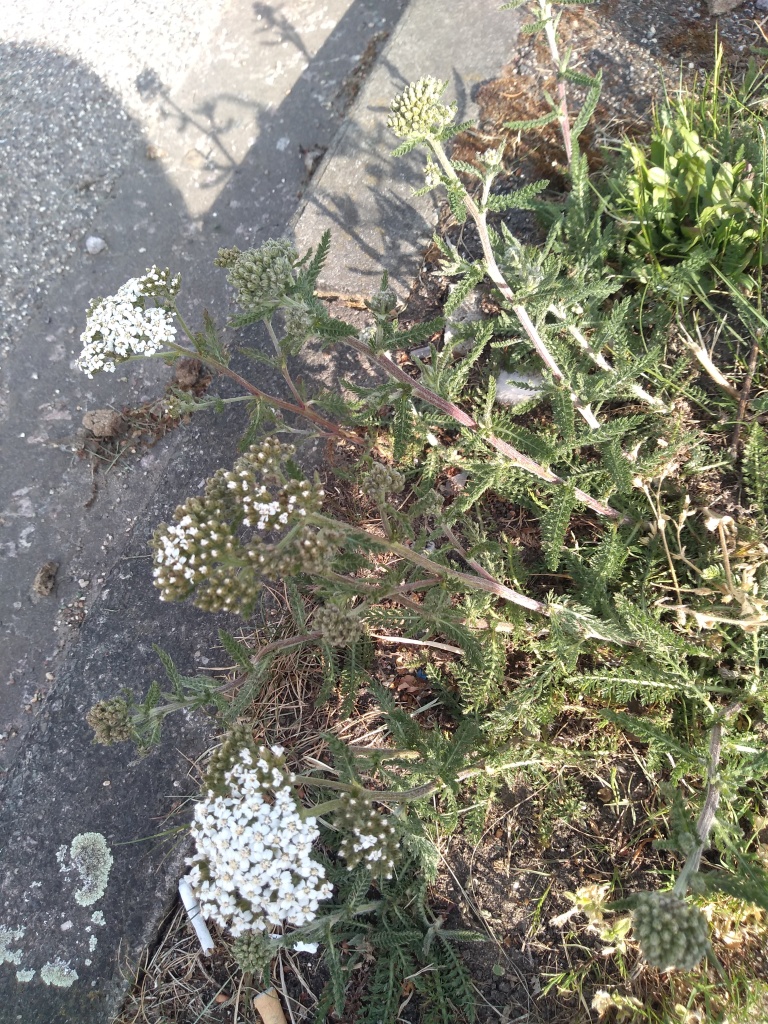
– and Yarrow (Achillea millefolium).
A plant that was new to me was Common knapweed (Centaurea nigra).
Along with all the wild flowers I noticed last week, the warm weather continued to encourage lots of insects out. There were more Holly blue (Celastrinaargiolus) and Orange-tip (Anthocharis cardamines) butterflies along with bumblebees.
I also saw a Cinnabar moth (Tyria jacobaeae) at the allotment, amongst the long grass.
This moth flies flies during the day as well as at night time.
The most interesting insect I observed last week was a Pine ladybird (Exochomus qadripustulatus).
I have never seen this species of ladybird before. It dropped onto my sunglasses as I worked. Due to its small size (3mm in length), to begin with I thought it was a bit of dirt. As the name suggests, this beetle inhabits Pine (Pinus) trees. However they can also be found around other trees and shrubs especially Hawthorn (Crataegus monogyna).
The proverb ‘March winds and April showers brings forth May flowers’ came to mind several times in the past week. Now that May has arrived, I look forward to seeing what will bloom this month.
Due to the amount of rain within the week, observations were few and far between; although I occasionally noticed bees flying around during dry periods when the sun shone.
I saw several Common carder bees (Bombuspascuorum) visiting an expanse area of White dead-nettle (Lamium album).
Bees also visited Welsh poppies (Papavercambricum) which were blooming early.
They tend to start flowering between June to August. I love the golden shades of yellow and orange produced by this plant. Their chearful appearance, is perhaps why clients often like having these in their gardens.
I learnt some more wildflowers last week. It’s always lovely to expand my knowledge of wildflowers.
I found two in some borders, Hedgerow crane’s-bill (Geraniumpyrenaicum) and
Lamb’s lettuce (Valerianella locusta).
The last one I saw was in a lawn, under the canopy of a tree, it was Meadow Saxifrage (Saxifraga granulata).









 Bee in the Moment