Posted in Allotment, nature

New Life

What a week; variable weather (rain, sun and strong winds), new life (in the form of frogspawn) was evident and the Primroses (Primula) finally began to bloom.

After three weeks, the frogspawn of the Common frog (Rana temporaria) become tadpoles. Initially they eat algae before feeding on leaves, moss and small insects.

From about fourteen weeks they metamorphose from tadpoles into froglets (young frogs). The rate of metamorphosis depends on environmental factors. Tadpoles can delay their transformation, for several months, if there isn’t enough food, there are lots of predators to escape or the weather is too cold (they are also susceptible to frosts). When they become Froglets they start to eat invertebrates such as snails, slugs and flies just as mature frogs do.

Frogs can live between five and ten years (if they manage to avoid being eaten by snakes, owls, herons, otters, badgers and weasels) reaching sexual maturity at two or three years of age. Frogspawn can become food for fish, beetles, newts, dragonfly larvae, rats, foxes and hedgehogs.

I became aware of another trees lifecycle last week, the non-native Sweet gum (Liquidambar styraciflua). This is of my favourite ornamental trees along with Gingko biloba, Magnolia stellata, Tibetan cherry (Prunus serrula) and Acers.

Although I noticed this tree last Friday, it really comes into its own during autumn when the leaves produce a brilliant display of crimson, oranges and purples.

I love the first part of it’s name, Liquidambar, named by Carl Linnaeus, who combined the Latin ‘Liquidus’ with the Arabic ‘Ambar’ (for amber); it refers to the gum that the tree exudes when the trunk is wounded.

The mature fruit remain on the trees throughout winter and can be seen as the the leafbuds appear.

Elsewhere last week, the Rhubarb on the plot continued to grow and one of my houseplants, the Small-leafed spiderwort (Tradescantia fluminensis) began to bloom.

I am salivating just looking at this photo; looking forward to harvesting it when ready.
I almost missed these small delicate flowers as they blend in with the leaves. Tradescantia are so easy to look after and propagate.
Posted in Allotment, nature

A Spring into New Beginnings

The first of March, meteorological spring along with St Davids day all took place last Monday. Even the first grass cut of the season took place last week (albeit only a high cut to level off uneven growth).

Blackthorn was fully blossoming and spring flowers still bloomed as the birds, amphibians and insects continued to become more active. There were a few new observations; I noticed a single Two-leaf squill (Scilla bifolia) growing in a lawn and, in the same garden, saw a male Ring necked Pheasant (Phasianus colchicus) strutting his stuff.

Things are moving on at the allotment. Sweetpea and Vegetable seedlings are doing well as are the seeds sown for cut and wild flower areas on the plot. The beds are ready for direct sowing which I hope to undertake within the next few weeks and I wait for Yellow rattle (Rhinanthus minor) and Bird’s-foot trefoil (Lotus corniculatus) to germinate. I also hope to get the shed painted, install a water conserving system and build a bigger greenhouse sometime in the future.

While I am looking forward to the new growing season to begin in earnest I am also mindful to enjoy this moment; to stop, observe, reflect and plan and allowing nature to dictate the speed when things need to begin.

Aubergine and Chilli seedlings
Kale seedlings
Tithonia, Scabious and White clover seedlings (Trifolium repens)
Posted in Allotment, nature

Magic on the Winter Solstice

As a gardener and wildlife lover following the seasons is important to me. I celebrate seasonal festivals throughout the year to acknowledge the importance of nature in my life.

During the winter solstice I take time out to observe the sunrise, reflect on the past twelve months as well as think about the year to come. I also go for a walk to collect greenery for my home and give presents to the local wildlife. This year I planted some Heather and Mahonia for any winter foraging bumblebees and made fat balls for my bird feeder.

I am glad that even in tier 4 I can still go for walks amongst nature and visit my allotment for exercise; for me these are essential for healthy body and mind.

Last week I checked on plant growth on my plot. I currently have seedlings and cuttings safe in a small greenhouse; all remain healthy and continue to grow. I also noticed buds on my fruit trees along with borage still growing in the beds.

On monday I also witnessed a Kestrel (Falco tinnunculus) hover above a road (More information on Kestrels can be found at the RSPB). I don’t get to see these amazingly beautiful birds often enough. It was a magical sight on the longest day of the year which began with me watching the sunrise at Stonehenge (online) while at home and listening to bird song; plenty of positivity on a gloomy day.

Posted in Allotment

Allotment Love

It was National Allotment Week between the 10-16th October this year. Started in 2002 by The National Allotment Society, it is a way of increasing awareness of allotments and their positive impact upon people’s lives including their mental and physical wellbeing. Just as gardening generally and being amongst nature do as well. All three certainly add fulfilment in my life as well as improve my health mentally and physically.

Apparently during this Covid-19 pandemic, applications for allotments has increased as more people have become interested in growing their own produce as well as gain therapeutic rewards from it.

I had been on the waiting list for my local allotment site for a year. I finally received and accepted an offer for a plot just as lockdown occurred; having initially been furloughed, I spent my hour exercise each day clearing and developing my new plot. It gave me purpose, hope and stability at a time when I couldn’t connect with people or gardens at work. It also enabled me to remain in the moment and observe nature continue as normal when so much upheaval was occurring in the world; helping to keep my anxiety at bay.

The downside at this time was that my partner couldn’t help me until lockdown eased, when at last we could work at the allotment at a social distance. Eventually we were able to form a support bubble and work together on the allotment properly and spend quality time with one another.

I love my little plot. It’s a place where I can grow cut flowers, edible produce as well as support local wildlife. I aim to work with the land in an organic permaculture, no dig method; taking care of rather than try to control it.

Practically, this journey is still in its infancy and yet I have come so far already.

Socially, I have met lovely fellow allotmenteers.

While in a personal note, I look forward to continue growing along with the plants I tend to.

Week one after the council strimed the long grass.
The latest photo of my beautiful Allotment.
Posted in Allotment, nature

Butterfly Numbers Flying High.

With Buddleia, Lavender and Verbena bonariensis in full bloom at the moment butterfly sightings have increased significantly.

Along with plenty of Peacocks (Aglais io), Red Admirals (Vanessa atalanta) and Large whites (Pieris brassicae), I noticed a few other butterflies last week.

The first was a Gatekeeper (Pyronia tithonus) visiting Shasta daisies (Leucanthemum × superbum),

but I also saw a Comma butterfly (Polygonia c-album) pollinating some Verbena bonariensis too.

Along with these butterflies, the European gypsy moth (Lymantria dispar) reappeared, still under the Rhubarb patch on the allotment (see my ‘All you Need is Love and Nature.’ post from the 29th June 2020). However it was no longer a caterpillar but in the next stage of its life cycle, a pupa hanging from a Rhubarb leaf.

It can be in the Pupal stage for a fortnight so I will keep checking for its emergence as the adult moth, so I can hopefully see it take place. As I don’t exactly know when the Pupal stage began I’m not sure how soon it will occur. The male and female moths look very different so can be easily identified, plus the females don’t fly (see Butterfly Conservation); therefore if no moth is found then it was probably a male that has flown away.

The last insect that was noticeable last week was a Common red soldier beetle (Rhagonycha fulva).

It is always great to see these beetles as the are beneficial insects which predate aphids while their larvae eat
invertebrate pests, slugs and snails.

Posted in Allotment, nature

Spectacular Sighting

Last week began with me spotting a Grey heron (Ardea cinerea), presumably trying to catch fish while standing in the local river, as I walked passed to the first job of the day.

Yet the rest of the week remained fairly quiet until Friday morning arrived.

This is when I saw a Swallow tail (Ourapteryx sambucaria) moth.

As the moth ages it’s cream coloured wings lighten.

This one had been disturbed because they are night flying moths. The caterpillars overwinter in tree bark, and feed on Broadleaf trees such as Hawthorn (Crataegus monogyna) and Horse Chestnut (Aesculus hippocastanum) along with Ivy (Hedera helix).

Afterwards, at my allotment on Saturday I noticed a Parasitic wasp (Hymenoptera) on my Echinacea purpura PowWow wild berry, although I’m not sure which one.

There are 40 families of parasitic wasp in the UK and Ireland, from which 6,500 species have been recorded. I am pretty convinced that the one I saw wasn’t the Braconid Dinocampus coccinellae which causes the host, a dead Seven-spot ladybird (Coccinella septempunctata), to remain in situ over the wasp’s pupa cocoon as protection until it hatches. Nor does it appear to be Cotesia glomerata. This parasitic wasp lays it’s young in Large white (Pieris brassicae) caterpillars which dies as the young develops. Once they emerge they cocoon themselves beneath the caterpillar until they finally transform into adult wasps. I have Seven-spot ladybirds as well as Large white caterpillars at my plot but neither appear to be affected. Interestingly parasitic wasps can become hosts themselves. The parasitic wasps of parasitic wasps are called hyperparasoids.

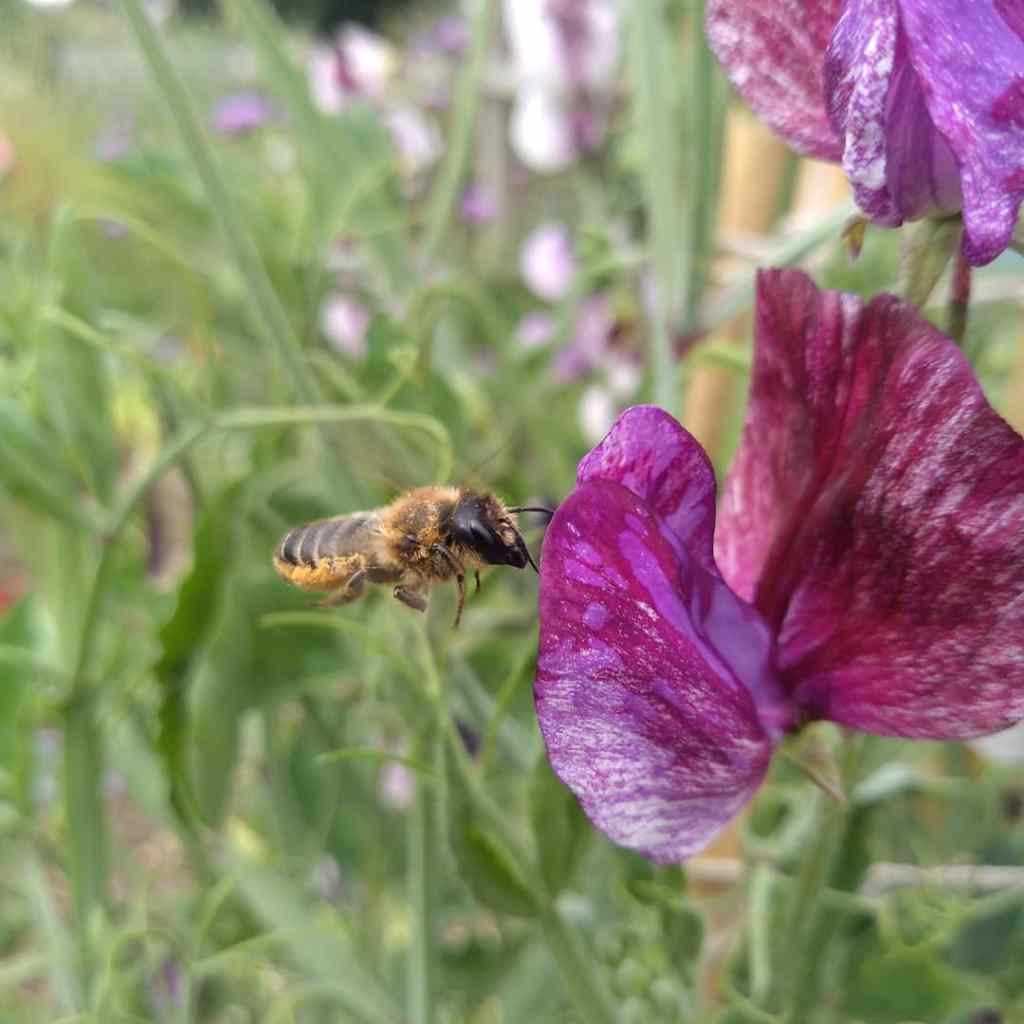
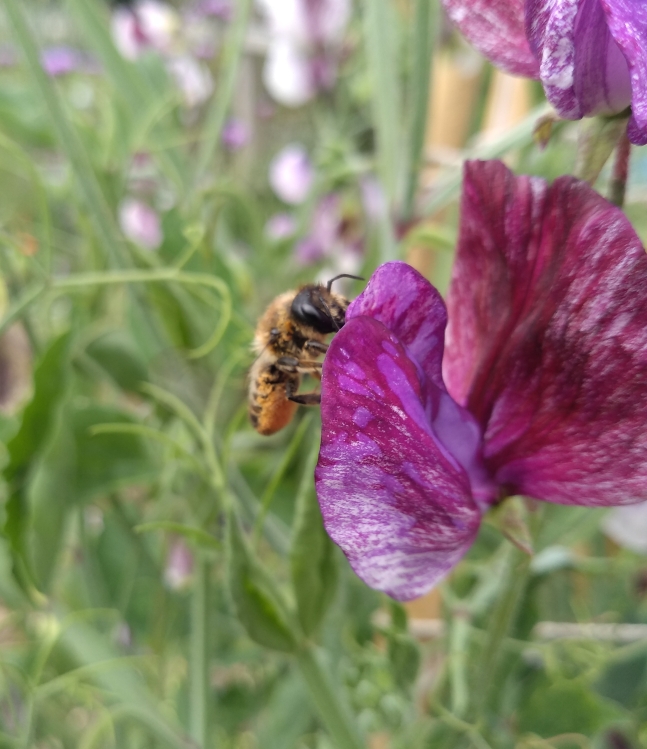
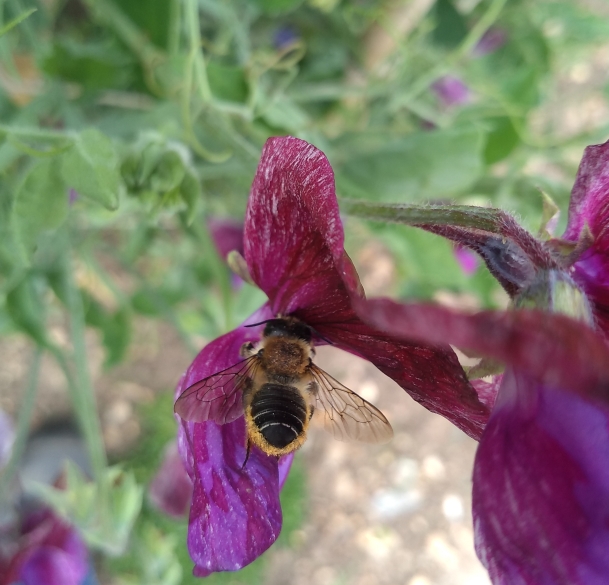
However this wasn’t the highlight of my week. Also at the allotment on Saturday I finally got to see a Leaf-cutter bee. I was so excited to see this spectacular sighting but had to stay quiet and still while I attempted to capture a photo of it.

There are different Leaf-cutter bees in the UK but the one I saw was a Patchwork Leaf-cutter (Megachile centuncularis) bee. It was visiting my sweetpeas, collecting pollen and nectar for her young. The orange pollen brush underneath the abdomen clearly identifying it as a female of this species. The only thing left on my must see list, when it comes to Leaf-cutter bees, is to see one carrying a piece of leaf and also a nest. I do have a bee hotel on the allotment so here’s hoping.

Posted in Allotment, nature

‘March’ing into Spring

As with the first of March, this week ended with sunshine; although there have been moments of heavy rain as well. Meteorological Spring has begun and things are certainly waking up in the gardens. My Scilla have started to bloom and the Anemone blanda are looking magestic too.

Scilla
Anemone blanda

Wild flowers are starting to grow now as well; particularly Hairy bittercress (Cardamine hirsuta) and Common chickweed (Stellaria media).

When the sun was out, I noticed bees foraging. I have seen an Early bumblebee (Bombus pratorum) and a few Buff-tailed bumblebees (Bombus terrestris) visiting flowers. Early bumblebees are one of the smallest in the uk and emerge from hibernation in March, before many other species are seen.

A Bombus terrestris visiting a
Spring crocus (Crocus vernus)

I managed to spend Saturday at the allotment. It’s only the second week on a new plot. After an initial viewing the previous Saturday, my partner and I spent five productive hours this weekend; pruning the apple tree, removing grass from the weedsheet covered beds and sorting the compost bins. No Robins (Erithacus rubecula) visited as earth was disturbed but we did have some friendly Jackdaws (Corvus monedula).

Our allotment helpers

I also treated myself, and pollinators, to a Fuji cherry (Prunus incisa) ‘Kojo-no-mai’. It is the only thing flowering on the allotment at the moment (until we start growing cut flowers, fruit, herbs and vegetables) so it looked wonderful blooming in the sun.