Posted in nature

Beautiful Colours Shining Through.

It has been lovely to see more colour shining through the gloom. Winter aconites (Eranthis hyemalis) are in full bloom now.

These Winter aconites should be flowering now unlike a Flowering Quince (Chaenomeles speciosa) that I noticed.

Clearly this shrub rather optimistically thinks it’s Spring. I guess it’s sheltered sunny position is helping to contribute along with the slightly milder weather we have been experiencing lately. Hopefully a few bees will find the flowers.

One more thing I noticed last week was some Oakmoss, (Evernia prunastri) that had fallen onto the lawn.

Confusingly, given its name, it is a Lichen and not a moss. Also, while usually found on Oak (Quercus) trees, it can be found on other species of tree too, like conifers (Pinophyta). There was a conifer nearby so it most likely originated from there. The resin from that tree will have been absorbed by the lichen and therefore shares the same turpentine quality as the tree.

This Lichen has been used in the perfume industry (for its earthy aroma), in cooking and as a dye. I wasn’t feeling adventurous so rather than take it I moved it to the nearby conifer. Lichen grows very slowly, hopefully it will survive for even longer.

Posted in nature

A London Adventure

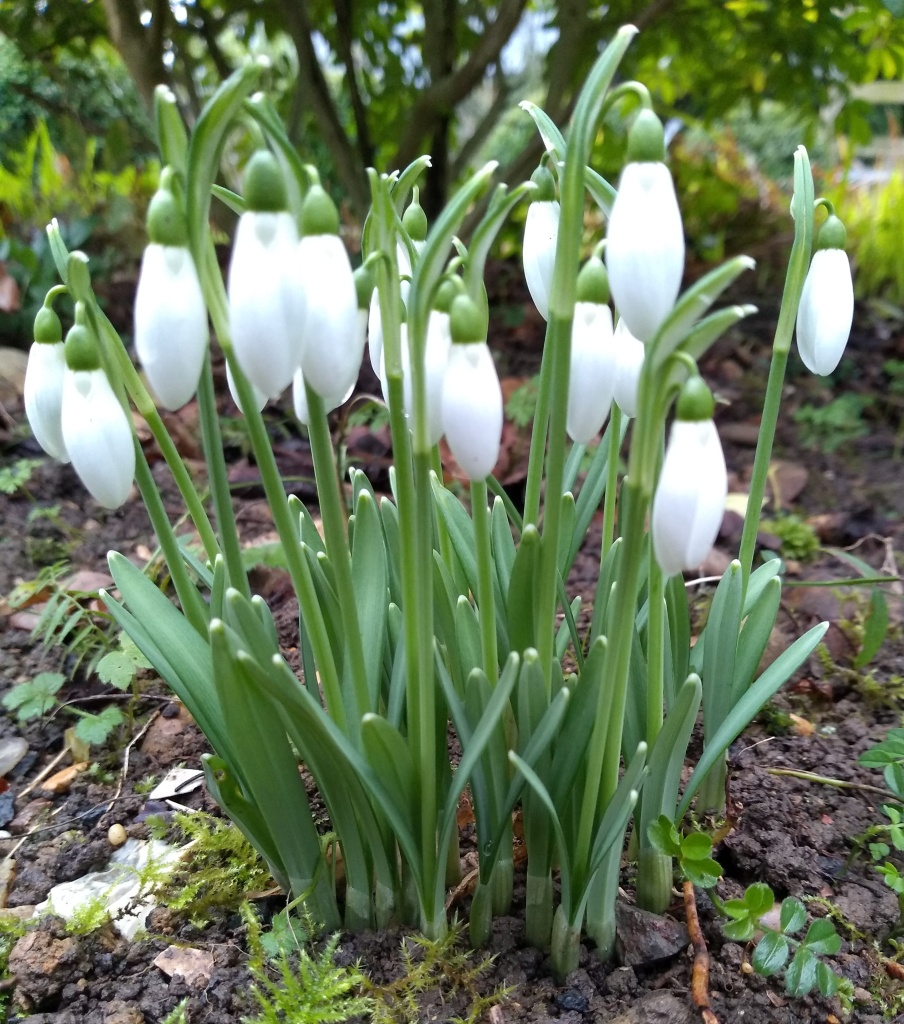
Last week saw Snowdrops (Galanthus) in full bloom

and Winter aconites (Eranthis hyemalis) starting to show themselves.

Robins (Erithacus rubecula) continued to follow me around, in the hope of a tasty meal, as I worked. Plus I noticed a Goldfinch (Carduelis cardueli) sing loudly on top of a fir tree, along with a Jay (Garrulus glandarius) retrieve buried acorns from a lawn.

However trees grabbed most of my attention last week. On Tuesday I noticed some lichen and moss on an old apple tree.

I love the different textures shown here.

Saturday was a glorious day, wonderfully warm in the sunshine. I spent the day in London, enjoying a picnic besides the Thames in Island gardens, under a large London plane tree (Platanus × acerifolia)


These trees are a hybrid from the American sycamore (Platanus occidentalis) and Oriental Plane (Platanus orientalis). They were first discovered in the 17th century, although it is unlikely that trees from that century still exist. They are commonly found in cities, especially London, as this tree can tolerate pollution and compacted soil.
London planes have a beautiful silhouette. Their seed clusters (seen below) hang like balls, remain on branches until spring when they are released and become airborne.

Male flowers are yellow while the female ones, also on the same tree, are red.

A close up of the bark on the trunk.

This camouflage patterned trunk occurs as bark flakes, when the tree grows, revealing newer bark beneath; meaning that pollution captured within it is discarded regularly.

Posted in nature

Is this a Weed? 🌱

Weeds are plants growing in the wrong place, or at least where we don’t want them to grow. After all weeds don’t exist without humans. We determine when a plant is a weed because we view them negatively rather than see their beauty or positive attributes. Usually wild flowers are called weeds when they grow in our gardens but it is possible for cultivated plants to become a nuisance and therefore a weed too.

I am often asked “Is this a weed?” I answer with the plants name and supply information on their growing habits together with their positive attributes (and any negative ones). For example, Dandelions (Taraxacum officinale) unwanted in immaculate lawns are great for early foraging bees (when there aren’t many other flowers about). Euphorbia characias subsp. wulfenii however is bought from garden centres and then freely self seeds where you don’t want it to. Then there are some Marmite plants like Forget-me-nots (Myosotis arvensis) that split opinion and therefore allowed in some gardens but not others.

Historically, some plants regarded as a nuisance now weren’t always disliked. They once had medical, culinary, cosmetic uses or were used as dyes; uses that now are not commonly known. What have the Romans done for us? Add bringing Ground elder (Aegopodium podagraria) to Britain to the list. Once used by the Romans as a herb and medicine (see Alys Fowler’s Guardian article).

I love wild flowers and am happy to allow space for them in a wildlife garden. One wildflower I leave is Garlic mustard (Alliaria petiolata) because it is eaten by Orange tip and Green-veined white caterpillars. Whilst nectar rich flowers are needed in gardens for butterflies, their caterpillars have specific plant requirements without which you won’t get more adults.

So when did our obsession for weeding begin? There is an fascinating extract from ‘The Climate Change Garden’ by Sally Morgan and Kim Stoddart.

‘much of what we consider traditional advice nowadays is based on the comparatively recent practices of Victorian country houses… Prior to this very controlled Victorian approach, in which outside spaces were kept meticulously tidy, the gardens of everyday working folk (aka peasants) exhibited a more free-spirited, practically-minded ethos. Their gardens had a much more ‘higgledy piggledy’ planting of crops, flowers and weeds, many of which were important for both their culinary and medicinal uses in the home.’ p116

So it’s something else the Victorians invented.

I find the subject of ‘weeds’ fascinating. Four wonderful books on the subject that I’ve read recently are,

1. ‘Weeds’ by Nina Edwards
2. ‘Weeds’ by Richard Mabey (For historical and cultural information.)

3. ‘Wild about Weeds; Garden Design with Rebel Plants’ by Jack Wallington (Which shows how to incorporate ‘weeds’ into garden design.)

4. ‘The Climate Change Garden’ mentioned above. It has a chapter entitled ‘Working with Wildlife’ (about wildlife gardening) as well as other chapters on how to adapt garden practices to future proof against long-term changes in climate, from flooding or drought to the importance of trees in combating climate change.

Reading these books will give you a different perspective on ‘weeds’.

Posted in nature

I Spy… Something Beginning With B

The mild temperature continued last week. When the sun came out on Wednesday and Friday mornings it almost felt like spring. Bees foraged on both days. Wednesday was the busiest as a [1] Buff-tailed Bumblebee (Bombus terrestris) and about five [2] Honeybees (Apis mellifera) were visiting a Winter honeysuckle (Lonicera fragrantissima).

[1]

[2]

While on Friday another Buff-tailed Bumblebee was collecting nectar from a Mahonia. I found the perfume from these shrubs hard to ignore so I am not surprised that the bees were intoxicated by them too. However I have never seen Honey bees active in January before.

Other things I noticed last week, usually associated with Spring, were lawns full of daisies (Bellis perennis) along with a Great tit (Parus major) loudly singing it’s repetitive two syllable song ‘tea-cher, tea-cher’.

[3]

Should I be concerned that I am noticing lots of spring activity in January? It is lovely to be reminded that Spring isn’t far away but hopefully it won’t be a continuing annual trend.

Posted in nature

RHS Wisley; January 2020

I celebrated the start of a new year by visiting RHS Wisley. It was a lovely way to end my holiday, as I walked round the winter garden, knot garden, herbaceous borders, Enchanted Botanical Christmas in The Glasshouse and the evening event Glow 2019.

The Winter garden was full of life, colour and perfume. Some plants I noticed were:

Helleborus Walberton’s Rosemary = ‘Walhero’

Helleborus ‘Verboom Beauty’

Edgeworthia chrysantha ‘Red Dragon’

Cornus sanguinea ‘Anny’s Winter Orange’

Hamamelis × intermedia ‘Harry’

Pinus mugo ‘Winter Gold’

Iris lazica

Galanthus ‘Magnet’

Daphne bholua ‘Hazel Edwards’

Viburnum × bodnantense ‘Charles Lamont’

Erica carnea

Along with plants, there were some birds in the garden too. I saw Robins (Erithacus rubecula)

and a couple of Pied Wagtails (Motacilla alba).

Between the winter garden and herbaceous borders is the knot garden containing evergreen and deciduous shrubs as possible replacements for Buxus as topiary and small hedges (see below). The RHS are investigating alternatives to box because of the loss of Buxus through Box blight and Box tree Caterpillar.

I was also interested in seeing the herbaceous borders at RHS Wisley. Obviously the Perennials have died back by winters arrival but I was glad to see that they hadn’t been tidied or ‘put to bed’ . Instead, the perennials had been left for the insects and birds; to be cut back in spring. I think the borders looked beautiful and the seedheads very architectural.

Lastly I have included a couple of highlights from the glasshouse and glow exhibits.

Inside the glasshouse.

It was clear enough to see some stars and Venus.

Posted in Bookworm review, nature

Bookworm Review- The Wild Remedy (How Nature Mends Us~ A Diary) by Emma Mitchell

I have wanted to read this book for a while. As somebody who seeks solace in nature, especially when my depression and anxiety worsen, I am always interested in reading about other peoples experiences.

A long time sufferer of depression Emma describes her ‘Grey Slug’ through the seasons and she uses nature to improve her mental well-being along with conventional help. She lives in the Cambridgeshire fens and sees a variety of wildlife from insects to mammals and wild flowers such as the Bee Orchid as she explores her local area.

Even during her darkest days, when she is unable to go out of the house to emerse herself in nature, she relies on watching birds in her garden.

This lovely book is soothing and inspirational. Her writing transports you to the world around her, while her beautiful illustrations and photographs are a joy to look at. This book is proof that nature can help mend us.

Posted in nature

One Day of Christmas

Having time off has allowed me to catch up on some reading, listening to the birds as I do so. In the mornings I usually notice Blue tits (Cyanistes caeruleus), Great tits, (Parus major), Robin (Erithacus rubecula), Blackbird (Turdus merula) and Magpie (Pica pica) until eventually a Pigeon (Columba palumbus) wakes up and joins in with the chorus. Although it has been nice to relax, it isn’t long before cabin fever kicks in and I need to be outdoors.

As I went for a walk last week, my mood was elevated. I noticed a red-legged partridge (Alectoris rufa) pecking at food along a path.

For a ground dwelling bird, that prefers to run than fly (in short bursts) when danger is near, it was no surprise that it wasn’t in a pear tree. However seeing this bird did feel appropriately festive.

I also saw some Winter jasmine (Jasminum sieboldianum) blooming; bringing a welcome burst of yellow at this time of year.

Upon my return home I caught the lovely sweet scent Sarcococca confusa too.

The small flowers are insignificant amongst the evergreen foliage but they have an intoxicating aroma that I love. I hope the birds find the black berries to eat.

My other winter flowering plants blooming at the moment are;

Sarcococca hookeriana

– and Witch hazel ‘Diane’

(Hamamelis × intermedia ‘Diane’)

Both of these plants are fragrant too but their scent is more subtle than that of the Sarcococca confusa.

I enjoy the transition between years. I don’t make resolutions but I love the positive feeling of renewal and freshness that occurs at New Year.

I also like to reflect on the previous twelve months. The highlight (rather predictably) was catching sight of some Painted lady butterflies (Vanessa cardui) after they migrated in large numbers to this shore in the summer.

I have learnt so much about the wildlife that I’ve seen as I have written my blog; it has been a very enjoyable experience. I am grateful for those of you who follow my discoveries, thank you for taking an interest in my ramblings

Best wishes for 2020!

🐝

Posted in nature

Growing Food for Birds

I saw contrasting images last week which made me think of feeding birds with plants from the garden.
I first observed the Rowan (Sorbus) tree outside, now stripped bare of it’s berries, before noticing some Cotoneaster

and Ivy (Hedera) full of berries. Clearly the pollinators had been busy during the Summer and Autumn months.

Along with supplementary food, on the ground and bird feeders, birds can also rely on trees and other plants in the garden for food in winter. Along with the examples already mentioned there are other berries, fruit, seeds and nuts which are enjoyed by birds.

Some other plants providing fruit and berries are;
Hawthorn (Crataegus)
Honeysuckle (Lonicera)
Guelder rose (Viburnum opulus)
Dog rose (Rosa canina)
Berberis
Bird cherry (Prunus padus)
Crab apple (Malus sylvestris)
Blackthorn (Prunus spinosa)
Pyracantha
Sarcococca hookeriana
Mahonia

Plants providing seeds and nuts include;
Oak (Quercus)
Beech (Fagus)
Hazel (Corylus)
Spindle (Euonymus europaeus)
Teasel (Dipsacus)
Sunflower (Helianthus)
Miscanthus
Bergamot (Monarda)
Verbena bonariensis
Lavender (Lavandula)
Yarrow (Achillea millefolium)
Asters

Leaving seedheads on perennials not only provides food for birds, they also give shelter to beneficial insects. In fact a little bit of leaf litter also has this affect which in turn helps feed birds who eat the insects.

Common birds to see in winter include;
Redwings (Turdus iliacus)
Waxwings (Bombycilla)
Starlings (Sturnidae
Blackbirds (Turdus merula
Robins (Erithacus rubecula
Chaffinches (Fringilla coelebs)
Bramblings (Fringilla)
Goldfinches (Carduelis carduelis)
Bullfinches (Pyrrhula pyrrhula)
Dunnocks (Prunella modularis)
Goldcrests (Regulus regulus)
Blue tits (Cyanistes caeruleus)
Long-tailed tits (Aegithalos caudatus)
Coal tits (Periparus ater)
Great tits (Parus major)
Fieldfares (Turdus pilaris)

The RSPB Big Garden Birdwatch, which takes place on the 25-27th Jan 2020, has been going for over 40 years. Surveying birds visiting your Garden or local park for one hour is calming and enjoyable. This citizen science continues to give the charity useful information on the numbers of birds in the UK.

Further information on feeding birds can be found in the book, ‘RSPB Pocket Bird Feeder Guide’ by Robert Burton (published by Dorking Kindersley) or on the Gardeners World website.

Posted in nature

First Signs of Snow(drops)

The cold weather is setting in, days continue to shorten and the gardens seem dorment; it is easy to feel gloomy when the sun isn’t shining. Yet, even at this time of year, life is beginning to break through. Last week Snowdrops (Galanthus nivalis), Daffodils (Narcissus) and Hellebore flowers (Helleborus) started to show themselves. It is lovely to see these small signs of growth. It is a reminder that even in the darkest days small glimmers of hope can be found if you look carefully.

Snowdrops (the Latin name meaning ‘Milk flower of the snow’) are simple yet elegant. There are 2,500 varieties, the rarest are highly prized. Some gardens have collections of snowdrops which can be visited in February such as
Colesbourne gardens and
Benington Lordship garden.

The substance galantamine (contained in Snowdrops and other plants from the Amaryllidaceae family) has been used in the drug Reminyl for the treatment of Alzheimer’s. A fact I discovered when I visited the Chelsea Physics Garden earlier in the year.

Hellebores complement Snowdrops nicely. The Hellebore traditionally associated with Christmas is the early flowering Christmas Rose (Helleborus Niger). It is referred to as a rose because the flower resembles those of wild roses; it isn’t part of the Rosa genus. Other Hellebores (Helleborus hybridus) begin to flower a little later. There are different varieties of each species. Hellebores have a long flowering season, blooming until March.

Cutting back the old leaves of this perennial from late autumn has two advantages. Firstly it enables you to see the beautiful flowers more clearly and secondly it prevents leaf spot from spreading further.

Hellebores are great for pollinators, like solitary bees which are searching for food in early spring. They can also make lovely cut flowers.

Hellebores have a tendency to cross pollinate and self seed easily, producing increasingly murky colours if left to keep growing on. However, the seeds can be cleared quickly by hoeing or by cutting the flowers off before germination can occur.

If these two plants aren’t enough to bring joy at this time of year then hearing Robins (Erithacus rubecula) sing loudly is wonderfully uplifting. Along with Robins other birds are easy to spot now trees are bare.

I had an unusual sighting last week, that of a Great Spotted Woodpecker (Dendrocopos major). It held onto the side of a tree trunk as I entered a garden. I accidentally disturbed it so it crept round to the back of the tree before eventually flying off. It appeared to be feeding. Woodpeckers capture insects or larvae with their long sticky tongues; however during winter they can start eating berries and from bird feeders too.

On route to Wales, at the weekend, I noticed a Kestral (Falco tinnunculus) hovering alongside the motorway. Clearly it was making the most of the brief break in the clouds looking for small mammals, birds, worms or insects.

It was lovely to see the Woodpecker and Kestral last week as I don’t often see these birds.

Posted in nature

National Tree Week (23/11/19-01/12/19)

Meteorological winter has begun. Rather appropriately Autumn turned wintery yesterday as we had a very cold and frosty start to the morning. Apparently it was the coldest night since February.

National tree week ends today too. Started by the Tree Council in 1975 it’s a time to focus on the importance of tree planting along with celebrate these amazing plants. The week coincides with the best time of year to plant trees. This time round there has been a specific emphasis on promoting the usefulness of trees in combating climate change (by pollution and carbon dioxide absorption).

I have planted many trees in the past, however last week the main job continued to be leaf collection.

A little momento of some beautiful leaves.

While most trees shed leaves consistently over a period of time, in my experience, leaf drop of English/ Pedunculate Oak (Quercus robur) and European Beech (Fagus sylvatica) tends to occur in one go at the end of Autumn. This has certainly been true this year, as we collected huge amounts of leaves from large Oak and Beech trees in many gardens; their beautiful rich autumnal colours like carpets on the ground.

Both these deciduous trees are from the Fagaceae family which explains their similarities. Both grow to great heights, have dense canopies and can exhibit marcescence (where some dead leaves are retained on the trees throughout winter).

Both trees are great for wildlife too. Beech nuts are eaten by Deer, Badgers (Meles meles), Grey squirrels (Sciurus carolinensis), Mice, Chaffinches (Fringilla coelebs) and Brambling (Fringilla montifringilla). Even the foliage is food for caterpillars of several species of moth like the Barred hook-tip (Drepana cultraria) and Olive crescent (Trisateles emortualis). Beech trees create a vital habitat for butterflies along woodland edges as well; including Orange-tip (Anthocharis cardamines) and Gatekeepers (Pyronia tithonus). Plus ectomycorrhizal truffle fungi grow beneath them. Turned into hedges, Beech can also create a habitat for birds.

As with the European Beech, the Pedunculate Oak supports a variety of fungi, animals, birds- particularly Jays (Garrulus glandarius) and insects such as Stag beetles (Lucanus cervus)
and the Purple hairstreak (Neozephyrus quercus) and Purple emperor (Apatura iris) butterflies. In fact of all the native British trees the Pedunculate Oak supports more wildlife than any other tree. Even its leaf litter and dead wood is full of life. I love these wonderful trees, especially ancient oaks. I enjoy thinking of all the hidden life existing alongside me as I work in the gardens. Also they are wonderful trees to hug. 🌳🤗