Posted in nature

Early Transition into Summer.

Last week began with Spring bank holiday monday. I went for a socially distant walk around the village with my partner. Thankfully he was very patient as I constantly stopped to take photos with my phone.

There were lots of sights and sounds to observe and it really felt like a summers day (which aren’t far off). Some I have noticed for a while like Orange-tip Butterflies (Anthocharis cardamines), Red-tailed bumblebees (Bombus lapidarius), Skylarks (Alauda arvensis), Red kites (Milvus milvus) and House sparrows (Passer domesticus).

Yet amongst the Elderflowers (Sambucus nigra) and Brambles (Rubus fruticosus), which are blooming at this time of year,

These flowers are great for making Elderflower cordial.
Looks like there will be lots of Blackberries this year.

were many more plants flowering too. The explosion of colour within our countryside is fantastic for pollinators. One insect I saw on Mondays walk, in a field busily pollinating Buttercups (Ranunculus), was the False oil beetle (Oedemera nobilis). This very small beetle is a vibrant metallic green colour. When it’s wings glistened in the sun, they changed from mid to light green.

Unfortunately this is the best photo I managed to get of this tiny beetle.

Upon my return to work, I noticed other insects flying about. Several small tortoiseshell Butterflies (Aglais urticae) were too quick for me to photograph, however I did capture Common carder bees (Bombus pascuorum) on Common comfrey (Symphytum officinale) and

a Cream Spot Ladybird (Calvia quattuordecimguttata)

Once again, another ladybird determined to get my attention by falling on my sunglasses while I wore them.

The Cream Spot ladybird has fourteen spots and survives winter in tree bark and Beech masts. Although it is usually found amongst hedgerows rather than gardens.

Wildflowers that were in full bloom last week were;

-Purple toadflax (Linaria purpurea),

-Field scabious (Knautia arvensis),

– Common stork’s-bill (Erodium cicutarium),

This plant is a good food source for Brown argus Butterfly (Aricia agestis) caterpillars, along with Meadow and Dove’s-foot Crane’s-bills (mentioned below). This butterfly is often found in southern chalk and limestone grassland but it can also inhabit places with disturbed soil like verges and coastal areas. In fact this plant was found on disturbed soil edging a field.

-Meadow crane’s-bill (Geranium pratense),

-Creeping cinquefoil (Potentilla reptans),

-Common poppy (Papaver rhoeas),

-Dove’s-foot Crane’s-bill (Geranium molle),

-Field bindweed (Convolvulus arvensis),

-Common mallow (Malva sylvestris),

-Creeping woodsorrel (Oxalis corniculata),

-Birds-foot trefoil (Lotus corniculatus) and

-White clover (Trifolium repens).

Found amongst lawns, this is a wonderful food source for the Common blue butterfly (Polyommatus icarus) and some bumblebees

Recent weather conditions have caused dryness within nature that normally exists during summertime. Water is already required and talk of conserving water has already begun to help prevent restrictions later in the year. I shall be interested to see how nature deals with this early warm dry weather, especially with less human disturbance due to lockdown. Will it be another great year for butterflies? I look forward to discovering more as we spring into summer.

Posted in nature

🎵The Heat Is On. 🎤 🎹🎷🎶


“Tell me can you feel it, tell me can you feel it, tell me can you feel it, the heat is on…”

The 80’s song from the Beverly Hills Cop soundtrack with Glenn Frey’s voice, synthesizer and saxophone was my earworm as the temperature soared last week. The temperature increased to around 27°C mid week, which meant lots more insects ventured out as it felt like summer.

I was happy to see my first Red admiral (Vanessa atalanta) butterfly of the year, however my main observations were bees including the Red-tailed bumblebee (Bombus lapidarius) and Honey bees (Apis mellifera).

A Red-tailed bumblebee pollinating some geranium.
Honey bees visited Nepeta.

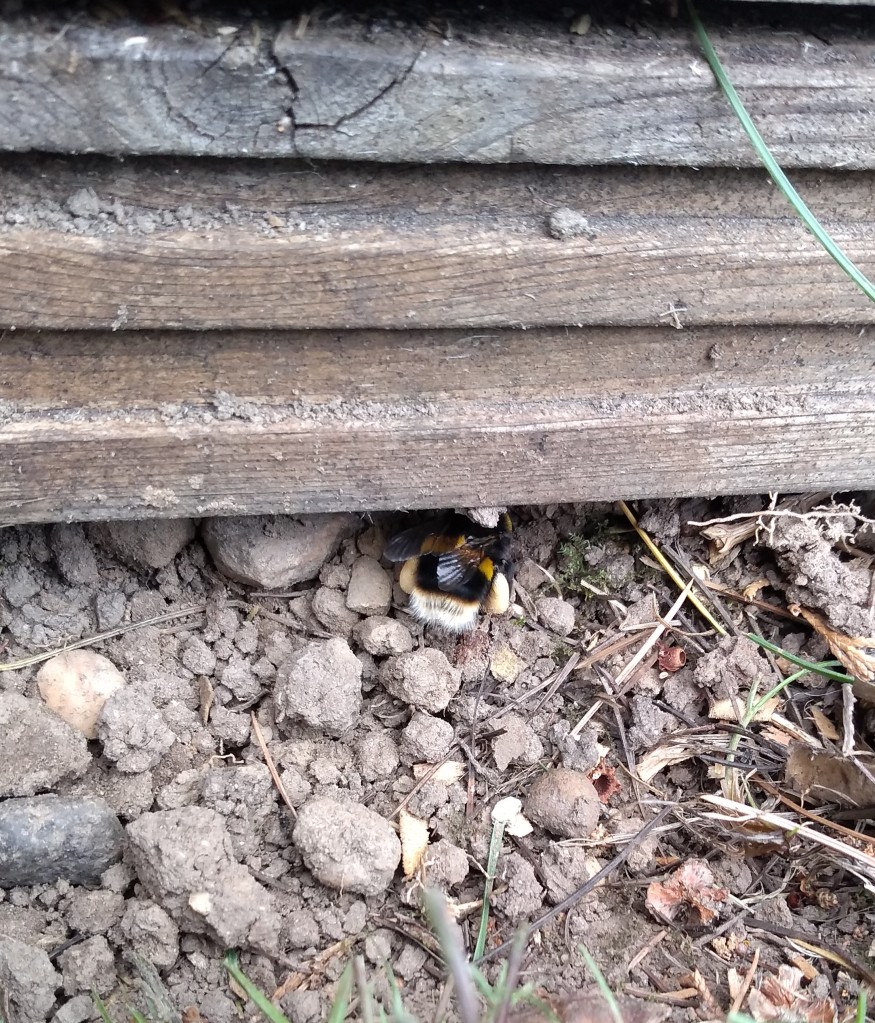
Another bee I started seeing last week was the Tree bumblebee (Bombus hypnorum). I noticed a nest inside a compost bin as I emptied grass clippings from the mower bag.

I have seen Tree bumblebees nest in bird houses before but not under compost. I made sure I avoided tipping grass onto their home and used the next bin along. I couldn’t help watching them for a little while as I stopped for a breather on the very hot Wednesday.

Moths were prominent throughout the week too. Unfortunately Box tree moth (Cydalima perspectalis) caterpillars and the signs of heavy infestation (foliage that had been eaten and covered with webbing) was noticeably present in several gardens. Therefore, I spent lots of time picking them off buxus topiary and informing clients to keep an eye out for them as well. For more information on this pest see the RHS website.

I discovered this years first sighting of a Silver Y (Autographa gamma) moth.

A Silver Y moth resting on a Heuchera leaf.

This immigrant is one of the few brown moths I can identify easily, mostly due to the clear y markings on it’s forewings but also because of their size and shape. This is a day and night flying moth which can be observed visiting flowers to obtain nectar.

However my most exciting moth sighting was the Lime hawk-moth (Mimas tiliae).

This spectacular large moth is night flying. It’s wingspan is 4.6-7.8cms and it can be found in broadleaf woodland, parks and gardens between May and July. I accidentally disturbed it as I pruned some shrubs under a Lime (Tilia sp.) tree. Thankfully it didn’t seem bothered by the disruption and it was carefully placed back near the lime tree. While adult moths of this species don’t feed, the caterpillars do. Once they have emerged from overwintering pupa, the caterpillars will eat Lime, elms (Ulmus sp.), Alder (Alnus glutinosa), Downy Birch (Betula pubescens) and Silver Birch (Betula pendula), Plane (Platanus x hispanica) along with some Cherry cultivars. This was the first Hawk-moth I have ever seen. There are a few that exist in the UK. The nearest I came to seeing one before was observing caterpillars of the Elephant hawk-moth (Deilephila elpenor) eating away at some Fuchsia. For more information on these Hawk-moths see the Butterfly Conservation website (Lime hawk-moth and Elephant hawk-moth)

I also saw hoverflies. I am still learning about these insects and learnt another one last week.

The photo above shows a Narcissus bulb fly (Merodon equestris). The maggots eat away at the centre of bulbs from the Amaryllidaceae family. However even though the maggots are a pest, the adult hoverflies are pollinators.

Posted in nature

Things Come in Threes

At least in several gardens last week, things with three leaves appeared as several Trefoils began to flower.

In some lawns the yellow flowering Slender hop clover (Trifolium micranthum) has shown itself along with Red clover (Trifolium pratense).

Slender hop clover
Red clover

Red clover is also called Bee-bread (along with White clover- Trifolium repens) due to its popularity with bees. It’s nectar is especially loved by Common carder bees (Bombus pascuorum), Honeybees (Apis mellifera) and Red-tailed bumblebees (Bombus lapidarius). Red clover, which is less commonly found in nature than White clover, is used for livestock feed and crop rotation (due to its nitrogen fixation abilities). It is also used in herbal medicine to treat respiratory and skin ailments,along with menopausal and PMS symptoms because the flower contains isoflavones. When taken internally, isoflavones become phytoestrogens which has similar affects in the body as estrogen (see Plantlife)

I will have to wait a little longer to see White clover flowering as it blooms from June. However White clover is commonly found in verges and grassland so I’m sure to see some eventually.

Unfortunately I have never spotted a four leaf clover (or five leaved). I am ever hopeful, just for the challenge because they are so hard to spot in the wild.

Several trees are blooming at the moment. Along with Hawthorn (Crataegus monogyna- the May tree flowers referred to in the rhyme ‘Cast ne’er a clout ere May is out’) the Horse chestnut (Aesculus hippocastanum) is also in flower; they have white flowers with a pink tinge.

I also see the Red horse chestnut tree (Aesculus x carnea Briotii) on my travels, both trees have very showy flowers.

It was great to see lots of bees about last week and various species too.

The first type of bee I saw was a Hairy-footed flower bee (Anthophora plumipes) around some forget me nots (Myosotis).

I also noticed lots of Buff-tailed bumblebees (Bombus terrestris),
Honey bees and Early bumblebees (Bombus pratorum) throughout the week too.

This Cotoneaster hedge was alive with Honey bees. Make sure the sound is on to listen to their relaxing buzzing.
The Early bumblebees were also visiting the Cotoneaster flowers.
I noticed five Buff-tailed bumblebees coming and going from a nest under some decking in one garden.
Posted in nature

Every Day is a School Day

No doubt due to the recent weather, I have noticed more flowers blooming earlier than their traditional start time of June. One example is the Common nipplewort (Lapsana communis).

The Common nipplewort is part of the sunflower family.

Other plants flowering at the moment are Greater celandine (Chelidonium majus),

This isn’t a relative of the Lesser celandine (Ficaria verna) despite its name. It is part of the poppy rather than buttercup family.

– Three-cornered garlic (Allium triquetrum),

Ants spread the seeds of this wild flower.

– Red campion (Silene dioica),

A dioecious plant, male flowers bloom on separate plants to the female flowers.

– White campion (Silene latifolia),

White campion is pollinated by moths because it is night scented

– Cleavers (Galium aparine),

The flowers of Cleavers are tiny. This photograph has been enlarged so they can be seen more clearly.

– Common honeysuckle (Lonicera periclymenum),

I noticed the sweet scent first. This plant is beneficial for a variety of butterflies, like the White admiral (Limenitis camilla), bumblebees and moths. Birds such as Thrushes (Turdidae), Warblers (Sylvidae) and Bullfinches (Pyrrhula pyrrhula) also eat its berries. Plus Dormice (Muscardinus avellanarius) inhabit and feed on this plant.

– A sow thistle (Sonchus),

– A Hawkweed (Hieracium),

– Mouse-ear Hawkweed (Hieracium pilosella)

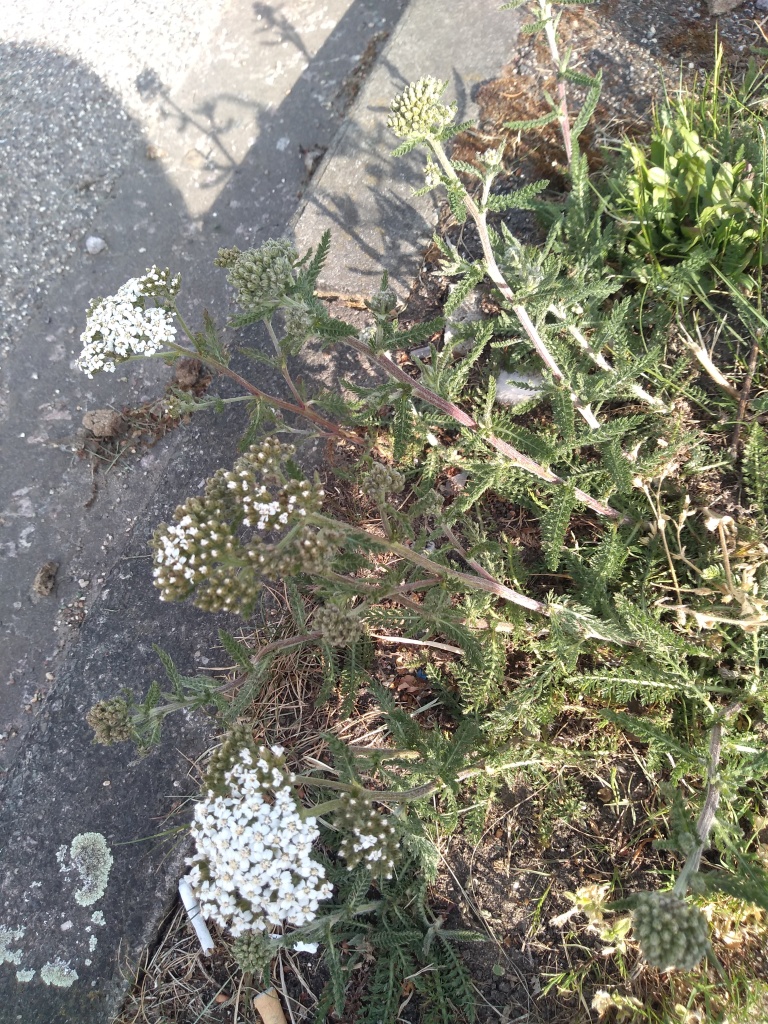
– and Yarrow (Achillea millefolium).

A plant that was new to me was Common knapweed (Centaurea nigra).

Along with all the wild flowers I noticed last week, the warm weather continued to encourage lots of insects out. There were more Holly blue (Celastrina argiolus) and Orange-tip (Anthocharis cardamines) butterflies along with bumblebees.

I also saw a Cinnabar moth (Tyria jacobaeae) at the allotment, amongst the long grass.

This moth flies flies during the day as well as at night time.

The most interesting insect I observed last week was a Pine ladybird (Exochomus qadripustulatus).

I have never seen this species of ladybird before. It dropped onto my sunglasses as I worked. Due to its small size (3mm in length), to begin with I thought it was a bit of dirt. As the name suggests, this beetle inhabits Pine (Pinus) trees. However they can also be found around other trees and shrubs especially Hawthorn (Crataegus monogyna).

Posted in nature

April Showers Finally Arrive.

The proverb ‘March winds and April showers brings forth May flowers’ came to mind several times in the past week. Now that May has arrived, I look forward to seeing what will bloom this month.

Due to the amount of rain within the week, observations were few and far between; although I occasionally noticed bees flying around during dry periods when the sun shone.

I saw several Common carder bees (Bombus pascuorum) visiting an expanse area of White dead-nettle (Lamium album).

Bees also visited Welsh poppies (Papaver cambricum) which were blooming early.

They tend to start flowering between June to August. I love the golden shades of yellow and orange produced by this plant. Their chearful appearance, is perhaps why clients often like having these in their gardens. 

I learnt some more wildflowers last week. It’s always lovely to expand my knowledge of wildflowers.

I found two in some borders, Hedgerow crane’s-bill (Geranium pyrenaicum) and

Lamb’s lettuce (Valerianella locusta).

The last one I saw was in a lawn, under the canopy of a tree, it was Meadow Saxifrage (Saxifraga granulata).

Posted in nature

What a Hoot.🦉🎵🦉🎶

On Saturday night I woke up to a beautiful duet. A pair of Tawny owls (Strix aluco) were calling to one another, reinforcing their territory. The male call sounds like ‘hooo, hu, huhuhuhooo’ while the female gives a ‘keewik’ sound (see BTO).

Tawny owls pair for life and remain in their territory (initially established in winter) throughout the year. Deciduous broadleaf woodland is their traditional habitat but sometimes they live in large gardens and parkland. They nest within tree cavities or nest boxes. Occasionally eggs are laid in February but more often between March and April. While the female is slightly larger than the male, these owls are the same size as a wood pigeon. They feed on small mammals, birds, rodents, fish, frogs, insects and worms. Their UK Conservation Status is Amber as their numbers are declining. 

Another bird which caught my eye last week was a male House sparrow (Passer Domesticus). I was leaving the allotment when I observed him collecting nest material before flying off. As with the Tawny owl, House sparrows pair for life and their numbers have also been declining for a while; House sparrows are Red in the UK Conservation Status list. I grew up seeing lots of them but since moving down south, I haven’t seen one for years so this was a wonderful sight. I love these little birds, especially hearing their chattering and chirping in their colonies. Hopefully I will see him and more Sparrows soon.

As the week went on I noticed more flowers blooming in the hedgerows. Wild strawberry, also called Alpine strawberry (Fragaria vesca), was the first one I saw.

The fruit of this strawberry can be eaten.

Others I saw were; Bugle (Ajuga reptans),

These flowers are visited by White-tailed bumblebees (Bombus lucorum), Common carder bees (Bombus pascuorum), Silver Y moths (Autographa gamma) along with Green-veined white butterflies (Pieris napi).

– Herb bennet/Wood avens (Geum urbanum) and

Grizzled skipper butterfly (Pyrgus malvae) caterpillars feed on this plant.

– Bush vetch (Vicia sepium).

Bees and other pollinators enjoy these flowers.

I got to see a female Orange- tip (Anthocharis cardamines) butterfly, having seen a male one the other week. Males have the orange tips while the tips on the female’s forewings are black (both have the black spots). The female can be identified apart from other white butterflies by the mottled green and white underwings (also exhibited by the males). Caterpillars of this butterfly feed on Garlic mustard (Alliaria petiolata) and Cuckoo flower (Cardamine pratensis).

Posted in nature

Even Nature Turned Blue for the NHS.

While flowers dominated my thoughts last week, there were moments when I enjoyed observing bees and butterflies too. I saw my first male Orange-tip butterfly (Anthocharis cardamines) and female Red-tailed bumblebee (Bombus lapidarius) of the season; both visiting Dandelions (Taraxacum officinale). Other butterflies I noticed were more Speckled woods (Pararge aegeria) and Peacocks (Aglais io). All were too busy making the most of the sun to remain still long enough for me to photograph them.

After threatening to rain last Sunday, with distant thunder in the afternoon and evening, wet weather eventually arrived the following weekend. On Friday it rained late in the day through to Saturday afternoon. The ground loved that sustained soaking and together with all the sunshine we’ve had recently the grass is beginning to flourish. Thankfully lots of wild flowers bloom despite the lack of water, including;

– Ivy-leaved toadflax which is also called Kenilworth ivy (Cymbalaria muralis),

– Lords and ladies, otherwise known as Cuckoo-pint (Arum maculatum),

– Ribwort plantain (Plantago lanceolata),

The seedheads are great for feeding birds in winter.

– Dog’s mercury (Mercurialis perennis),

The tiny flowers are easy to miss amongst the leaves.

– Ox-eye daisy (Leucanthemum vulgare) and

– Cuckoo flower (Cardamine pratensis).

The name for this comes from the belief that this plant blooms at the same time the first Cuckoo arrives in the UK.

The main spring spectacle of the English countryside however are English Bluebell (Hyacinthoides non-scripta) woods in full bloom. Photos of these have filled social media over the past week. I am lucky enough to live near to several woods where English bluebells flower, however due to the lockdown this year I have to make do with spotting the ones amongst the headgerow, on my way to the allotment. Thankfully even small scale sightings of these flowers makes my heart soar. Swathes of these beauties are an indicator of ancient woodland (they are slow growers with seeds taking five years to become bulbs, which then flower). 

English bluebells continue to be under threat from the Spanish bluebell (Hyacinthoides hispanica) escaping from gardens, brought to these shores by the Victorians, which readily hybridise with English ones to produce the Hybrid bluebell (Hyacinthoides x massartiana). However, this isn’t the only threat to our native Bluebell. Habitat destruction is another reason for their decline. Simply walking on them can prevent them from flourishing for years afterwards as photosynthesis is prevented and the plant is weakened. They are a protected species under the ‘Wildlife and Countryside Act (1981)’. This means that people can be prosecuted for removing the plants and bulbs from their habitat and/ or selling them. 

It is possible to tell the English and Spanish Bluebells apart.
English Bluebells are a deep violet shade of blue with creamy-white pollen. The leaves are narrow (1-1.5mm wide) as are the flowers. The tips of each petal (six in total) curl up and inwards. The scented flowers grow on one side of the stem causing it to arch over to the one side (referred to as inflorescence).

Spanish bluebell flowers are pale blue (but can be pink or white), have a wider open bell shape with flared petal tips and bloom all around the stem, which therefore remains upright. The leaves are also wider (by 3cms) than its English counterpart and the flowers have no scent. 

Unsurprisingly the hybrids possess characteristics of both parents, however their appearance tends to be more like the English Bluebell meaning distinguishing the two can sometimes be difficult. 

Last week I saw both English and Spanish Bluebells on my daily exercise.

English Bluebells are great for long-tongued bumblebees. However previously I have seen evidence of short-tongued bumblebees visiting Bluebells. Unable to reach the nectar in the traditional method, I noticed a hole in the base of the flower where a bee had obtained the nectar without pollinating it. This is referred to as ‘nectar robbing’.
Spanish bluebells found in a garden.

Bluebells are interwoven into our culture. In the past the sap was used to glue feathers to arrows and in book binding. Plus the Elizabethans used the bulbs to starch collar and sleeve ruffs.

In folklore they are associated with fairies while in the language of flowers (popular in the Victorian era) they represent humility, constancy, gratitude and everlasting love. What better flower to have bloom during this difficult time when we are showing our appreciation for the NHS and other frontline workers. It seems even nature has turned blue in solidarity.

Posted in nature

No Rain but Rainbows Everywhere

I continue to get my daily exercise outdoors and enjoy seeing rainbows drawn by children in windows or on driveways. Although we had sun last week there was no rain so these cheerful rainbows of unity were the only ones that have appeared.

The lovely weather encouraged many insects out. Last week I managed to count eight Peacock (Aglais io) butterflies. I also saw one Brimstone (Gonepteryx rhamni) butterfly visiting some Dog violets (Viola riviniana). I have never noticed insects pollinate these pretty flowers before so it was lovely to observe that. These dainty plants are very useful additions to wildlife gardens for another reason too; several fritillery butterflies lay eggs on them. During that same walk I also saw lots of seven-spot (Coccinella septempunctata) ladybirds as well as a few Dark-edged bee-flies (Bombylius major).

A Dark-edged bee-fly pollinating some Forget-me-not (Myosotis sylvatica) flowers.

I have never seen these parasitic flies before whose host is the Tawny mining bee (Andrena fulva). The Tawny mining bee is commonly found in urban areas especially in lawns, although I have yet to see one (to find out more see the Bumblebee Conservation Trust). There is a recording scheme for Bee-flies so I shall pass this information on to the (BRC).

On Friday mornings exercise I saw a Song thrush (Turdus philomelos). The last time I saw one was a couple of years ago but this probably isn’t surprising because they are on the red UK conservation status list (see RSPB). It was great to see this one, although I wonder if I accidentally disturbed it looking for food; I came across it on a path before it flew into some trees.

As I walked further, I noticed more plants beginning to bloom. These were;

-Bulbous buttercups (Ranunculus bulbosus),

Identified by the reflexed sepals (turned downward), leaf shape, furrowed stems and the fact it is flowering before May.

-Danish scurveygrass (Cochlearia danica),

Once only found in coastal areas this plant now thrives here because of the salted roads during winter.

-Garlic mustard (Alliaria petiolata),

-Yellow corydalis (Pseudofumaria lutea) and

This often grows in the gaps in old walls.

-Dove’s-foot Crane’s-bill (Geranium molle).

Even without natural rainbows nature was still full of colour last week.

Posted in nature

All Four Seasons in One Week

The weather during the second week of lockdown was mixed. It began with snow flurries and sleet but ended with the warmest day of the year so far.

I continued my daily exercise walks around my area and saw more wild flowers, trees, bees and birds enjoy Spring.

Plants that began to bloom last week were;

– Shepherd’s Purse (Capsella bursa-pastoris),

– Snake’s head fritillary (Fritillaria meleagris),

– Herb Robert (Geranium robertianum),

– Annual honesty (Lunaria annua),

– Common Groundsel (Senecio vulgaris)

– and Laurel (Prunus laurocerasus).

I also noticed my first Dandelion (Taraxacum officinale) clock of the year 

Water droplets can be seen as frost began to melt on this Dandelion clock. A flower head will produce an average of 180 seeds.

along with Horse chestnut (Aesculus hippocastanum) trees budding at this time too.

One particularly special moment occurred last Wednesday when I visited my local woodland park. I went for my exercise as early as possible so that I would avoid too many people. As I entered the park I heard a sound of my childhood, that of Skylarks (Alauda arvensis). I grew up surrounded by farmland, similar to where I live now, and Skylarks singing was familiar to me (see RSPB). 

I knew there were nesting Skylarks in this area because of a notice I saw last year (see my blog post Relaxing into Autumn). There were three Skylarks, two were clearly a pair. Occasionally the third bird would get too close to the other two; causing a noisy aerial display before they all returned to the open ground apart once again. I watched this happen four times as I carefully moved around them; maintaining a distance so that I wouldn’t disturb them unnecessarily. Seeing and hearing these lovely birds was a beautiful experience to witness.

On Friday, while at home, I heard a group of Magpies (Pica pica). They were making such a raucous noise that I looked outside to see what was occurring. I was fascinated to see one Magpie (which was trying to escape) pinned down and being pecked at by another one. As this occurred, four more Magpies kept flying in, occasionally taking part in the attack. Eventually the bird which was under attack escaped and forced by the group to fly away. I have witnessed birds defend territories before but not like that.

Another sound I became aware of later in the week, were Greenfinch (Carduelis chloris), (See RSPB). Although I heard their call, I was unable to see them. However I have observed a Great tit (Parus major) and Coal tit (Periparus ater) and several Blue tits (Cyanistes caeruleus) visit the Rowan (Sorbus) tree outside my flat.

Posted in nature

Be Wild Indoors

Keeping isolated doesn’t mean you can’t see wildlife and gardens (as well as donkeys) in real time. Here are a few links to activities and webcams which enable you to get your nature fix while remaining indoors.


https://www.rspb.org.uk/

https://www.hertswildlifetrust.org.uk/wildathome

https://www.housebeautiful.com/uk/garden/g31913008/best-virtual-tours-garden/

https://www.wildlifetrusts.org/webcams

https://www.google.com/amp/s/www.lonelyplanet.com/amp/articles/best-wildlife-web-cams

https://www.google.com/amp/s/www.countryliving.com/uk/wildlife/countryside/gmp31784857/live-animal-webcam-zoo/

https://www.visitscotland.com/see-do/wildlife/webcams/

https://www.thedonkeysanctuary.org.uk/webcams