
Within the past month the temperature has reached the highest on record in the UK at 40.2 Celsius. Here in the south, rain still evades us leading to hosepipe bans in some counties. Plus as I write this blog another heatwave begins. While the parched grass will recover once rain eventually falls, and some insects may benefit from these conditions, this drought is not good for nature in general (including humans due to amber and red heat warnings for health issues and fires). We need to use resources more thoughtfully and manage the land better so that nature (to me humans are part of nature not separate from it) isn’t placed under unnecessary pressure due to extreme weather conditions anymore.
Most wildlife isn’t adapted to this current weather and certainly has no chance against wild fires, especially Badgers (Meles meles) and Hedgehogs (Erinaceus europaeus– whose numbers have been in decline for many years for other reasons too). Even birds with second broods will be finding these times difficult; that is why it’s so important to place water sources at both ground level and higher up for birds and Hedgehogs at this time. Plus insects like Butterflies and Bees suffer when flowers start to whither early due to water shortage. Nature can recover from the odd hot dry year but unfortunately this is a trend, year on year, due to climate change so we need to be concerned and act now. Stephen Moss has written a wonderful article regarding this issue recently, it can be read here.
Given the information from the article mentioned above, it will be interesting to see how this prolonged drought will affect the results of the Big Butterfly Count this year (which took place from the 15th July to the 7th August) and consequently next years results too.
I have undertaken a few counts this year. The first time I looked out for Butterflies was on a warm afternoon, in a garden containing a Buddleia along with some Lavender (Lavandula) and Mint (Mentha) that was flowering. During that time, I identified;
5 Red admirals (Vanessa atalanta)
5 Commas (Polygonia c-album)
2 Peacock (Aglais io)
5 Gate keepers (Pyronia tithonus)
1 Meadow brown (Maniola jurtina)
2 Small tortoishell (Aglais urticae)
together with 1 Hummingbird Hawkmoth (Macroglossum stellatarum). The Hummingbird Hawkmoth is fascinating. I have observed two individuals visiting Buddleia this year in different gardens that I work at. It is so amazing to watch it collect nectar as it hovers next to flowers.
On separate occasions (at the previously mentioned garden) I also noticed a Large skipper (Ochlodes sylvanus) and a Ringlet (Aphantopus hyperantus) too. That garden also has an allotment attached to it where I got to observe the full lifecycle of a ladybird on one bean plant (thanks to the Blackfly being present). On this occasion it was the Harlequin (Harmonia axyridis) ladybird.


My second Butterfly Count was during a morning as I picked Blackberries (Rubus) at the local woodland park, where I saw
5 Gatekeepers, 1 Speckled wood (Pararge aegeria) and 1 Small copper (Lycaena phlaeas).

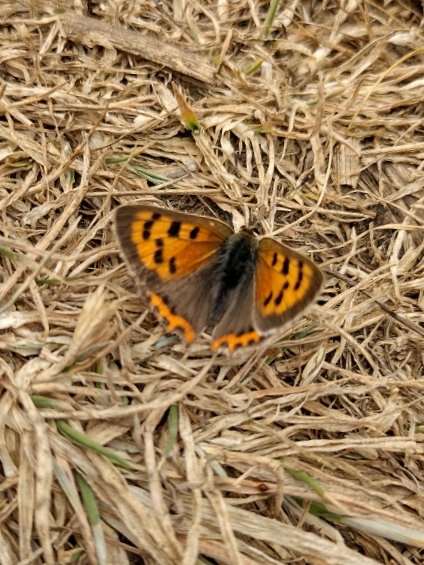
The Small copper is one I had never seen before. It is a small butterfly with a wingspan of 32-35mm. The caterpillars feed on Common Sorrel (Rumex acetosa), Sheep’s Sorrel (R. acetosella) and sometimes the Broad-leaved Dock (R. obtusifolius). They can be found in heath, moor and grassland together with woodland clearings or on waste ground.
At my allotment I have seen lots of Cabbage whites, along with the odd Peacock and Small tortoishell as well as a small blue Butterfly (that never settled so I was unable to identify it properly but was most likely a Holly blue- Celastrina argiolus). Thankfully I have also noticed plenty of bees during my butterfly observations, including honey, bumblebees and solitary bees.
Lughnasadh (also known as Lammas) a time when harvests begin to be ready for picking, occurred at the beginning of August. During this time I love to wander through natural environments, spending time observing the changes of the seasons. On my walk the previous weekend I observed Sloes (from Blackthorn- Prunus spinosa) and Elderberries (from Elder- Sambucus) already ripening alongside the Blackberries.
I must confess that I often struggle to enjoy the hottest days of summer. To me extremely hot temperatures are often overwhelming and I would love nothing better than to hibernate underground during the hottest times. I find the days exhausting and uncomfortable (due to the constant itchiness and sore skin). At these moments I rely on my mental strength to keep in mind that ‘this too shall pass’. I also try to remind myself that I love the changing seasons, including summer, and all they bring with them. Gratitude helps as each day I look for the little things that bring me joy such as the shining sun, the amazingly beautiful wildlife around me and the cooler night time temperatures. So until the heat reduces significantly I will keep taking things slowly, keep hydrated, take plenty of rest and be kind to myself. I am under no pressure to get things done at this time which is why this post took so long to complete.
 Bee in the Moment