
It is Halloween, British Summer Time ended last night and initially today was a stereotypically autumnal day; windy and very wet. However now it’s less blustery and the sun is shining. Throughout the day, I’ve kept hearing Carrion crows (Corvus corone) call too; I love their haunting sound. Autumn has definitely taken hold over the past few weeks and there have been lots of treats to see.
Fungi continued to appear, showing biodiversity in untreated lawns. I managed to spot one of my favourites again this year, the Shaggy mane (Coprinus comatus) in various stages of development.


I also saw Yellow club fungus (Clavulinopsis helvola).

As with other fungi, Yellow club fungus has no negative affect on lawns. It likes acidic mossy lawns appearing between September and November.
There was one more fungi that I noticed (see below), possibly a Honey waxcap (Hygrocybe reidii) although I am not entirely sure my identification of this one is correct.

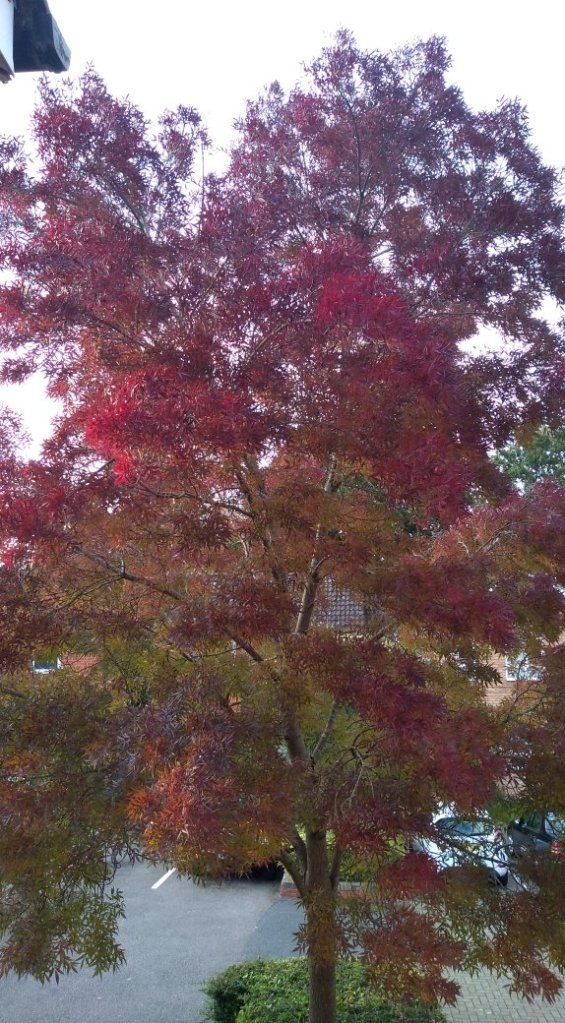
The tree that has already shown it’s autumn colours is the Claret ash or ash ‘Raywood’
(Fraxinus angustifolia ‘Raywood‘). There are a couple in the car park, one of which is now completely bare.

I have noticed the occasional pollinator still flying around during the last fortnight. One observation was some Common wasps (Vespula vulgaris) visiting Common ivy (Hedera helix) flowers. Evidence that Ivy is a wonderful source of pollen and nectar late in the year along with that fact that wasps have a purpose.

Along with pollination, there are many wasps that are useful predators of spiders and insects which are fed to their young. Unfortunately the adult wasps need for sugar means they are often disliked by humans, but can we really blame them for having a sweet tooth just like us or trying to get to something that is easily accessible? A fascinating article about wasps and their usefulness in the world, published by the Natural History Museum, can be viewed here.
 Bee in the Moment