Posted in nature

October Treats (Tricks not Included) 🎃

It is Halloween, British Summer Time ended last night and initially today was a stereotypically autumnal day; windy and very wet. However now it’s less blustery and the sun is shining. Throughout the day, I’ve kept hearing Carrion crows (Corvus corone) call too; I love their haunting sound. Autumn has definitely taken hold over the past few weeks and there have been lots of treats to see.

Fungi continued to appear, showing biodiversity in untreated lawns. I managed to spot one of my favourites again this year, the Shaggy mane (Coprinus comatus) in various stages of development.

Also called Shaggy inkcaps or Lawyers mane.
Here the gills have turned black and have begun to ‘drip’ onto the lawn, resembling ink.

I also saw Yellow club fungus (Clavulinopsis helvola).

The photo was taken after the grass had been mown so the very tip of the fungi had been cut off.

As with other fungi, Yellow club fungus has no negative affect on lawns. It likes acidic mossy lawns appearing between September and November.

There was one more fungi that I noticed (see below), possibly a Honey waxcap (Hygrocybe reidii) although I am not entirely sure my identification of this one is correct.

The tree that has already shown it’s autumn colours is the Claret ash or ash ‘Raywood’
(Fraxinus angustifolia ‘Raywood‘). There are a couple in the car park, one of which is now completely bare.
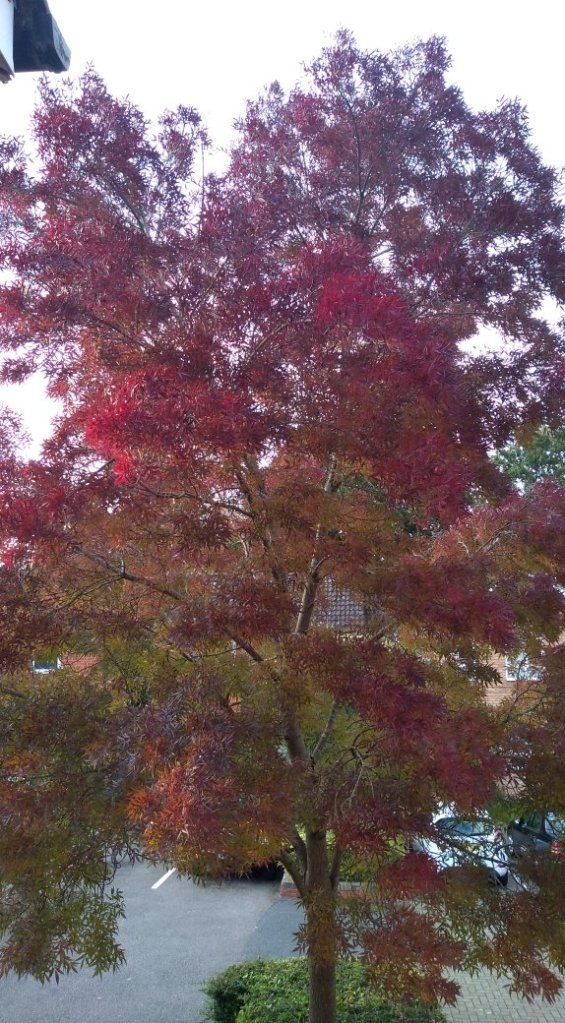
The deep claret coloured leaves glow bright red in the sunlight.
The bark of the Claret ash.

I have noticed the occasional pollinator still flying around during the last fortnight. One observation was some Common wasps (Vespula vulgaris) visiting Common ivy (Hedera helix) flowers. Evidence that Ivy is a wonderful source of pollen and nectar late in the year along with that fact that wasps have a purpose.

Along with pollination, there are many wasps that are useful predators of spiders and insects which are fed to their young. Unfortunately the adult wasps need for sugar means they are often disliked by humans, but can we really blame them for having a sweet tooth just like us or trying to get to something that is easily accessible? A fascinating article about wasps and their usefulness in the world, published by the Natural History Museum, can be viewed here.

Posted in nature

Garden Gems

For the last couple of weeks conkers and sweet chestnuts have begun to fall, there isn’t a big harvest, neither are there lots of acorns or beech masts. However 2020 was a mast year (where trees produce bumper crops) so reduced harvests this time isn’t too surprising; Mast years only happen every five to ten years. However the low numbers could also be due to this years cold damp spring impacting bud development and fertilization, especially with wind pollinated trees. This issue is discussed further in an article by the Woodland Trust see Nature’s Calendar.

It has been lovely to notice Boston ivy (Parthenocissus tricuspidata), along with Virginia creeper (Parthenocissus quinquefolia) develop their bright red autumnal colour. They are so vibrant in the low autumn sunshine. I’ve also noticed the small beginnings of autumn leaf colour in many trees too.

Boston ivy growing up a wall of an old building.
Virginia creeper winding its way through some shrubs.

Now that October has arrived, Cyclamen (Cyclamen hederifolium) and Crocuses (Crocus speciosus) have sprung up alongside Fungi in a few lawns. I noticed a waxcap commonly called the Witches hat (Hygrocybe conica) as well as Lilac fibrecaps (Inocybe geophylla var. lilacina); both resembling Gemstones standing out amongst the grass.

Witches hat waxcaps are so called because they look like witches hats when they blacken with age.
A Lilac fibrecap

I also saw another fungi in one lawn, possibly a Blusher (Amanita rubescens), although the identification was difficult so I’m not entirely sure.

A Blusher?

Plantlife run Waxcap watch from the 13th September. The charity want to discover previously unknown waxcap grassland sites, uncover habitat conditions and give better protection for them in the future. More information about this survey can be found here

Something else I observed while weeding a gravel path at work was a Lunar underwing moth (Omphaloscelis lunosa).

This night flying noth had been hiding under some dandelion leaves.

Lunar underwing moths fly between August and October and their pupae overwinter in long grass which they will feed on when they become caterpillars. I managed to re-home this one under a nearby shrub.

Posted in nature

Bees in Autumn

The Autumn equinox finally arrived last Wednesday. It was lovely to notice bees still flying around when the sun shone. While these insects are synonymous with spring and summer, some are still active in September.
Common carder bees (Bombus pascuorum) were the most noticeable last week but I also saw a new Buff-tailed (Bombus terrestris) bumblebee queen visiting some Hylotelephium as well.

Common carder bee
Buff-tailed bumblebee queen

I also observed a couple of active bee nests in some lawns too. It was difficult to identify the specific species although given the time of year and colouration they were possibly Common furrow-bees (Lasioglossum calceatum) also called Slender mining bees. These bees are active from Spring until mid Autumn and nest in short grass.