
Over the last few weeks Buddleja have been in flower, encouraging butterflies to visit and making them more visible. I have begun to notice Red admirals (Vanessa atalanta) and Peacocks (Aglais io) alongside Large (Pieris brassicae) and Small white (Pieris rapae) butterflies.
Having some time off work enabled me to take more walks. In my local woodland park I started to see a lot more Commas (Polygonia c-album) and Small heath (Coenonympha pamphilus) butterflies too. On a few occasions they flitted around me as I stopped to watch them; an absolutely joyful experience, almost like they were interacting with me in their own way.
Thankfully in the two weeks, I managed to venture further afield. On one occasion, I saw a Ringlet (Aphantopus hyperantus) butterfly while visiting an Arboretum in Herefordshire.

Woodlands are their habitat and they can be seen during July and August. The Caterpillars of this butterfly feed on various grasses, such as Tufted Hair-grass (Deschampsia cespitosa), Common Couch (Elytrigia repens), and other meadow grasses (Poa spp.).
Spending some time away on holiday gave me the chance to explore other environments, including those next to water, thus enabling me to notice different wildflowers.
One walk took me past a canal. Water mint (Mentha aquatica) and Purple Loosestrife (Lythrum salicaria) were growing all down the canal edge.
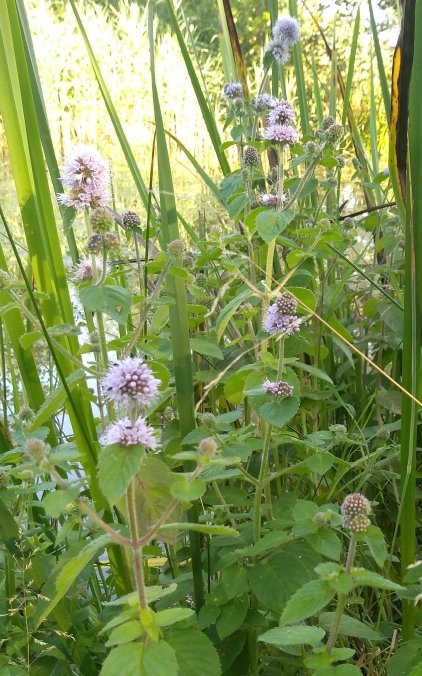
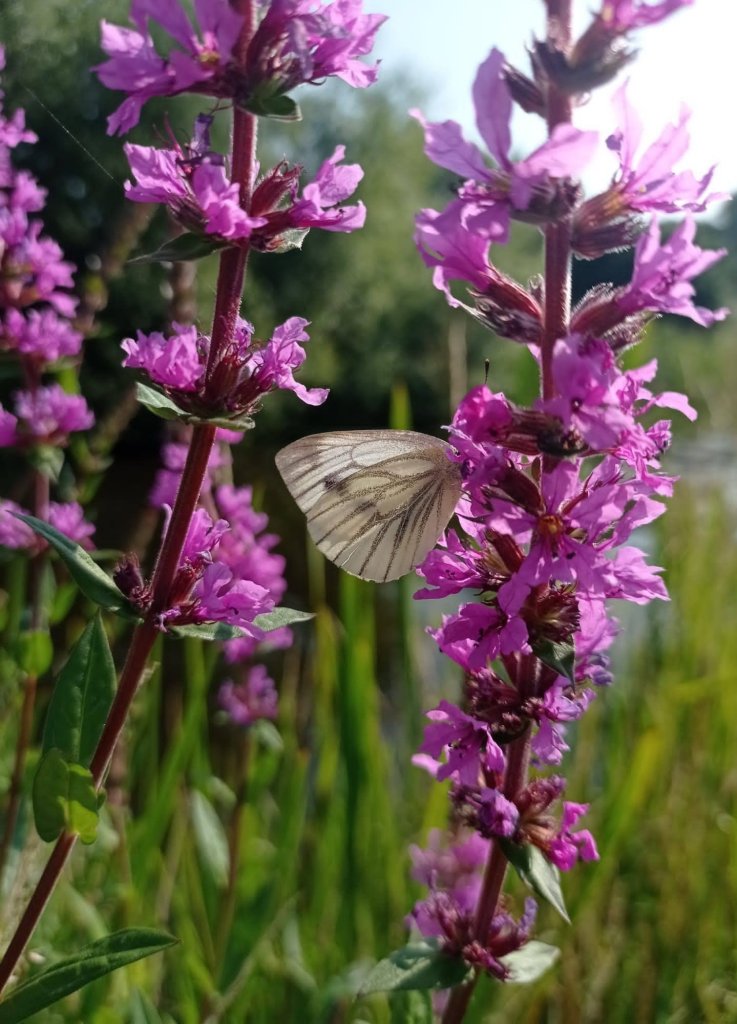
Both plants grow in shallow water and boggy conditions so are often found in fens and marshes as well as along the margins of ponds, streams, rivers and of course canals, as I discovered. They require habitats with full sun or dapled shade to bloom and are great for pollinators. Water mint flowers from the beginning of July up to November while Purple loosestrife only blooms between June and August. Purple Loosestrife can be visited by insects with long tongues and particularly enjoyed by butterflies and Red-tailed Bumblebees (Bombus lapidarius). It is also eaten by caterpillars of the Small Elephant Hawk-moths (Deilephila porcellus).
As well as butterflies there were several dragonflies and damselflies, including this Blue-tailed damselfly (Ischnura elegans) dancing over the water.

However, most of the bees I saw on that walk were interested in the plant I encountered at the first lock, Himalayan balsam (Impatiens glandulifera).

While the lock was completely swamped by this plant, it was only section I saw it in. It’s the first time I had come across Himalayan balsam, although I know of its reputation.

First introduced into the UK in 1839, from the Himalayas, this plant soon escaped formal gardens and naturalized in the wild becoming a nuisance in waterways. It grows fast and can become invasive very quickly as, up to 800 seeds from each pod, explode as far as 7 meters from the parent plant and even travel downstream. It isn’t long before a thicket is created where the plant out-competes other species to reduce biodiversity, cause erotion of riverbanks and affect water quality. All this means it is considered a weed in waterways and often removed by work-parties whenever possible. In fact it had been previously cleared from a lot of this canal. Control methods include pulling and cutting before they get a chance to set seed. It can take a few growing seasons before control over this plant is established. Management of this plant is mentioned under schedule 9 of the Wildlife and Countryside Act 1981. Interestingly, in Hertfordshire, control of this plant involves collection of the flowers to produce pink Gin (further information can be found at Herts Wildlife Trust).
The following week I visited a beach in Kent, it was so relaxing to hear the sounds of the seaside. One plant I noticed growing amongst the rocky area near the shingle was Alfalfa (Medicago sativa).
I know this plant as a green manure on allotments and gardens, adding nitrogen to soil for crops the following season. It’s also used as silage for livestock in agriculture plus alfalfa sprouts are used in some cuisines. I have never seen it in the wild or even flowering. There wasn’t a great swathe of it so clearly the plants were due to the odd escapee into the wild; perhaps a few seeds having blown there or been disposed by a bird. It was certainly good for local pollinators.

 Bee in the Moment