
The last few weeks have been opposites in terms of the weather. A wet previous week turned into the hottest of the year so far (with no relief overnight). Although too hot for my comfort, it was perfect weather for butterflies, and a great start for the Big Butterfly Count. Finally I was beginning to witness an increase in the amount of butterflies. I was getting worried this years reduction in butterfly sightings (due to the cold spring and wet summer experienced in 2021 up to this point) would continue. However by the end of the first week, I saw a Speckled wood (Pararge aegeria) and a Brimstone (Gonepteryx rhamni). Then, while on a walk around my local woodland park (early on the following, sunny and very warm, Sunday morning) I witnessed lots of butterflies making the most of the sunshine.
In one open area of the park, the grass had been allowed to grow, with many species of wildflower blooming amongst it. One of the plants I saw was Common centuary (Centaurium erythraea) which blooms between May and October. Overshadowed by the other wildflowers and grasses, initially this shorter plant was difficult to spot; in fact had it not been next to a mown walkway, I may not have seen it. Thankfully it’s pink and yellow colouration stood out enough, from the more muted colours surrounding it, as I wondered past trying to identify butterflies.

This plant is found in a many places, from heathlands and woodlands to cliff tops and quarries. A natural meteorologist, the flower closes when the weather is dull and damp to reopen once the weather brightens up. While I’m not sure this is a practical weather indicator to use (when a simple observation of the sky, in that moment, will give you the information you require) it’s a pretty cool reaction to weather conditions.
There were many butterflies flitting about on that Sunday morning. Most prominent were Gatekeepers (Pyronia tithonus), Small skippers (Thymelicus sylvestris)
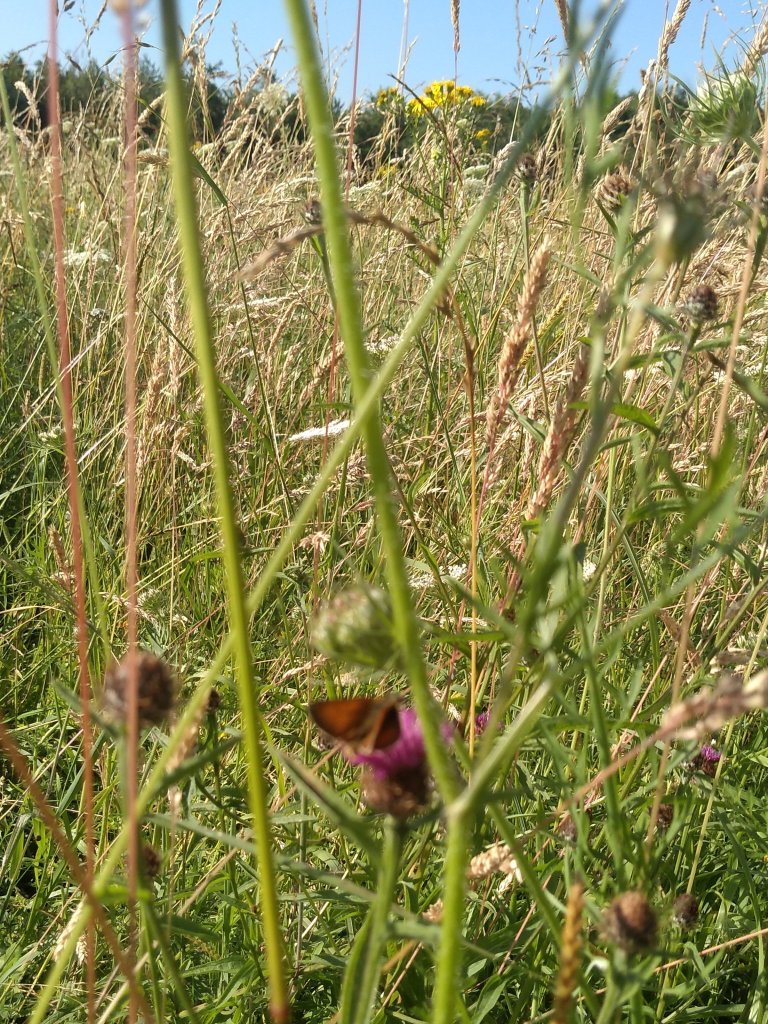
and Small heath (Coenonympha pamphilus) butterflies; probably due to the grass being allowed to grow fully. All these species of butterfly are associated with grassland and their caterpillars feed on grasses.
Marbled white (Melanargia galathea) caterpillars also feed on grasses while the adults feed on many purple coloured flowers, including knapweeds; so it was lovely to see one of these butterflies flying around the meadow too.
Another plant that was growing amongst the long grass was Ragwort (Jacobaea vulgaris). This is a favourite nectar source of the Gatekeeper butterfly, along with other plants including Bramble (Rubus fruticosus), Wild marjoram (Origanum vulgare) and Wood sage (Teucrium scorodonia).

I also got to see another insect with a strong connection to Ragwort, a caterpillar of the day flying moth, the Cinnabar (Tyria jacobaeae).

This wasn’t the only caterpillar I noticed. Earlier in the week, I saw a caterpillar of the Knot grass moth (Acronicta rumicis), seen below on a bramble leaf.

This caterpillar will be part of this years second brood, the adults of which appear in August and September. The Caterpillars have a varied diet, eating a wide range of herbaceous plants; this one clearly eating out (and pooping on) bramble. The photo of the adult moth can be seen at Uk Moths.
 Bee in the Moment