Posted in nature

Flowers to Lift the Spirit


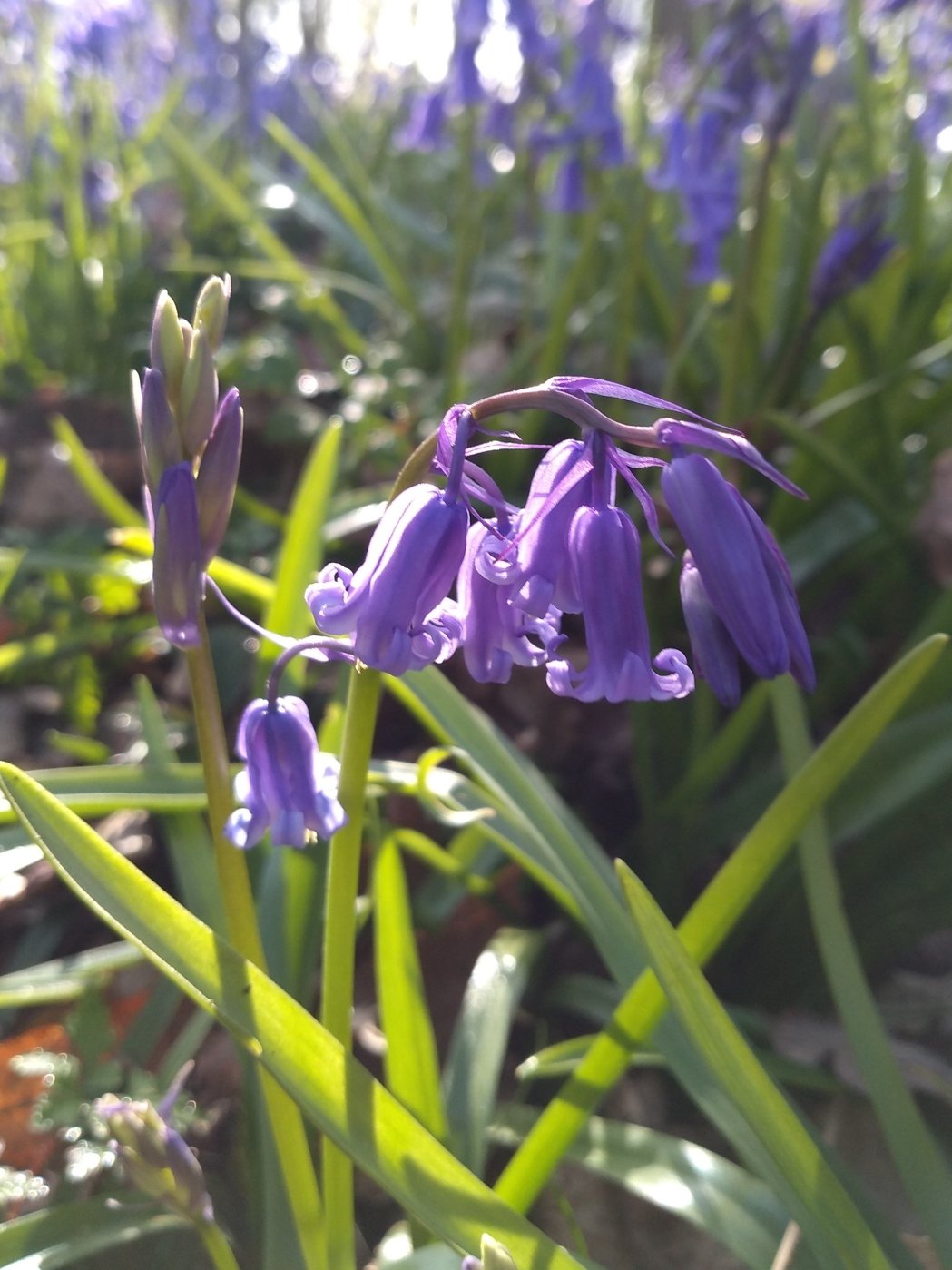
Last week the Bluebells (Hyacinthoides non-scripta) were just beginning to open. I always look forward to seeing these delicate flowers appear; it brings such joy to see their destinctive shade of blue on mass. Although not yet in full bloom, as I knelt down to take photographs I caught their delicate aroma.

Then later the same day, I got my first sighting of a Common carder (Bombus pascuorum) bee of the year, as it took advantage of the apple tree blosom.

I will never tire of hearing birdsong, it’s a wonderful soundtrack to have as I work. Not only is birdsong relaxing to me but it gives me the opportunity to keep learning too. The bird I became most aware of last Tuesday was the Nuthatch (Sitta europaea). Amongst all the birds I could here on that day, this was the clearest (it can be heard here on the RSPB website).

Unfortunately I didn’t get to see it. Having never seen one before I would have loved to see it’s mostly bluish grey and chestnut plumage (with hints white along with a black stripe across the eyes).

Similar in size to a Great tit (Parus major) these birds resemble a small Woodpecker as they climb trees. Nuthatches can be seen clinging to trunks or branches, as they climb up or down headfirst (the only British bird to descend trees in this way). They forage for insects and invertebrates, as well as feast on seeds and nuts (including beechmasts, hazel nuts and acorns) using tree crevices to store food for later. They also bury food and hide it beneath stones.

Nuthatches are found in mixed  broadleaf woodlands, parkland or urban gardens which have sufficient tree cover; occasionally eating from bird feeders. They particularly like areas with mature Oak (Quercus) trees. There was an established Oak nearby where I worked, so perhaps that’s where it was singing from.

They remain close to the nesting site where they fledged and are mostly seen in England and Wales; although their range is expanding into Scotland. Nests are holes in trees such as old Woodpecker nests.


Posted in nature

Amazing Auburn Beauty Spotted

Annual honesty (Lunaria annua), Shepherd’s purse (Capsella bursa-pastoris) and Hedge garlic (Alliara petiolata) were all blooming last week, which is great for the increasing numbers of pollinators I saw flying around.

Some flowers began to open up on a Crab apple (Malus spectabilis) I saw in in one garden too.

As alluded to above, more insects were prominent throughout last week compared to earlier in the month. I saw my first male Orange-tip butterfly (Anthocharis cardamines) and undisturbed Seven-spot ladybirds (Coccinella septempunctata) of the year.
Yet more species of bee were buzzing about too; I observed female Early bumblebees (Bombus pratorum) one Hairy-footed flower (Anthophora plumipes) bee queen, along with several female Red-tailed (Bombus lapidarius) bumblebees.
A great Bumblebee ID guide can be viewed at Blooms for Bees; this website also includes ways to encourage bees into your garden.

Then on Thursday, as I was clearing wildflower seedlings from a path, I noticed a beautiful redhead resting next to me.

This photo doesn’t do the vibrant colouration of this bee justice.

I recognized it was a bee but was initially unsure of the species. Upon further investigation, via Google lens, I discovered it was a female Tawny mining bee (Andrena fulva).

Given the place I saw the bee, I was unable to locate it’s nest, in fact it may have flown in from another garden anyway. Their burrow is usually located in lawns (sometimes flower beds); identifiable from a mound of earth with a hole at the top for the entrance. Often described as having a volcano like appearance it can be differentiated from ants nests which are flatter and have no distinguishable hole at the summit. After several weeks these mounds are no where to be found, so they can be left undisturbed without any worry of damage to lawns.

These solitary bees (which do not sting) can be seen between April and June in gardens and parkland as well as along the edges of fields and orchards.

The appearance of these beautiful bees coincides with the flowing of Cherry (Prunus), Pear (Pyrus), Hawthorn (Crataegus), Blackthorn (Prunus spinosa), Maple (Acer), Willow (Sallows) and Apple (Malus) trees, along with other plants such as Buttercups (Ranunculus) and Dandelions (Taraxacum). Nectar and Pollen from these blooms is collected for the bee larvae that develop in the nest beneath the ground. Once the young become pupa, they continue to hibernate through winter to eventually emerge the following spring.

Males are smaller than the female Tawny bees and are a dull brown colour. They do not take any part in creating nests or rearing the young, the females will undertake these jobs alone.

Posted in nature

Hints of Summer with Winter Showers; Must be April.

Last week had very mixed weather. Easter Sunday was sunny and warm (a hint that summer isn’t far away) replaced by snow showers and frost on Monday and Tuesday; eventually cold days with occasional sunny spells remained.

I took advantage of the glorious weather last Sunday and went for a walk around my local woodland park. More Brimstone (Gonepteryx rhamni) butterflies were flitting about, along with one Comma (Polygonia c-album) and several Peacock (Aglais io) butterflies too.
Blackthorn was still blossoming in earnest, attracting these butterflies as well as bees and hoverflies.

A Peacock butterfly feeding in the sun.

Pollinators weren’t the only wildlife noticeable; lots of Squirrels (Sciurus carolinensis) were running between and up the surrounding trees while birds were singing.

I even noticed a couple of Blackcaps (Sylvi atricapilla). I’m not sure if these birds are resident to the woodland or migrated from Europe or northern Africa. Since the 1960’s records of these Warblers remaining in the UK all year round exhist and since then numbers have increased. Those not living the UK full time visit from April or May and remain until September or October.

It is the first time I have ever seen Blackcaps (presumably a pair given how they were interacting with each other).
As they were so high up in the tree, completely unaware I was watching from below, I was unable to actually see their caps (males have black caps while females have a chestnut colouration to the top of their head) however I was able to identify them from their bird song. An example of this can be heard on the RSPB website.

This wasn’t the only amazing experience I had with a bird last week. On the following Tuesday I was privileged to witness a Wren (Troglodytes troglodytes) flying around me as I worked, singing as it did so. At one point it landed on a shrub within a few feet from me; I remained as still as I possibly could, watching this amazing spectacle. Usually remaining near cover Wrens are usually heard but not seen so this was lovely to see; plus I managed to obtain footage.

Posted in nature

Tuesday was a School Day

The lovely sunshine we’ve had on and off recently has encouraged lots of wildflowers to start blooming over the past week. Amongst the Daffodils were Daisies (Bellis perennis), Snake’s head Fritillary (Fritillaria meleagris),

Snake’s-head fritillary has become naturalised in the lawn of this woodland area of the garden.

Dandelions (Taraxacum),

Perfect for pollinators, especially bees but also butterflies.

Cowslip (Primula veris),

Primroses on my allotment adds a little colour at this time.

Green alkanet (Pentaglottis sempervirens) and Forgot-me-nots (Myosotis). Even brave Tulips were beginning to open up.

Last Tuesday I learnt another plant, the Marsh marigold (Caltha palustris).

This particular plant was in a raised water feature made from an old rectangular metal container which replicated it’s natural growing conditions. In the wild, Marsh marigold grows in damp conditions such as ponds, marshes and wet woodland and flowers from March to July. It’s common name ‘Kingcup’ is a reference to the large buttercup like flowers resemblance to large golden cups (therefore cup of the kings); Even the latin Caltha means goblet.

A wonderful addition to ponds in gardens, this perennial provides shelter for amphibians as well as nectar for pollinators (Bees, beetles and flies).

However, one word of warning, the sap can be an irritant as it contains glycoside protoanemonin, especially in the older growth.

Magnolias and Ornamental cherry trees, including my Prunus incisa ‘Kojo-no-mai’ on the allotment, joined the wonderful display of Blackthorn (Prunus spinosa) blossom.

Sunny blue skies are the perfect backdrop to this huge Magnolia and Ornamental cherry (see below).
Along with the Cowslips, this ‘Kojo-no-mai’ cherry provides some pollen and nectar on my allotment.

I also noticed that Horse chestnut (Aesculus hippocastanum) trees were showing evidence of flower development alongside recently unfurled leaves; although they won’t bloom until May.

Will it be a good year for playing Conkers?

With all these flowers appearing, it was wonderful to see more bees take advantage of all the pollen and nectar available. On the sunniest days I even caught glimpses of the first Brimstone (Gonepteryx rhamni) and Peacock (Aglais io) butterflies of the year; venturing out of hibernation when it is warm enough too.