
The Common Dog Violet (Viola riviniana) has begun to bloom, both in the wild (in woodlands, heaths and amongst hedgerows)
as well as gardens.
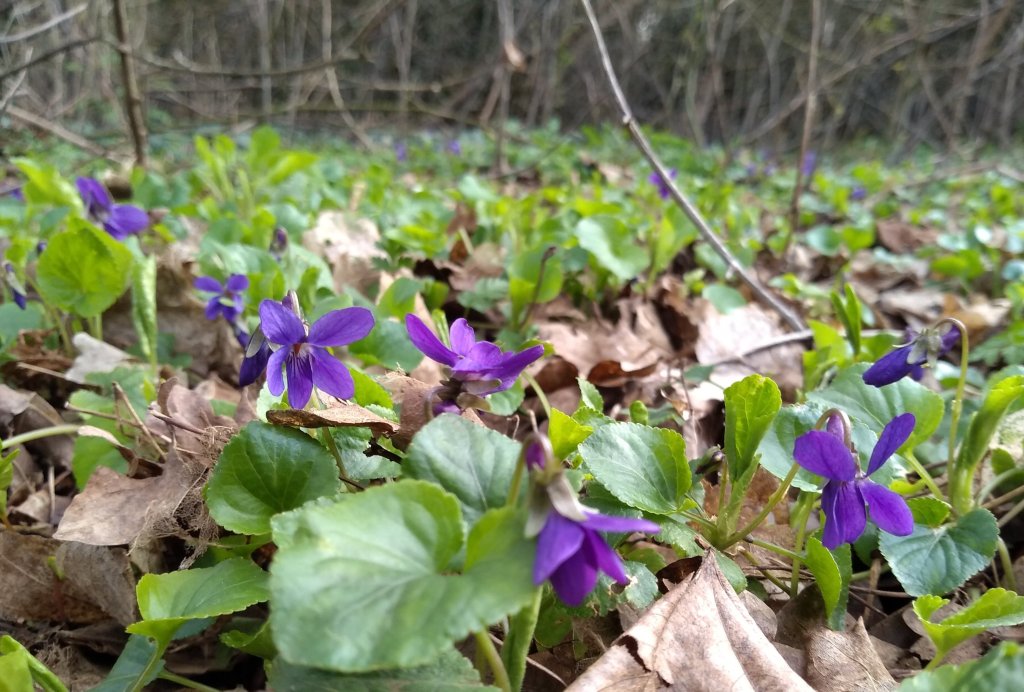
This splash of purple usually arrives in April and lasts until June. If you are lucky, you may notice certain Fritillary butterflies feed from and lay their eggs on this plant (a spectacle I’ve yet to witness).
Willows were blooming last week too. There is one mature Goat Willow (Salix caprea) that I see regularly as I work. Another common name for the Salix caprea is Pussy willow, due to the male catkins resemblance to cats paws before they bloom.

Willow trees are dioecious; therefore females catkins, grow on separate trees to the male ones. Unlike the male catkins shown above, female ones are green and longer in length. Catkins appear on the trees before the leaves do.


I am not sure how old this specific tree is but the species can live for about 300 years and grow up to 10 meters tall. The specimen in the garden I work at has definitely reached it full height.
The Kilmarnock willow (Salix caprea ‘Kilmarnock’) is a much smaller version of the Goat willow tree (grafted onto a dwarfing rootstock). I often see this tree in gardens and they were blooming last week too.
Unlike its larger counterpart, the Kilmarnock willow is a great addition to the average sized garden as it too is loved by bees.

Goat willow trees are usually found in woodland, hedgerows and scrub, especially near waterways such as lakes, streams and canals.
Willows are a fantastic source of pollen and nectar for bees and other pollinators. They’re also a good food source for Sallow kitten (Furcula furcula), Sallow clearwing (Synanthedon flaviventris), Dusky clearwing (Paranthrene tabaniformis) and Lunar hornet clearwing (Sesia bembeciformis) moth caterpillars too. Even birds forage for insects amongst their branches.
As the wood burns well it is used to make charcoal. Plus it’s also used for wattle in timber frame houses.
My favourite fact is that the words witch, wicked and Wiccan are derived from Willow.
Traditionally, it was used to help treat toothache by chewing the bark and used to relieve diarrhoea, arthritis, sore throats, stop bleeding and clean wounds. In fact Aspirin, derived from salicin, was sourced from Willows.
The bacteria Brenneria salicis can cause Watermark disease in Willows which causes dieback and eventual death to the trees if left untreated.
If you are looking to add a small tree to your garden, the Kilmarnock willow is definitely worth looking into; unless you have a large garden then choose a mature male Goat willow instead (the bees will thank you for it).
 Bee in the Moment