Posted in nature

A Splash of Purple

The Common Dog Violet (Viola riviniana) has begun to bloom, both in the wild (in woodlands, heaths and amongst hedgerows)
as well as gardens.
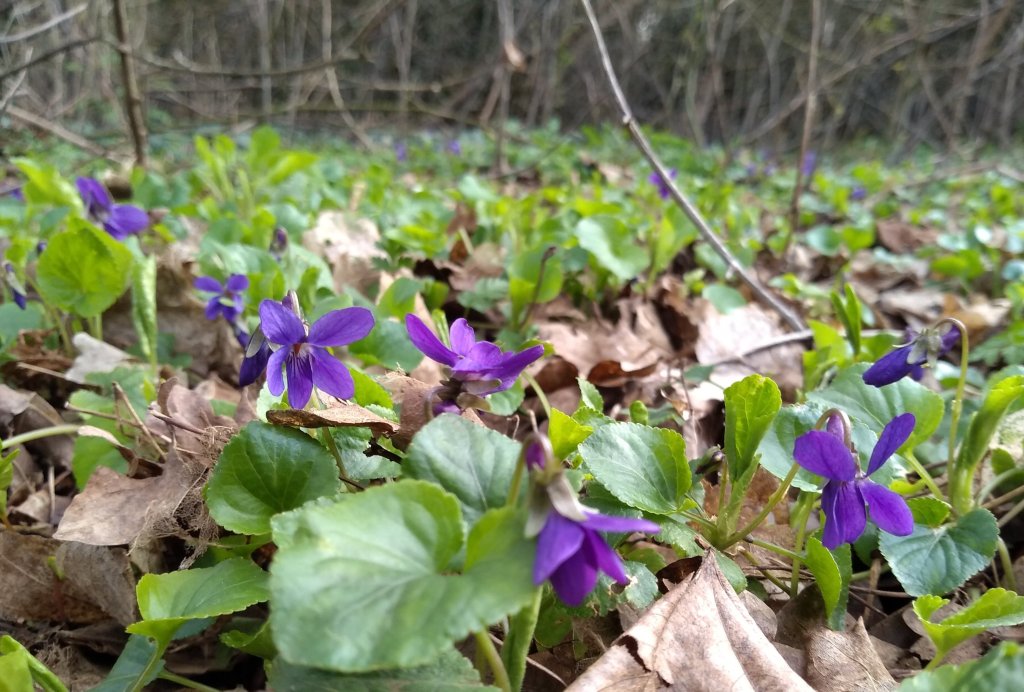
This splash of purple usually arrives in April and lasts until June. If you are lucky, you may notice certain Fritillary butterflies feed from and lay their eggs on this plant (a spectacle I’ve yet to witness).

Willows were blooming last week too. There is one mature Goat Willow (Salix caprea) that I see regularly as I work. Another common name for the Salix caprea is Pussy willow, due to the male catkins resemblance to cats paws before they bloom.

Only males catkins turn yellow once they open.

Willow trees are dioecious; therefore females catkins, grow on separate trees to the male ones. Unlike the male catkins shown above, female ones are green and longer in length. Catkins appear on the trees before the leaves do.

So many catkins were open that the tree seemed alive with the sound of bees.
I love the reddish tinge in the bark.

I am not sure how old this specific tree is but the species can live for about 300 years and grow up to 10 meters tall. The specimen in the garden I work at has definitely reached it full height.

The Kilmarnock willow (Salix caprea ‘Kilmarnock’) is a much smaller version of the Goat willow tree (grafted onto a dwarfing rootstock). I often see this tree in gardens and they were blooming last week too.

Unlike its larger counterpart, the Kilmarnock willow is a great addition to the average sized garden as it too is loved by bees.

The pollen covered Buff-tailed bumblebee pictured here clearly enjoyed visiting the male catkins on this Kilmarnock willow.

Goat willow trees are usually found in woodland, hedgerows and scrub, especially near waterways such as lakes, streams and canals.

Willows are a fantastic source of pollen and nectar for bees and other pollinators. They’re also a good food source for Sallow kitten (Furcula furcula), Sallow clearwing (Synanthedon flaviventris), Dusky clearwing (Paranthrene tabaniformis) and Lunar hornet clearwing (Sesia bembeciformis) moth caterpillars too. Even birds forage for insects amongst their branches.

As the wood burns well it is used to make charcoal. Plus it’s also used for wattle in timber frame houses.

My favourite fact is that the words witch, wicked and Wiccan are derived from Willow.

Traditionally, it was used to help treat toothache by chewing the bark and used to relieve diarrhoea, arthritis, sore throats, stop bleeding and clean wounds. In fact Aspirin, derived from salicin, was sourced from Willows.

The bacteria Brenneria salicis can cause Watermark disease in Willows which causes dieback and eventual death to the trees if left untreated.

If you are looking to add a small tree to your garden, the Kilmarnock willow is definitely worth looking into; unless you have a large garden then choose a mature male Goat willow instead (the bees will thank you for it).

Posted in Allotment, nature

New Life

What a week; variable weather (rain, sun and strong winds), new life (in the form of frogspawn) was evident and the Primroses (Primula) finally began to bloom.

After three weeks, the frogspawn of the Common frog (Rana temporaria) become tadpoles. Initially they eat algae before feeding on leaves, moss and small insects.

From about fourteen weeks they metamorphose from tadpoles into froglets (young frogs). The rate of metamorphosis depends on environmental factors. Tadpoles can delay their transformation, for several months, if there isn’t enough food, there are lots of predators to escape or the weather is too cold (they are also susceptible to frosts). When they become Froglets they start to eat invertebrates such as snails, slugs and flies just as mature frogs do.

Frogs can live between five and ten years (if they manage to avoid being eaten by snakes, owls, herons, otters, badgers and weasels) reaching sexual maturity at two or three years of age. Frogspawn can become food for fish, beetles, newts, dragonfly larvae, rats, foxes and hedgehogs.

I became aware of another trees lifecycle last week, the non-native Sweet gum (Liquidambar styraciflua). This is of my favourite ornamental trees along with Gingko biloba, Magnolia stellata, Tibetan cherry (Prunus serrula) and Acers.

Although I noticed this tree last Friday, it really comes into its own during autumn when the leaves produce a brilliant display of crimson, oranges and purples.

I love the first part of it’s name, Liquidambar, named by Carl Linnaeus, who combined the Latin ‘Liquidus’ with the Arabic ‘Ambar’ (for amber); it refers to the gum that the tree exudes when the trunk is wounded.

The mature fruit remain on the trees throughout winter and can be seen as the the leafbuds appear.

Elsewhere last week, the Rhubarb on the plot continued to grow and one of my houseplants, the Small-leafed spiderwort (Tradescantia fluminensis) began to bloom.

I am salivating just looking at this photo; looking forward to harvesting it when ready.
I almost missed these small delicate flowers as they blend in with the leaves. Tradescantia are so easy to look after and propagate.
Posted in Allotment, nature

A Spring into New Beginnings

The first of March, meteorological spring along with St Davids day all took place last Monday. Even the first grass cut of the season took place last week (albeit only a high cut to level off uneven growth).

Blackthorn was fully blossoming and spring flowers still bloomed as the birds, amphibians and insects continued to become more active. There were a few new observations; I noticed a single Two-leaf squill (Scilla bifolia) growing in a lawn and, in the same garden, saw a male Ring necked Pheasant (Phasianus colchicus) strutting his stuff.

Things are moving on at the allotment. Sweetpea and Vegetable seedlings are doing well as are the seeds sown for cut and wild flower areas on the plot. The beds are ready for direct sowing which I hope to undertake within the next few weeks and I wait for Yellow rattle (Rhinanthus minor) and Bird’s-foot trefoil (Lotus corniculatus) to germinate. I also hope to get the shed painted, install a water conserving system and build a bigger greenhouse sometime in the future.

While I am looking forward to the new growing season to begin in earnest I am also mindful to enjoy this moment; to stop, observe, reflect and plan and allowing nature to dictate the speed when things need to begin.

Aubergine and Chilli seedlings
Kale seedlings
Tithonia, Scabious and White clover seedlings (Trifolium repens)
Posted in nature

Natures beauty

A lovely mix of Snowdrops and Crocus.

Record breaking February temperatures, sun shining, bees foraging, and spring flowers popping up everywhere. How can you not feel cheerful? Last Thursday was the first grass cut of the season, on Saturday I saw a couple of Brimstones flitting about and on Monday I noticed Blackthorn flowering. Time to report Nature’s Calendar timings.

Posted in nature

Glimpses of Warmer Weather

Last week the sun shone and temperatures increased; in fact some days were unusually warm for the time of year. However, as gardeners will testify, you shouldn’t get too carried away, colder temperatures and frosts (that nip unprotected tender seedlings) can quickly return. It was lovely to see nature basking in the sunshine though (eager to enjoy the moments of glorious weather just like the rest of us) as winter flowering plants are joined by spring blooms and insects, amphibians and birds become more active.

Last week I noticed the dawn chorus begin in earnest. On Wednesday morning I managed to identify ten birds (by sound) when bird calls were heard alongside singing; those birds were Jackdaws (Corvus monedula), Crow (Corvus corone), Robin (Erithacus rubecula), Pigeon (Columba palumbus), Blue tit (Cyanistes caeruleus), Coal tit (Periparus ater), Great spotted Woodpecker (Dendrocopos major), Ring-necked parakeet (Psittacula krameri), Magpies (Pica pica) and Sparrows (Passer domesticus).

I even heard Skylarks (Alauda arvensis) singing throughout the day on several occasions. As these birds are red on the UK conservation status (and therefore protected by The Wildlife and Countryside Act 1981) it is always wonderful to hear these birds located in different places as I worked nearby.

Robins could be seen in pairs, relinquishing their incredibly territorial need to be the only robin within a garden and allowing a mate to feed alongside them. I also saw frogs and newts becoming active in ponds; it won’t be long before we see frogspawn.

At the beginning of the week, there was a gentle buzz of Honey bees (Apis mellifera) around several shrubs; the intoxicating aroma enticing them to feed on the nectar and collect pollen.

A Honeybee enjoying a Mahonia japonica.
A Sarcococca confusa visted by a Honeybee.

Lots of Buff-tailed bumblebee (Bombus terrestris) queens emerged too, taking advantage of all the crocuses and heathers currently in bloom.

The diminutive flowers of Heathers are perfect for the short tongues of Buff-tailed bumblebees.
A Buff-tailed bumblebee asleep in a crocus, presumably exhausted from a days foraging.

Another shrub that started to put on a show were Camellias. Although these are beautiful, they don’t appear to entice wildlife to them.

Frosts can quickly turn flowers brown, however no damage occurs to the plant as a whole.

Wildflower seedlings started too pop up in gardens, although not every seed requires soil. On a weekend walk I saw vivipary in action. Vivipary is the germination of seeds while they are still inside the seedhead rather than when they fall to the ground.

Vivipary occuring within a Teasel (Dipsacus).


The next tree that has begun to bloom is the blackthorn. Buds and flowers appear before leaves unfurl. This is the opposite to Hawthorn which also blossoms slightly later in the year.

Blackthorn (Prunus spinosa) have hermaphrodite flowers that bloom in March and April. The white blossom is a joyful sight in early spring.

Blackthorn are good trees for for wildlife, the flowers providing nectar and pollen for bees at this time of year. The leaves too are a food source for caterpillars of several moths, including the Magpie (Abraxas grossularia), Swallow-tailed (Ourapteryx sambucaria) and Yellow-tailed (Euproctis similis); plus caterpillars of the Black hairstreak (Satyrium pruni) and Brown hairstreak (Thecla betulae) butterflies also feed on the Blackthorn foliage. These trees also feed birds as they feast on the sloes and any hiding insects throughout autumn and winter. Their dense canopy even make great places to nest amongst.

Blackthorn wood, once associated with wands of witches, is used for walking sticks and tool handles because it is hard wearing.

Traditional remedies using blackthorn bark, blossom and sloes were made to aid digestion and rhumatism as well as cleanse the blood. These days sloes are used to flavour gin as well as make wines and preserves.

The trees are under treat from blossom wilt due fungal diseases, as with other fruit trees. They can also get ‘pocket plum’ if infected by the Taphrina pruni fungus which produces galls and causes the sloes to remain small and shriveled.

While many things were eager to get going last week, not everything wanted to wake up. It was sweet to notice a few Seven-spot ladybird (Coccinella septempunctata) still hiding away.

One ladybird tucked up within some poppy foliage.
Another trying to hide inside the stem of a climber.

I can appreciate their wanting to cosy up for a while longer, it’s often how I feel when my alarm goes off.