
No doubt due to the recent weather, I have noticed more flowers blooming earlier than their traditional start time of June. One example is the Common nipplewort (Lapsana communis).

Other plants flowering at the moment are Greater celandine (Chelidonium majus),

– Three-cornered garlic (Allium triquetrum),

– Red campion (Silene dioica),

– White campion (Silene latifolia),

– Cleavers (Galium aparine),

– Common honeysuckle (Lonicera periclymenum),

– A sow thistle (Sonchus),

– A Hawkweed (Hieracium),

– Mouse-ear Hawkweed (Hieracium pilosella)

– and Yarrow (Achillea millefolium).
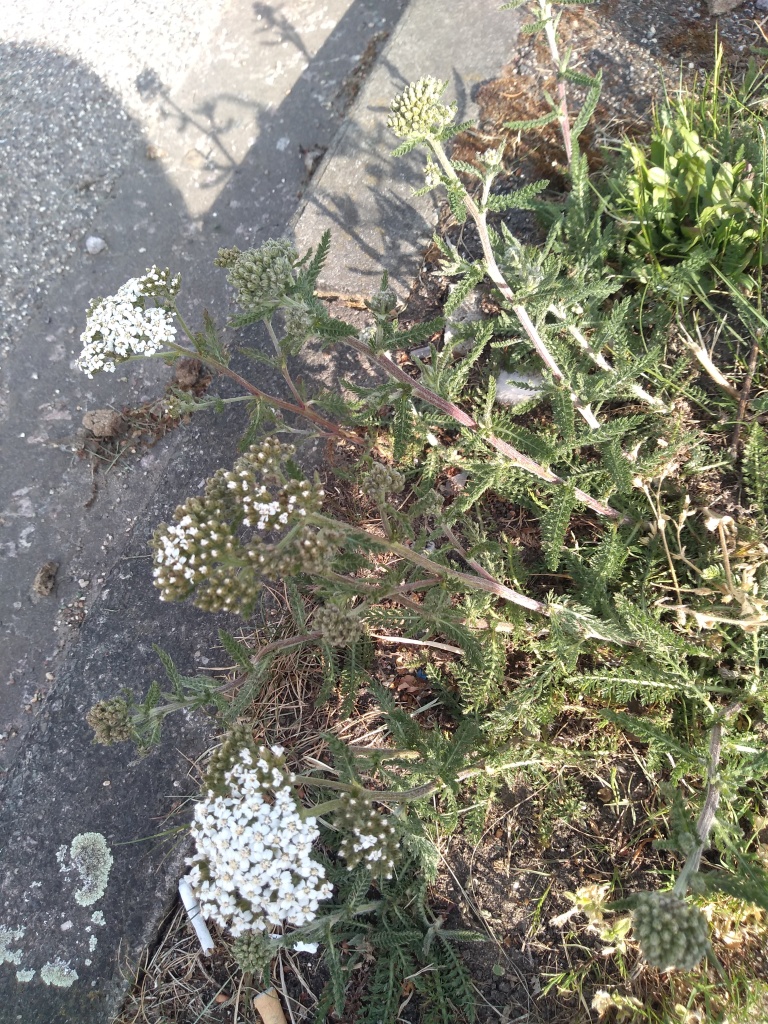
A plant that was new to me was Common knapweed (Centaurea nigra).

Along with all the wild flowers I noticed last week, the warm weather continued to encourage lots of insects out. There were more Holly blue (Celastrina argiolus) and Orange-tip (Anthocharis cardamines) butterflies along with bumblebees.
I also saw a Cinnabar moth (Tyria jacobaeae) at the allotment, amongst the long grass.

The most interesting insect I observed last week was a Pine ladybird (Exochomus qadripustulatus).

I have never seen this species of ladybird before. It dropped onto my sunglasses as I worked. Due to its small size (3mm in length), to begin with I thought it was a bit of dirt. As the name suggests, this beetle inhabits Pine (Pinus) trees. However they can also be found around other trees and shrubs especially Hawthorn (Crataegus monogyna).
 Bee in the Moment